
From hinge durability and app compatibility to update deadlines and repair costs, buyers should assess foldables as long-term two-screen systems rather than rely on headline specifications.
A foldable phone should be judged as two devices in one. Closed, it must work like a practical everyday handset; open, it should justify its premium with a larger, more capable screen. That is why the first decision is not brand or camera count, but form factor. Flip models prioritise compactness and quick cover-screen use, while book-style foldables trade pocketability for a larger workspace better suited to reading, multitasking and media. As iTechGuides notes in its buying advice, the right choice depends on how often you want to use the device shut, half open or fully unfolded.
The display check also has to cover both panels, not just the crease. A good foldable should remain readable in bright light, react cleanly to touch and avoid awkward scaling when an app moves between screens. Narrow outer displays can make typing and web browsing cramped, while an inner panel that is dim, uneven or badly calibrated can undermine the whole experience. Independent guidance from iTechGuides and other foldable-phone reviews stresses that buyers should test brightness, viewing angles, touch response and app behaviour in the same session, rather than relying on the specification sheet alone.
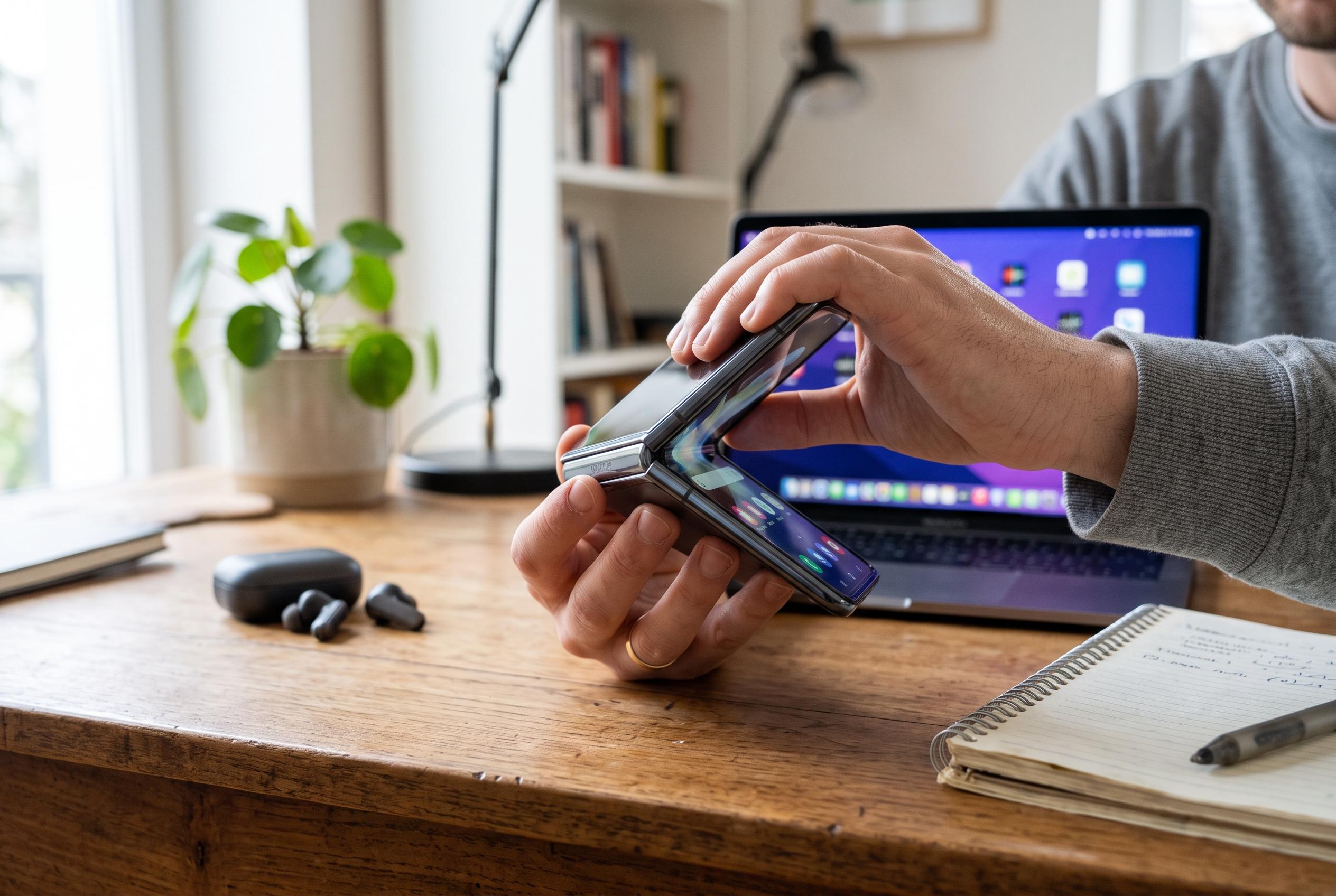
The hinge deserves equal attention. It should open with even resistance, hold intermediate positions securely and close without scraping, drifting or visible misalignment. A clean hinge is not just a matter of feel; it also affects durability. Foldables are particularly vulnerable to grit, sand and other debris, so model-specific care matters. That is why manufacturers often attach detailed warnings about foreign particles, screen protectors and authorised servicing. Buyers should confirm whether the factory-applied inner protector can be replaced, who is allowed to replace it and whether damage linked to an incompatible accessory would void coverage.
Water and dust claims need careful reading. Foldable phones are often advertised with an ingress-protection rating, but that code applies only to the exact model and the exact test conditions stated by the maker. It is not a general promise of ruggedness. A foldable rated for laboratory water resistance may still be vulnerable to salt water, pressurised spray, sand or drops that damage the frame or seal. Several foldable-phone guides urge buyers to ask for the precise IP code, the exclusions in the warranty and the circumstances under which liquid damage is covered or rejected.
Cameras should be compared as a full system, not by megapixels alone. On a foldable, that means checking the main sensor, ultrawide and telephoto lens individually, as well as the front cameras on both sides of the device. The most useful tests are practical ones: backlit faces, moving subjects, low-light scenes and video shot with the phone partly folded on a table. In book-style models, the rear cameras can often double as a high-quality selfie setup when the cover screen becomes a preview window, but that convenience only matters if your preferred apps support it properly.
Software support is another part of ownership that can be easy to misread. The important question is not only how many years of updates are promised, but when the clock starts. Google, for example, has stated that its Pixel 8 and later phones receive seven years of operating-system and security updates, counted from the date the device first became available in the Google Store in the United States. That means buyers need to record the exact model, region and start date before deciding whether the remaining support period is long enough for the price.
App compatibility can make or break the experience. A foldable is only useful if banking apps, authenticators, messaging tools, maps and streaming services work sensibly on both displays and across folding transitions. Some apps scale well; others restart, lose layout, or place key controls in awkward positions when the phone is folded or split into multiple windows. iTechGuides recommends testing the exact apps you rely on in cover-screen, inner-screen and split-screen modes before committing to a purchase. That advice is especially important for people who expect the device to replace a tablet or laptop for short bursts of work.
Ownership costs extend beyond the purchase price. Buyers should check battery capacity, charging speed, wireless charging support, storage options, accessory compatibility and local repair access. Foldable repairs are often more specialised than standard smartphone repairs, particularly for the inner display and hinge assembly, so out-of-warranty quotes matter. Insurance or protection plans should be weighed against their excesses and exclusions, especially for liquid damage, accidental drops and third-party screen protectors. The most sensible way to compare models is to treat the foldable as a long-term system, not a headline specification list: if both screens pass real-world testing, the hinge feels solid, the software support window is clear and local repair terms are acceptable, the device is far more likely to satisfy after the novelty wears off.
Disclaimer: This content is intended for informational purposes only. Readers are advised to exercise their own judgement, conduct due diligence, or consult a qualified expert before acting on any information provided.