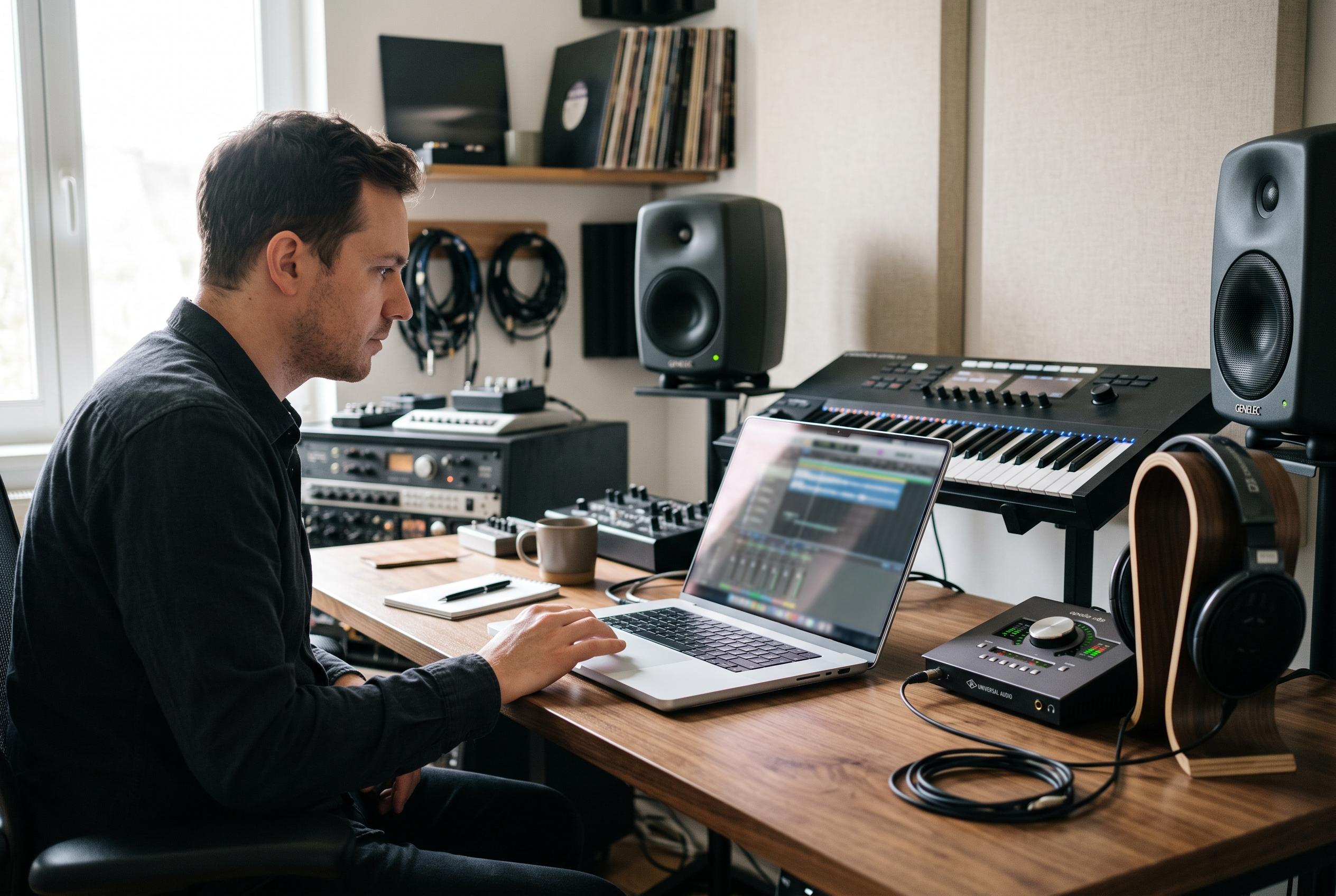

The M5 Max MacBook Pro handles huge music-production sessions with barely audible cooling and strong battery life, but Apple’s storage upgrades push the workstation-class laptop’s price above £8,000.
Apple’s latest MacBook Pro with M5 Max is, by any practical measure, a machine built for the upper end of music production. MusicRadar’s review describes it as a near-total solution for professional musicians and producers: powerful enough to anchor serious studio work, yet quiet and unobtrusive enough to stay out of the way while ideas are being shaped. That verdict is reinforced by Apple’s own launch material, which positions the M5 Pro and M5 Max as the latest step up in on-device performance and AI processing, with the 16-inch model starting at $3,899 before configuration upgrades.
The hardware specifications explain much of that confidence. Apple says the chip combines an 18-core CPU, a 16-core Neural Engine and either a 32-core or 40-core GPU, with unified memory options reaching 128GB. Tom’s Hardware’s review of the 14-inch model and Creative Bloq’s testing of the wider M5 Max line both underline the scale of the platform, while also noting the modern connectivity mix: MagSafe, HDMI, Thunderbolt-class USB-C ports and Apple’s updated wireless stack. In practice, that gives the MacBook Pro the sort of I/O and internal headroom expected from a workstation rather than a standard laptop.
MusicRadar’s stress tests suggest the M5 Max largely lives up to the specification sheet. In Logic Pro, the machine handled extremely heavy sessions with hundreds of channels, virtual instruments and effects without obvious strain, while keeping fan noise so low that it barely registered in a typical room. That matters for recording environments, where cooling noise can become a real operational nuisance. The review also says the built-in audio output proved capable enough for headphone-based work at up to 96kHz, which adds to the laptop’s appeal as a self-contained production tool.
Battery life appears equally strong. MusicRadar reported only a small drop during several hours of light daily use, and a much longer stretch of DAW testing still left the battery with room to spare. That aligns with the broader picture painted by Macworld and Tom’s Hardware, both of which describe the new generation as a major step forward in speed and efficiency, with faster SSD behaviour also forming part of the upgrade story. For mobile producers, that combination of silence, endurance and headroom is likely to be more important than raw benchmark numbers.
The obstacle is cost. MusicRadar’s review unit, a heavily specified 16.2-inch configuration with 4TB of storage, came in at £8,248, or about $8,149, before any added software. The review argues that storage pricing is especially hard to justify, with Apple charging substantial sums to move from 2TB to 4TB and again to 8TB. Apple’s base pricing is already high, and the premium rises steeply once memory and SSD options are pushed upwards. Even so, the underlying conclusion is clear: for professionals who can afford it and will use the power, the MacBook Pro M5 Max is among the most capable portable studio computers available.
Disclaimer: This content is intended for informational purposes only. Readers are advised to exercise their own judgement, conduct due diligence, or consult a qualified expert before acting on any information provided.