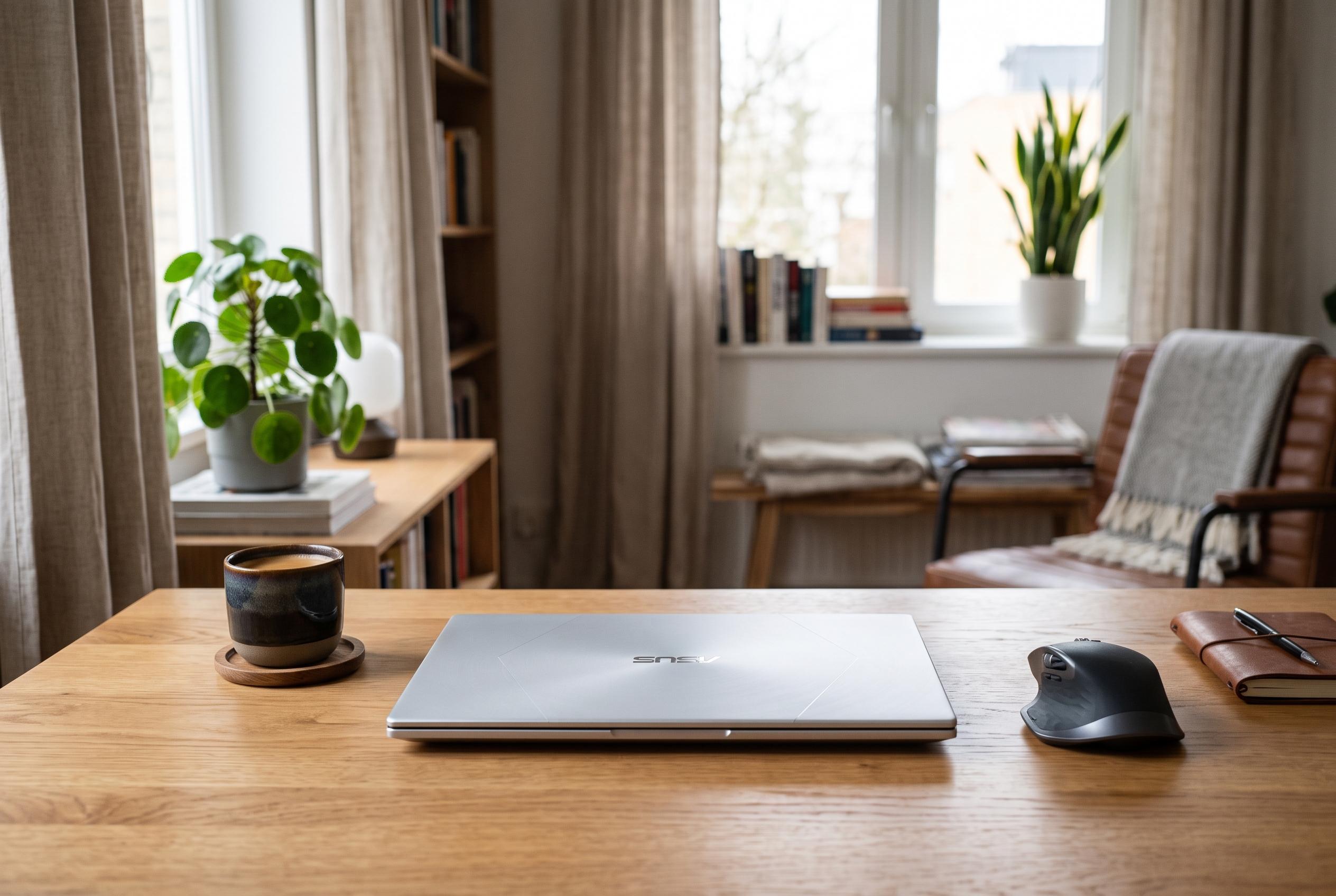

Asus’s latest Zenbook 14 combines elegant design and solid performance but struggles to surpass the battery life of its sibling, the Zenbook A14, raising questions about its all-day portability in a competitive market.
Asus’s latest Zenbook 14 is a neatly judged ultraportable that gets much right: it is light, distinctive and competent for everyday work. Yet its appeal is diluted by a familiar problem in this class of laptop, namely that a closely related rival from the same maker, the Zenbook A14, offers a far stronger battery life for not much more money. That makes the 14 a harder recommendation than its design suggests.
At first glance, the machine stands out in a market crowded with grey and silver slabs. TechRadar says Asus has used its Ceraluminum finish to give the laptop a softer feel and more vivid colour options than are typical at this price, while keeping the chassis impressively rigid for a 14-inch model. The company’s choice of rounded edges and textured surfaces gives it a more considered, less utilitarian look, although the rear feet add thickness and the keyboard can flex enough to undermine the otherwise solid impression.
The specification is sensible rather than flashy. Asus is offering the Zenbook 14 from £799.99 with a Snapdragon X1 chip, 16GB of RAM and a 512GB SSD, with AMD Ryzen AI 7 and Intel Core Ultra 9 versions also available at higher prices. The port selection is practical for a thin laptop, with USB-A, two USB-C ports, HDMI and a headset jack, and the OLED panel uses a 1920 x 1200 resolution that should be sharp enough for a 14-inch screen. Other reviews describe the configuration as well balanced for productivity, though some note that the base model’s lack of keyboard backlighting is a noticeable omission.
In use, the Zenbook 14 appears best suited to office work, browsing and video playback. TechRadar’s testing found the Snapdragon X1 model handled word processing and 4K streaming smoothly, while staying relatively quiet and cool under load. Benchmark results were respectable rather than class-leading, and light gaming was a weak point, which is unsurprising given the integrated graphics. PCWorld’s evaluation was similarly positive on general performance, describing the laptop as a capable everyday machine with strong productivity results.
The display is one of the laptop’s stronger features. The OLED panel should deliver the contrast and colour depth buyers expect, and reviewers agree that brightness is high enough to mitigate reflections in most conditions. Typing is less convincing: the keys are well spaced and comfortable, but the flex in the deck makes the whole experience feel less refined than the rest of the chassis. That matters because this is precisely the sort of machine people buy for long writing sessions and mobile work.
Battery life is where the Zenbook 14 loses ground. TechRadar measured 12 hours and 15 minutes in a looping video test, which is respectable in isolation but well behind the Zenbook A14, whose larger battery delivered more than 28 hours in the same test. The HP OmniBook 7 also lasted far longer in comparative testing. Asus does at least counter with fast charging, but when a near-identical sibling offers far better endurance at a similar price, the Zenbook 14 becomes the less obvious choice unless build feel matters more than all-day stamina.
Disclaimer: This content is intended for informational purposes only. Readers are advised to exercise their own judgement, conduct due diligence, or consult a qualified expert before acting on any information provided.