The LattePanda Mu Ultra introduces a modular platform aimed at on-device AI and edge computing, allowing users to build customised small desktops with flexibility and scalability, but requiring careful assembly and additional accessories.
The LattePanda Mu Ultra is not the kind of machine that arrives as a finished desktop. It begins as a compute module, then asks the buyer to decide how the rest of the system should come together. That distinction matters from the start, because the experience is shaped by the carrier board, cooling, storage, power supply and enclosure rather than by the module alone. According to LattePanda, the platform is aimed at on-device AI, edge computing and embedded systems, with support for Windows and Linux and software frameworks such as OpenVINO, llama.cpp and Ollama.
In practice, that modularity is both the attraction and the complication. LattePanda’s own materials and launch coverage describe the Mu Ultra as a compact x86 module built around Intel Core Ultra processors, with integrated Arc graphics and a dedicated NPU. The company says the family reaches up to 115 TOPS of AI performance, although that headline figure refers to peak capability across the relevant compute blocks rather than to a simple desktop benchmark. For buyers, the more useful detail is that the module tops out at 16 GB of LPDDR5X memory, which sets a firm limit on how far local AI workloads can be stretched.
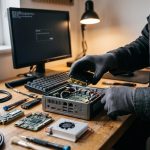
The review configuration used a Core Ultra 5 226V version with 16 GB of RAM and a 512 GB Kioxia SSD, mounted on the Mini Carrier Board and cooled actively inside a custom case. That combination is important because the finished system is not the bare module shown in marketing images. Once the carrier, storage and cooling are added, the project becomes a small desktop with real responsibilities: it must be powered correctly, kept within thermal limits and housed in a case that leaves room for the connectors and airflow.
That is also why the buying process deserves more attention than a typical mini PC purchase. DFRobot’s kit pricing, as reflected in the review, puts the Core Ultra 5 bundle at $643 and the Core Ultra 7 at $733, before shipping and local taxes. Those prices exclude the SSD, enclosure and, crucially, the wireless module if the buyer wants integrated Wi‑Fi. The result is a product that can look expensive in isolation but makes more sense once viewed as a custom-build platform rather than a closed box.
The assembly process is part of that proposition. The cooling hardware has to be fitted before the board is fully usable, the module must be seated correctly on the carrier, and power cannot be taken for granted. The Mini Carrier Board accepts USB-C Power Delivery at 20V and requires at least a 50W supply with this configuration. That is not a high demand by desktop standards, but it is a detail that can be missed if the buyer assumes the kit includes everything needed to boot. Tom’s Hardware’s earlier coverage of the LattePanda Mu family also underlined the platform’s dependence on proper cooling, noting that the fan stays relatively quiet in normal use but ramps up under load to keep temperatures in check.
Once assembled, the system appears well suited to ordinary desktop work. In the review, Garuda Linux and Omarchy both ran smoothly, and daily tasks such as writing, browsing with many tabs open and general office work were handled with little sign of strain. That result fits the platform’s design philosophy: LattePanda and launch reporting present the Mu Ultra as a device for local computing rather than a mass-market consumer box, and its appeal comes from making a tiny machine feel responsive enough for real use.
The more interesting test, however, is what happens beyond office work. The reviewer used the machine for light games, emulation up to PlayStation 2 and local AI experiments, and the results were broadly positive. That is consistent with the module’s specification, which combines Intel Core Ultra CPU cores, Arc graphics and an NPU intended to accelerate AI tasks. But the same specification also explains the boundary: with only 16 GB of fixed memory, larger models quickly force compromises in context length or model size. In other words, this is a platform for careful selection, not for unlimited scaling.
Connectivity is where the design feels least complete. The Mini Carrier Board offers Ethernet, USB-A, USB-C, HDMI, audio, OCuLink and GPIO, but wireless networking is not built in and must be added separately. CNX Software’s earlier coverage of the LattePanda Mu family showed that Wi‑Fi modules can be installed through the expansion path, yet the lack of integrated wireless still means another purchase, another part to fit and another item to budget for. For a device that may be used as a small home computer as well as an embedded module, that omission is hard to ignore.
Even so, the LattePanda Mu Ultra has a clearer identity than many small PCs. It is not trying to be the neatest out-of-the-box mini desktop, and it is not pretending that expansion and assembly are incidental. Notebookcheck described the platform as a compact option for professionals looking for a Raspberry Pi alternative for embedded AI, and that framing is apt here. The value lies in the freedom to build a machine that matches a specific use, even if that means accepting the cost of extra parts and the limitations of soldered memory. For the right buyer, that trade-off is the whole point.
Disclaimer: This content is intended for informational purposes only. Readers are advised to exercise their own judgement, conduct due diligence, or consult a qualified expert before acting on any information provided.