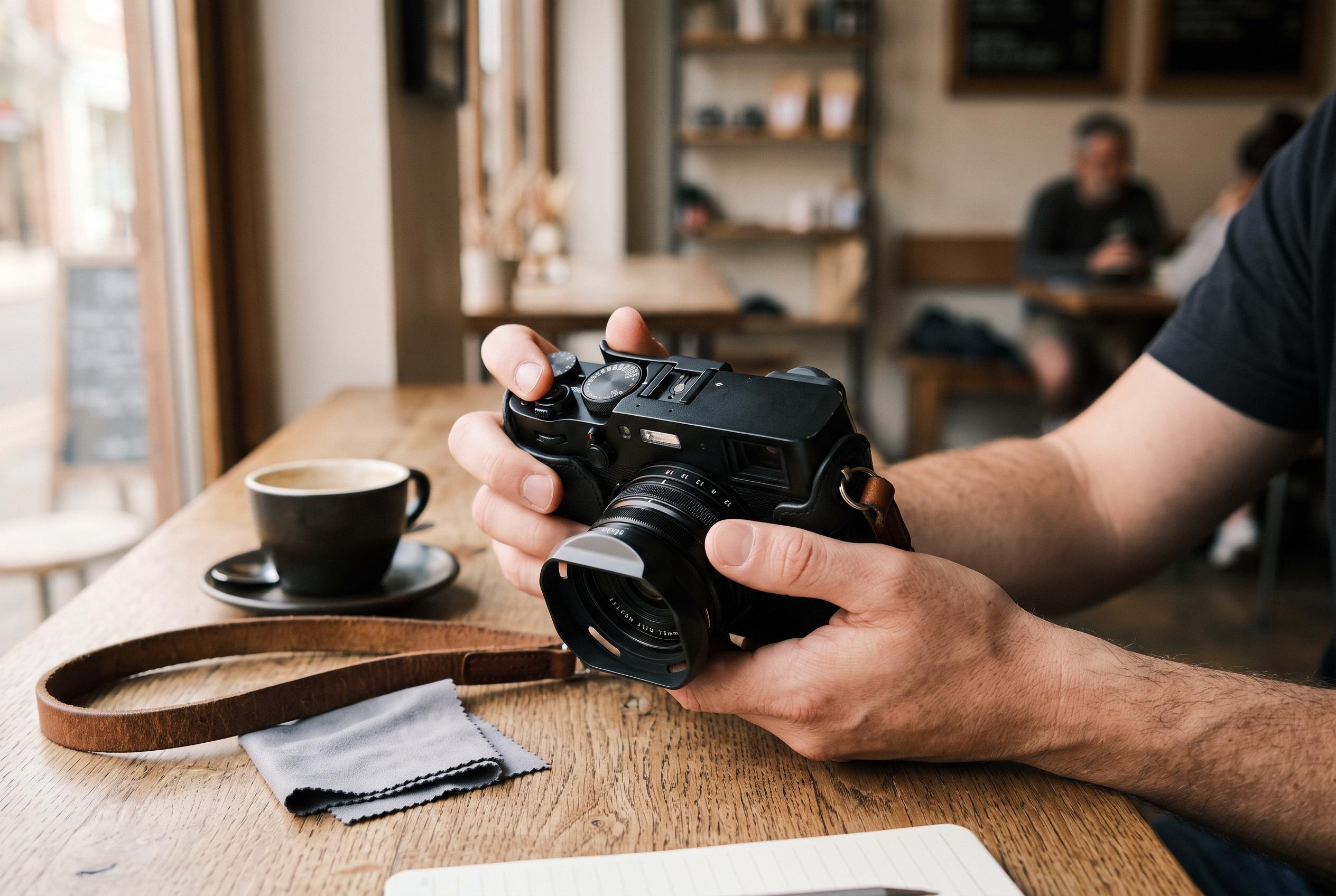

Alessandro Miceli’s review of the Fujifilm X100VI highlights how its design fosters a spontaneous, social approach to photography by prioritising simplicity and tactile controls over technical complexity, shaping a new user experience in premium compact cameras.
Alessandro Miceli’s account of the Fujifilm X100VI is less a conventional camera review than a case study in how design can reshape a photographer’s habits. He is a 24-year-old hobbyist who says the camera appealed because it removed friction from the process. For him, the attraction was not technical conquest but simplicity: fewer decisions, less time in front of a computer, and a faster route from moment to image. That perspective gives the X100VI a very different value proposition from the one usually attached to premium compact cameras.
According to Fujifilm, the X100VI is the latest model in the X100 line and combines a fixed-lens body with a five-axis in-body image stabilisation system, an advanced hybrid viewfinder and 6.2K video recording. The company also highlights a tilt screen, aluminium top and bottom plates, a grip designed for portability and integration with Adobe Frame.io. In practice, Miceli says the compact shape and lack of interchangeable lenses are precisely what make the camera work for him. He describes the fixed lens not as a restriction but as a way of ending the sort of indecision that often slows shooting down.
Miceli’s strongest praise is reserved for the camera’s JPEG output and film simulations, which he says let him stop editing almost entirely. He uses custom presets stored in the camera’s memory and says that the finished files look close enough to his preferred aesthetic straight out of the body. He also leans on an external mist filter to soften highlights and push the images further towards a film-like result. The upshot, in his telling, is a workflow built around immediacy: shoot, transfer to a phone and share, without the detour through Lightroom that had come to drain his enthusiasm.
He is equally positive about the physical controls. The shutter-speed, ISO and exposure-compensation dials give the X100VI a more deliberate feel than many modern mirrorless bodies, and Miceli says that tactile approach adds to the pleasure of using it. He acknowledges that the camera’s size means a less substantial grip than a DSLR would offer, but says accessories such as thumb grips and half cases can improve handling. He also singles out the built-in neutral-density filter as especially useful, allowing wide-aperture shooting in bright light without overexposure.
Where the review becomes more measured is in autofocus and battery endurance. Miceli says the autofocus can hesitate when movement speeds up, even if it remains adequate for the portraits and landscapes he usually shoots. Fujifilm’s own positioning suggests a broader remit for the camera, including hybrid viewfinder use and video capture, but Miceli’s experience centres on still photography and on the creative ease that the system gives him. He also notes that battery life is not a strong point and that he carries a spare for full-day outings.
His conclusion is personal, but it is also revealing about the market niche the X100VI occupies. On one level, the camera is a premium compact with stabilisation, a refined body and strong feature density. On another, it is a tool designed for photographers who want to keep the process immediate and social rather than technical and solitary. Miceli’s examples, from a beach scene to a dinner party, show the same pattern: the camera is valued not for producing the most corrected file, but for preserving the mood of the moment while it is still happening.
Disclaimer: This content is intended for informational purposes only. Readers are advised to exercise their own judgement, conduct due diligence, or consult a qualified expert before acting on any information provided.