
Leica’s Cine Compact 1 elevates portable projection with advanced optics and fully automated setup, challenging assumptions about premium compact projectors.
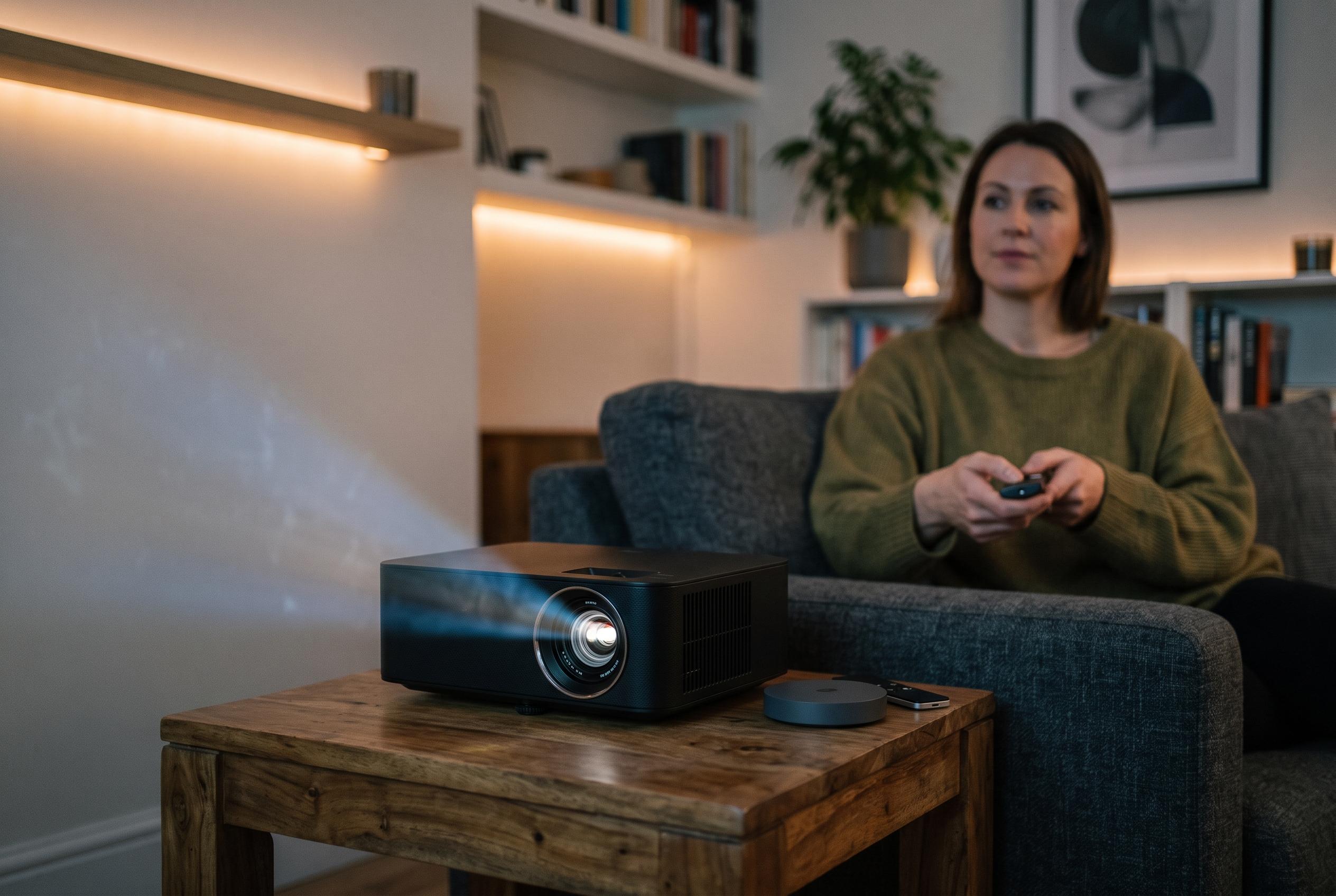
Leica’s Cine Compact 1 is a short-throw-style portable projector that tries to justify a premium price through its optics, automation and industrial design rather than brand cachet alone. In practice, that approach appears to work. According to Journal du Geek’s review, the machine locks on quickly, corrects itself automatically and produces an image that looks far more assured than one might expect from a compact projector at this level. Retail listings and other reviews place the price at €1,645 in Europe, with a maximum image size of around 220 inches and a claimed brightness of 1,700 lumens.
The strongest impression comes from installation. Leica’s ImageAlign system is designed to handle focus, framing and keystone correction without user intervention, while the 360-degree rotation mechanism makes placement unusually flexible for a projector of this type. Journal du Geek says the image appears in under three seconds with no manual correction needed, and other reviewers describe the same automated setup as one of the device’s most practical strengths. The chassis also feels more substantial than many rivals, with an aluminium body and glass front giving it the look of a serious home-cinema product rather than a casual lifestyle accessory.
The real differentiator is the lens. Leica uses a Summicron aspherical optical system, and that seems to be where much of the value lies. Journal du Geek reported that sharpness stays consistent across the frame, including towards the edges, even at larger image sizes. Son-Vidéo’s assessment was similarly positive, highlighting natural rendering, well-defined textures and convincing contrast in darker rooms. The projector also supports Dolby Vision and HDR10+, which helps it handle bright highlights and shadow detail more gracefully than basic HDR implementations.
Technically, the Cine Compact 1 is not a native 4K projector. As Crutchfield notes, it uses pixel-shifting from a 1080p DLP chip to generate a 4K-class image, which is common in this category. In normal viewing, that limitation is unlikely to dominate the experience, although close inspection of fine detail can reveal the difference. The DLP design also carries the usual possibility of rainbow artefacts for sensitive viewers, though Journal du Geek said the effect was rare in use. Brightness is good for a compact laser projector, but not enough to defeat strong ambient light completely; Computer Bild and Testberichte.de both suggest it performs best in dimmer environments.
Noise performance is another area where Leica appears to have made sensible trade-offs. Journal du Geek found the fan to be barely noticeable in normal viewing, and that matters in a projector intended for living-room use. The bundled carry case reinforces the portable pitch, although the lack of an internal battery means it still needs mains power at all times. On the software side, the French model ships with Hisense’s VIDAA platform, which provides mainstream streaming apps, Apple AirPlay support and HomeKit compatibility, but reviewers note that the interface is functional rather than especially fast. That same practical, slightly conservative approach extends to gaming, where Journal du Geek reported input latency below 20 milliseconds and a mode capable of 240Hz at 2K, making it a more capable display for consoles and PCs than its size suggests.
Disclaimer: This content is intended for informational purposes only. Readers are advised to exercise their own judgement, conduct due diligence, or consult a qualified expert before acting on any information provided.