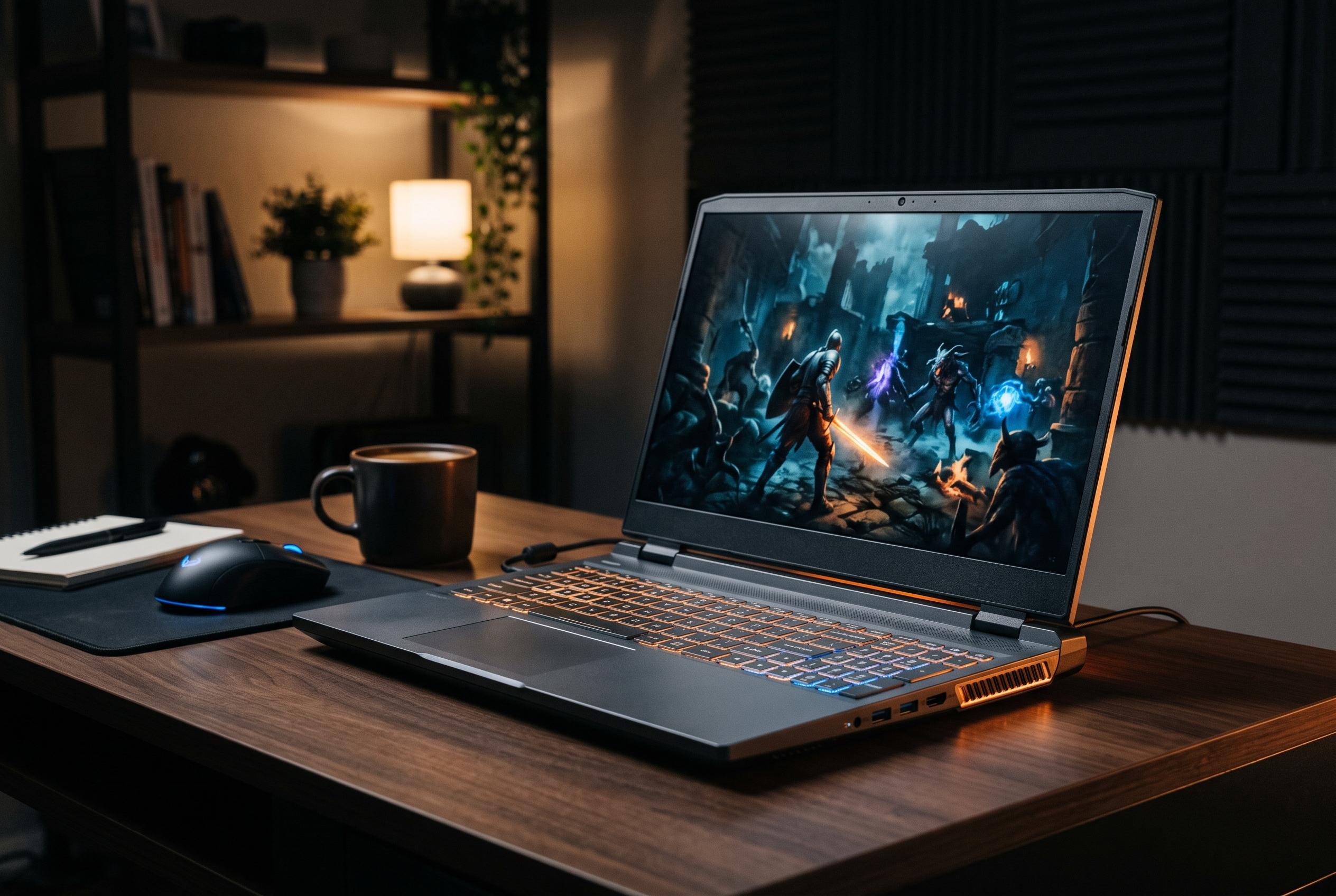

The global memory shortage in 2026 has driven up prices for gaming laptops, making budget models featuring Nvidia’s RTX 5050 GPU more attractive for mainstream gamers seeking 1080p performance amidst limited stock and distorted prices.
The global memory shortage has pushed gaming laptop prices sharply higher in 2026, making the budget end of the market far more attractive than it once was. TechRadar argues that this is where Nvidia’s RTX 5050 now makes the most sense: not as a high-end option, but as a way to keep a new machine within reach when flagship models have become difficult to justify. Across the current Labour Day sales period, retailers including Walmart are still listing several RTX 5050 systems at prices that sit far below the premium tier. According to PC Gamer, discounted gaming hardware is widespread this week, but stock is limited and pricing remains distorted by the wider shortage.
The key limitation is straightforward. The RTX 5050 laptop GPU typically comes with 8GB of GDDR7 memory and a 128-bit bus, which makes it an entry-level part rather than a do-everything chip. In practical terms, that means 4K gaming is off the table and 1440p will often be too demanding as well. Full HD remains the sensible target, and that is why laptops built around this GPU are usually paired with 1080p-class displays. In TechRadar’s view, paying extra for a higher-resolution screen would mostly help everyday work, not modern gaming.
That said, the RTX 5050 is not without merit. TechRadar says its performance is broadly similar to the older RTX 4060, a GPU that proved popular because it offered a workable balance between price and capability. Because the 5050 sits in Nvidia’s Blackwell family, it can also use DLSS 4, which can raise frame rates through AI upscaling. Multi Frame Generation is supported in principle too, although the 8GB memory ceiling can make that feature less effective in heavier games. For esports titles, indie games and older releases, the limits are far less severe.
The current deals reflect that value proposition. Walmart is selling an MSI Cyborg 15.6 with an RTX 5050, Intel Core i5-13420H, 16GB of memory and a 512GB SSD for $899, while PC World highlighted an Acer Nitro V with the same GPU, 16GB of RAM and a 165Hz screen for $579. TechRadar also pointed to an HP HyperX Omen 15.3 at $1,049.99 and an Alienware Aurora 16 at $1,249, both positioned as more premium takes on the same budget class. Smartprix lists other RTX 5050 models, including Acer and Gigabyte machines with 16GB of RAM and 165Hz panels, which shows how quickly this GPU has become the default compromise for buyers trying to stay under the upper end of the market.
For buyers, the decision is less about raw power than about realism. An RTX 5050 laptop is sensible if the aim is 1080p gaming, modest settings and a current-gen machine at a controlled price. It is much less suitable if the target is maximum detail, ray tracing or higher-resolution play. In a year when memory costs have made better-equipped laptops harder to buy, that distinction matters more than ever.
Disclaimer: This content is intended for informational purposes only. Readers are advised to exercise their own judgement, conduct due diligence, or consult a qualified expert before acting on any information provided.