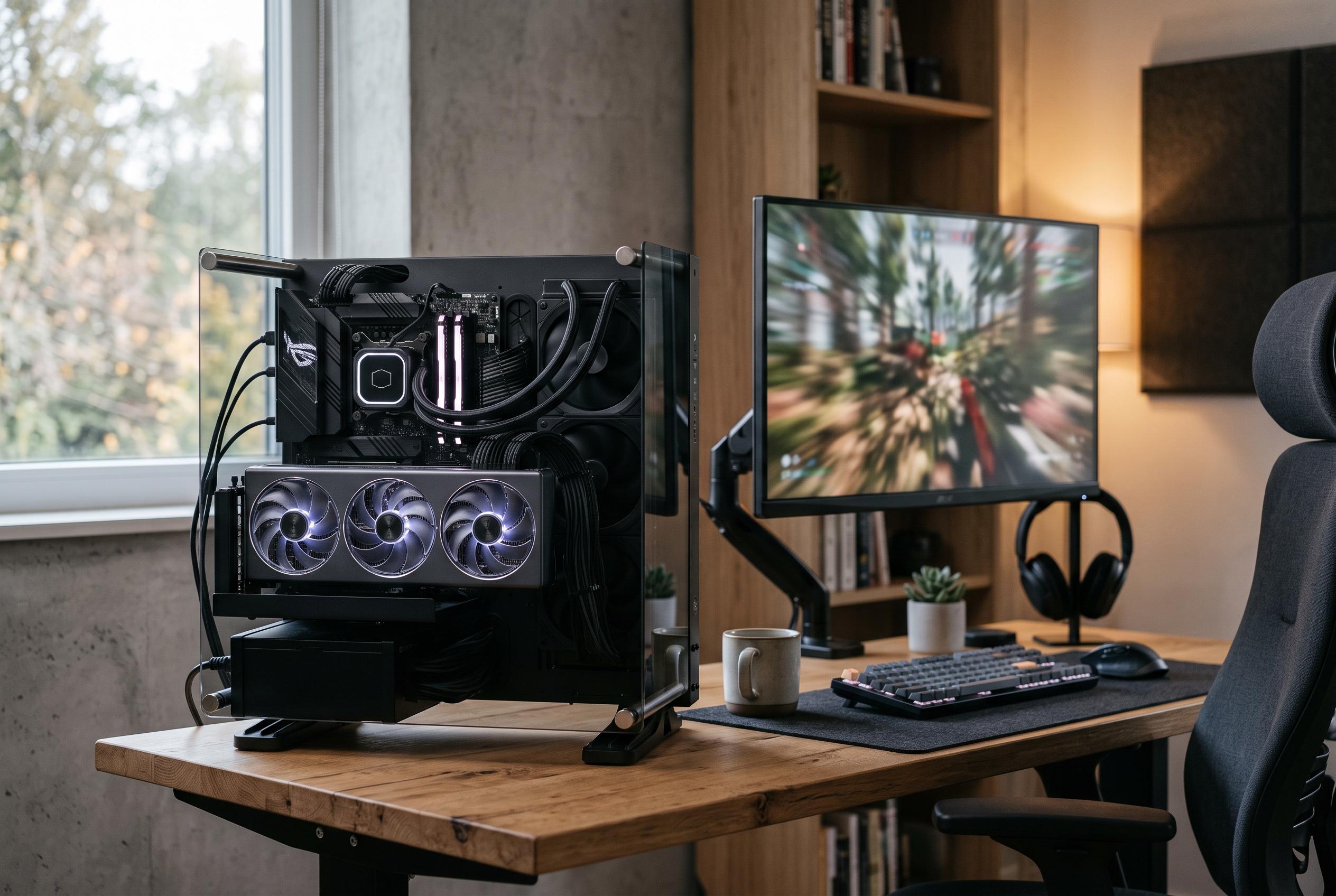

MSI’s compact RTX 5060 Ti 8G offers solid 1080p performance and easy installation, but loud cooling and an increasingly restrictive 8GB memory buffer make it a compromise rather than a future-proof upgrade.
MSI’s GeForce RTX 5060 Ti 8G VENTUS 2X OC PLUS arrives at an awkward moment for mid-range graphics cards. The 8GB version sits at the lower end of the RTX 5060 Ti family, while the 16GB model commands a much higher premium. That gap matters because modern games are already capable of using more than 8GB of video memory, especially once higher textures, ray tracing and frame generation enter the picture. Even so, for buyers trying to hold down costs, the cheaper card remains attractive. MSI positions it as a compact Blackwell-based board with 4,608 CUDA cores, a 128-bit memory interface and GDDR7 memory running at 28Gbps.
The board itself is deliberately plain. There is no RGB lighting, the cooler uses two fans, and the card is short enough to suit smaller cases. MSI lists a boost clock of 2,602MHz, a 180W board power figure and a recommendation for a 600W power supply. The design also retains the older eight-pin power connector rather than forcing the newer 12V-2×6 plug, which keeps installation simple for owners of existing systems. According to MSI’s specifications, the card provides three DisplayPort 2.1b outputs and one HDMI 2.1b output.
That modest power envelope is reflected in the review’s measurements. In gaming, the card generally ran at about 2.7GHz, with the cooler keeping the GPU and memory around 75C to 76C. Noise, however, was less impressive: the review says the card reached roughly 41dBA under load, which is loud for a 180W graphics board. MSI’s cooler uses direct-contact heatpipes, an aluminium base for the memory chips and a simple backplate that does not itself help with heat dissipation. In other words, the hardware is functional, but not especially refined.
Performance in rasterised games was broadly what one would expect from a mainstream RTX 5060 Ti. At 1080p, the card was usually comfortable, and only a couple of titles fell below 60fps. The review found that the 16GB RTX 5060 Ti was about 8% faster on average, although most games showed little sensitivity to the smaller memory pool, with Horizon Zero Dawn Remastered standing out as the clearest exception. Compared with the plain RTX 5060, MSI’s card was 11% quicker overall, while AMD’s Radeon RX 9060 XT 16GB held a slight lead in raster performance and the GeForce RTX 5070 stayed well ahead in raw frame rates. At 1440p, the 8GB model became more limited, not only by memory capacity but also by the class of GPU itself, and half the test suite failed to maintain 60fps.
Ray tracing exposed the card’s constraints more sharply. In native 1080p, the 8GB model could cope in lighter titles such as Hogwarts Legacy and Returnal, but in heavier games it was far behind both the 16GB RTX 5060 Ti and faster cards above it. At 1440p, the situation worsened, and only the least demanding traced workloads remained playable. Once upscaling entered the picture, however, the picture improved substantially: using DLSS Balanced, often with Ray Reconstruction, brought many results back towards the 60fps mark at 1080p. Even so, DOOM: The Dark Ages still showed how quickly an 8GB buffer can become a bottleneck. The review’s conclusion is clear enough: this MSI board is one of the cheapest RTX 5060 Ti options available, it can overclock well, and it is acceptable for cautious 1080p use, but its 8GB memory limit and louder-than-ideal cooling make it a compromise purchase rather than a fully future-proof one.
Disclaimer: This content is intended for informational purposes only. Readers are advised to exercise their own judgement, conduct due diligence, or consult a qualified expert before acting on any information provided.