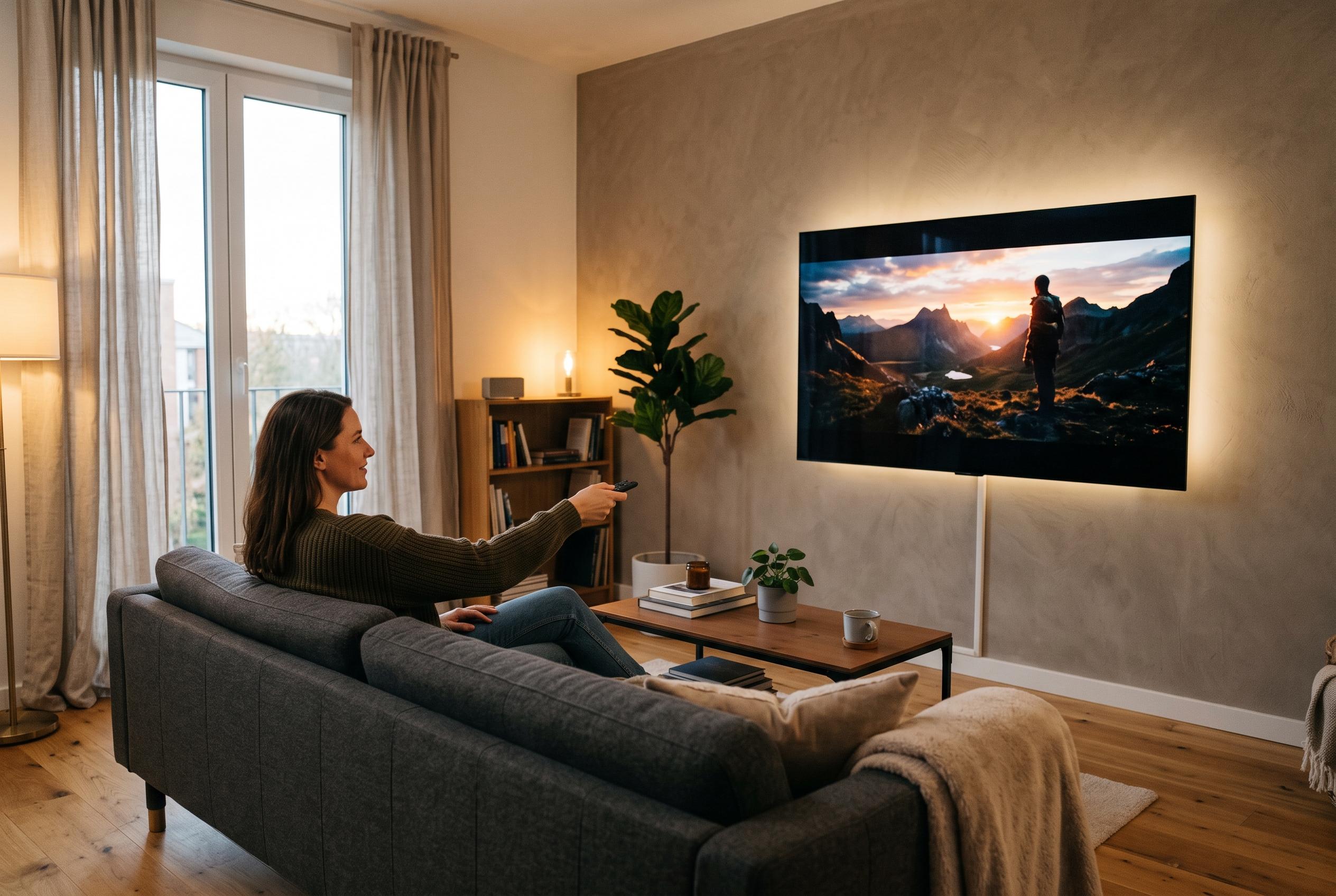

OLED leads in contrast and cinematic depth, while QLED offers greater brightness and avoids burn-in concerns. Here is how the LG C6, Hisense E7 and rival models compare for films, gaming and everyday viewing.
For shoppers who have already settled on screen size, the real decision often comes down to panel type. OLED and QLED are not competing versions of the same thing: OLED is self-emissive, with each pixel generating its own light, while QLED is an LCD panel that uses an LED backlight and quantum dots to improve colour and brightness. In practical terms, OLED tends to win on black levels and contrast, while QLED usually has the edge in bright rooms and at lower prices. That broad split is consistent with specialist comparisons from RTINGS, OLED-Info, Tom’s Guide and Display Ninja.
The most important question is where the television will be used. In a dark room, OLED’s ability to switch off individual pixels gives films and series a more convincing sense of depth, especially in shadow-heavy scenes. In a brighter living room, QLED’s backlight can be driven harder, which helps the picture hold up against daylight and reflections. That is why buyers who mostly watch films at night often prefer OLED, while households with large windows or all-day viewing often lean towards QLED.
Within the OLED choices, the LG C6 stands out as the most rounded option on the page. The listing highlights more than 8.3 million self-lit pixels, a 165Hz panel, 0.1ms response time, NVIDIA G Sync, AMD FreeSync Premium and VRR, alongside Dolby Vision, Dolby Atmos and OLED Care. For buyers who want one set to do both cinematic viewing and gaming, it is the strongest all-round OLED here, even if the specification sheet does not state an HDMI 2.1 port count. Sony’s BRAVIA 6 is the other serious OLED contender, mainly because it pairs four HDMI 2.1 ports with 4K at 120Hz, VRR, ALLM and SBTM, plus Dolby Vision, Dolby Atmos and DTS:X. That makes it the cleaner fit for a mixed-use room where connected devices matter as much as peak refresh rate.
Samsung’s S90H approaches the OLED category from a different angle. Its listing matches the LG C6 at 165Hz and adds G Sync or FreeSync Premium Pro, but it leans more heavily into gaming and anti-glare claims than into movie-first features such as Dolby Vision. That makes it attractive for bright gaming spaces, especially where fast motion and reduced reflections matter more than the broadest HDR format support. For buyers who care about motion performance above all else, it is a strong alternative to the LG model.
On the QLED side, the Hisense E7 is the most technically complete mid-range option. Its listing combines a mini LED backlight with full-array local dimming, Native 144Hz and a wide HDR spread that includes Dolby Vision IQ, HDR10+ Adaptive, HDR10 and HLG. That mix makes it the most convincing QLED choice for buyers who want the brightness advantages of an LCD-based panel but also want better control over dark scenes. TCL’s T7 is less aggressive on refresh rate at Native 120Hz, but it remains a sensible value option because it keeps the core QLED package intact: quantum dot colour, Dolby Vision, HDR10+, HDR10, HLG and four HDMI inputs. For a shopper balancing price and flexibility, it is the most straightforward bargain pick.
Samsung’s QN70H sits slightly apart from the rest because it is a 65-inch Neo QLED rather than a 55-inch model. Its appeal lies in the combination of Quantum Mini LED backlighting, 100% colour volume with quantum dots, the NQ4 AI Processor and 4K upscaling. The specification sheet is less explicit about refresh rate, HDR formats and HDMI 2.1 support, so it is less transparent than the Hisense and TCL sets for spec-led shoppers. Even so, it is a useful reminder that Neo QLED is Samsung’s naming for a QLED television with mini LED backlighting behind it, designed to narrow the gap with OLED on contrast while keeping the brightness and burn-in advantages of LCD-based technology.
The long-standing trade-off remains the same. OLED can be vulnerable to burn-in if static images remain on screen for long periods, although the risk is lower in normal mixed viewing and many sets include protection features such as pixel shifting or panel care routines. QLED does not face the same issue, which is why it is often the safer option for news channels, consoles with fixed interfaces or use as a computer display. For most buyers, the choice is therefore not about which technology is universally better, but about whether the room is bright or dark, how much gaming is involved and how much weight to place on long-term panel behaviour. On that basis, the LG C6 is the most compelling OLED pick, while the Hisense E7 is the strongest QLED alternative.
Disclaimer: This content is intended for informational purposes only. Readers are advised to exercise their own judgement, conduct due diligence, or consult a qualified expert before acting on any information provided.