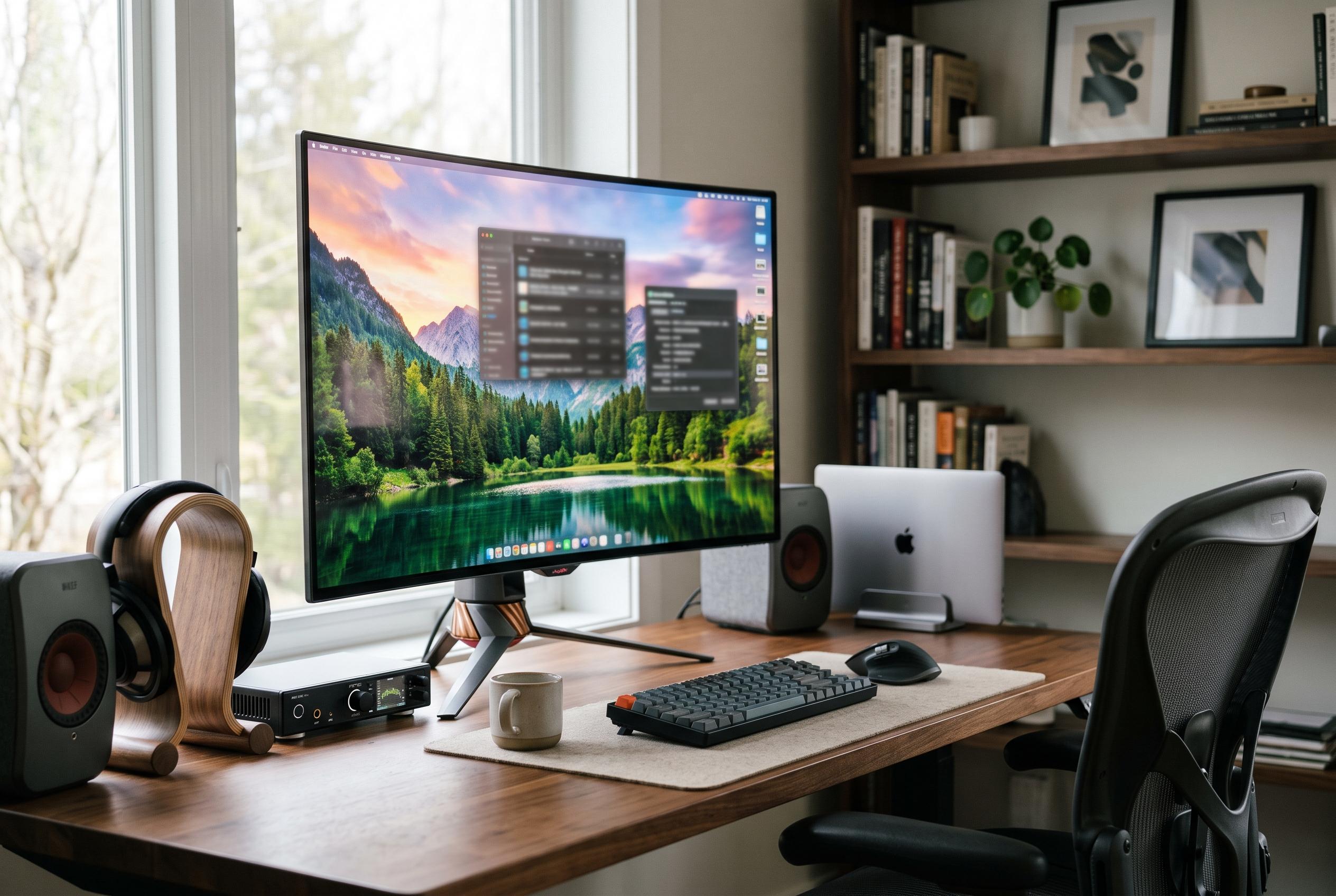

ASUS’s latest 32-inch 4K OLED monitors show that panel architecture remains decisive, with QD-OLED leading on balance, tandem WOLED on HDR brightness and efficiency, and rgb-WOLED on text clarity.
By 2026, 32-inch 4K OLED monitors had moved beyond the first wave of panels that arrived in 2024, and the latest generation now shows how much panel architecture still matters. Tweakers compared three ASUS models built around the newest QD-OLED and WOLED variants: the ROG Swift OLED PG32UCDM Gen 3, the ROG Strix OLED XG32UQWMS and the ROG Swift OLED PG32UCWM. The review makes clear that the panel type still shapes most of the experience, from black levels and viewing angles to text clarity, power draw and HDR behaviour.
In image quality terms, the newest QD-OLED remains the most rounded option overall. Tweakers found that the PG32UCDM Gen 3 delivered the best viewing angles, the cleanest white and grey uniformity, and the smoothest dark gradation. Its new coating also improves performance in ambient light, making blacks look deeper than on earlier QD-OLED panels, although WOLED still holds a small advantage when the room is bright. The tandem WOLED panel in the XG32UQWMS closes part of the gap in brightness and contrast, but it still shows more colour shift under angle and more visible dark-grey irregularities than the QD-OLED model. The rgb-WOLED panel in the PG32UCWM improves text sharpness, but at the cost of a stronger green-magenta tint near the edges and the weakest uniformity of the three.
Brightness remains a more mixed story. According to Tweakers, the tandem WOLED monitor is the most capable for HDR peaks and is also the most efficient of the trio, drawing just over 30W at the review’s fixed 150cd/m² test point. That is notably below the QD-OLED model and well below the rgb-WOLED screen, which consumed the most power and ran hottest. In practical SDR use, the QD-OLED and tandem WOLED models were broadly comparable, each reaching close to 300cd/m² full-screen brightness when uniform brightness limits were disabled, while the rgb-WOLED monitor sat at roughly the same level but looked less convincing in very bright rooms because it lacks the white subpixel that helps sustain luminance.
For HDR, the trade-offs become more visible. Tweakers reported that the XG32UQWMS can reach the highest peaks on paper and produces the brightest highlights in favourable scenes, but its tone mapping becomes less even once the monitor is pushed out of its more conservative HDR modes. The QD-OLED model tracks the HDR curve more cleanly in mid-tones and preserves richer colour in small, intense highlights, though it can lose some punch in the brightest mode because of the familiar QD-OLED brightness roll-off. The rgb-WOLED screen avoids some of that darkening but does so with greater deviation from the ideal HDR curve, leaving its image less consistent overall.
Text handling and desktop use give the rgb-WOLED panel a clear advantage. Tweakers said the PG32UCWM largely avoids the colour fringing that affects the other two panels, because its subpixel layout is much closer to a conventional monitor arrangement. The tandem WOLED panel still shows some edge tinting and can benefit from ASUS’s Clear Pixel Edge option, although that setting slightly softens the image. The QD-OLED monitor, by contrast, still shows the familiar coloured haloing around small text and fine UI elements. For gaming and video that matters less, but for mixed use and long desktop sessions it is still relevant.
The ASUS implementations also differ more than the panel comparison alone might suggest. The Strix model is the most pared-back, with a simpler stand, fewer ports and no USB-C, while the two Swift monitors include the fuller feature set expected from premium gaming displays, including DisplayPort 2.1, USB-C with 90W charging, a KVM-style USB setup and additional lighting features. Tweakers also noted that the rgb-WOLED model’s back housing feels less solid than the others, despite its striking transparent design. ASUS’s usual burn-in warranty applies to all three, and the company’s proximity sensor, anti-flicker controls and motion blur reduction features are present across the range.
The broader market context is that these panels are impressive but still not universal. According to Tweakers, by late 2026 the pool of monitors using the new panel generations remained relatively small, with many buyers still choosing older 32-inch OLED screens to save several hundred euros. At the high end, however, the newest panels are a clear step forward: QD-OLED remains the most balanced all-rounder, tandem WOLED offers the strongest HDR brightness and efficiency, and rgb-WOLED is the best choice if text clarity matters most. The result is not a single winner, but a more mature market in which each panel type now serves a distinctly different use case.
Disclaimer: This content is intended for informational purposes only. Readers are advised to exercise their own judgement, conduct due diligence, or consult a qualified expert before acting on any information provided.