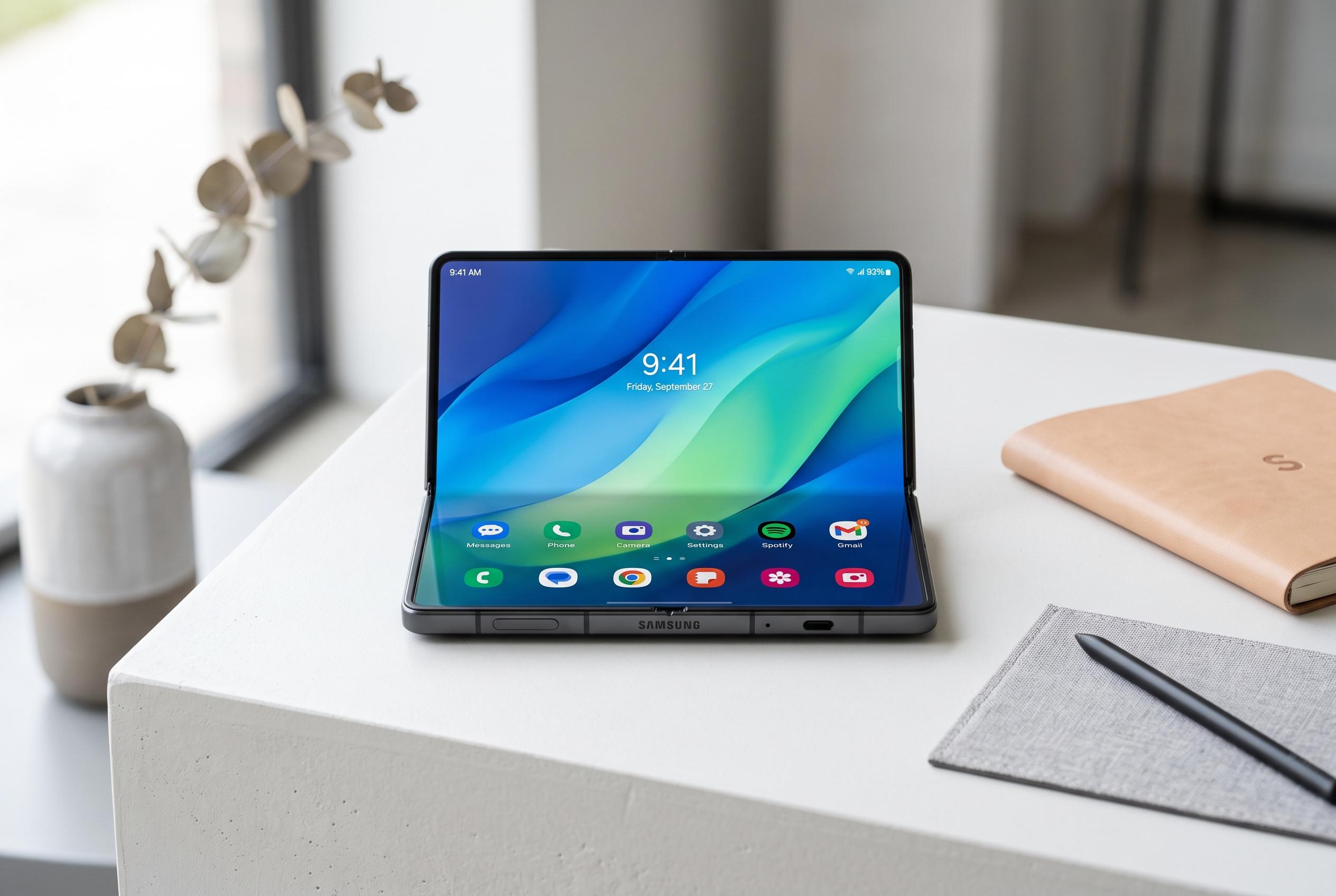

The Galaxy Z Fold8 emerges as Samsung’s most convincing foldable yet, blending lightweight design, improved display quality, and advanced software to deliver a seamless transition between phone and tablet , signalling a maturation in foldable technology.
Samsung’s Galaxy Z Fold8 is shaping up as the company’s most convincing attempt yet at a foldable that feels less like a compromise and more like a normal premium phone that happens to open into a tablet. In one week of daily use, the most striking qualities were its light weight, slim folded profile and an inner display whose crease is far less intrusive than on earlier models. The larger point, though, is that Samsung appears to have spent its eighth generation of foldables refining the basics rather than chasing novelty for its own sake.
That design work matters because the Fold8 is built around comfort as much as capability. Reviewers have described it as compact and easy to carry for a device in this category, with a matte finish that helps keep fingerprints down and an anti-reflective coating that improves usability on both screens. TechRadar and Digital Camera World both note the reduced visibility of the crease, while the foldable’s 5.5-inch cover display and 7.6-inch main panel make it easier to treat the phone as either a regular handset or a small tablet depending on the task.
The display arrangement is also central to the Fold8’s appeal. Samsung’s wider outer screen and square inner panel are not just spec-sheet talking points; they materially change how video, reading and navigation feel in daily use. TechRadar found the Fold8 especially strong for content consumption, with less awkward letterboxing in common viewing formats, while the phone’s lighter body made longer sessions easier on the hands. At the same time, the design brings one clear trade-off: the new hinge behaviour removes the flexible half-open angles that some foldable owners have used for hands-free viewing.
Samsung’s software remains one of the Fold8’s biggest strengths. One UI is tuned for multitasking, with split-screen layouts, floating windows and app continuity that take better advantage of the larger interior panel than most Android rivals. The device also carries Samsung’s Galaxy AI tools, adding features such as translation, search and photo editing on top of the usual foldable conveniences. A more surprising limitation is the app grid, which is reportedly capped at 4 by 4 on the inner display despite the available space. That feels more like a software choice than a hardware constraint.
Performance is another area where the Fold8 avoids obvious weakness. Reviewers point to the Snapdragon 8 Elite Gen 5 platform, with strong responsiveness, solid multitasking and gaming performance that holds up better than expected on a foldable. Battery life is likewise respectable, with the 4,800mAh cell supporting a full day of heavy use and, in some mixed-use testing, close to two days of moderate use. Charging support varies by market, but TechRadar says the phone supports 45W wired charging and 20W wireless charging. Camera hardware is more restrained, with dual 50MP rear sensors and no telephoto lens, yet the Fold8 still offers dependable image quality and useful video features. At $1,899 in US pricing, or RM7,099 in the Malaysian review cited here, it is still expensive, but it is also one of the few foldables that feels genuinely mature rather than experimental.
Disclaimer: This content is intended for informational purposes only. Readers are advised to exercise their own judgement, conduct due diligence, or consult a qualified expert before acting on any information provided.