

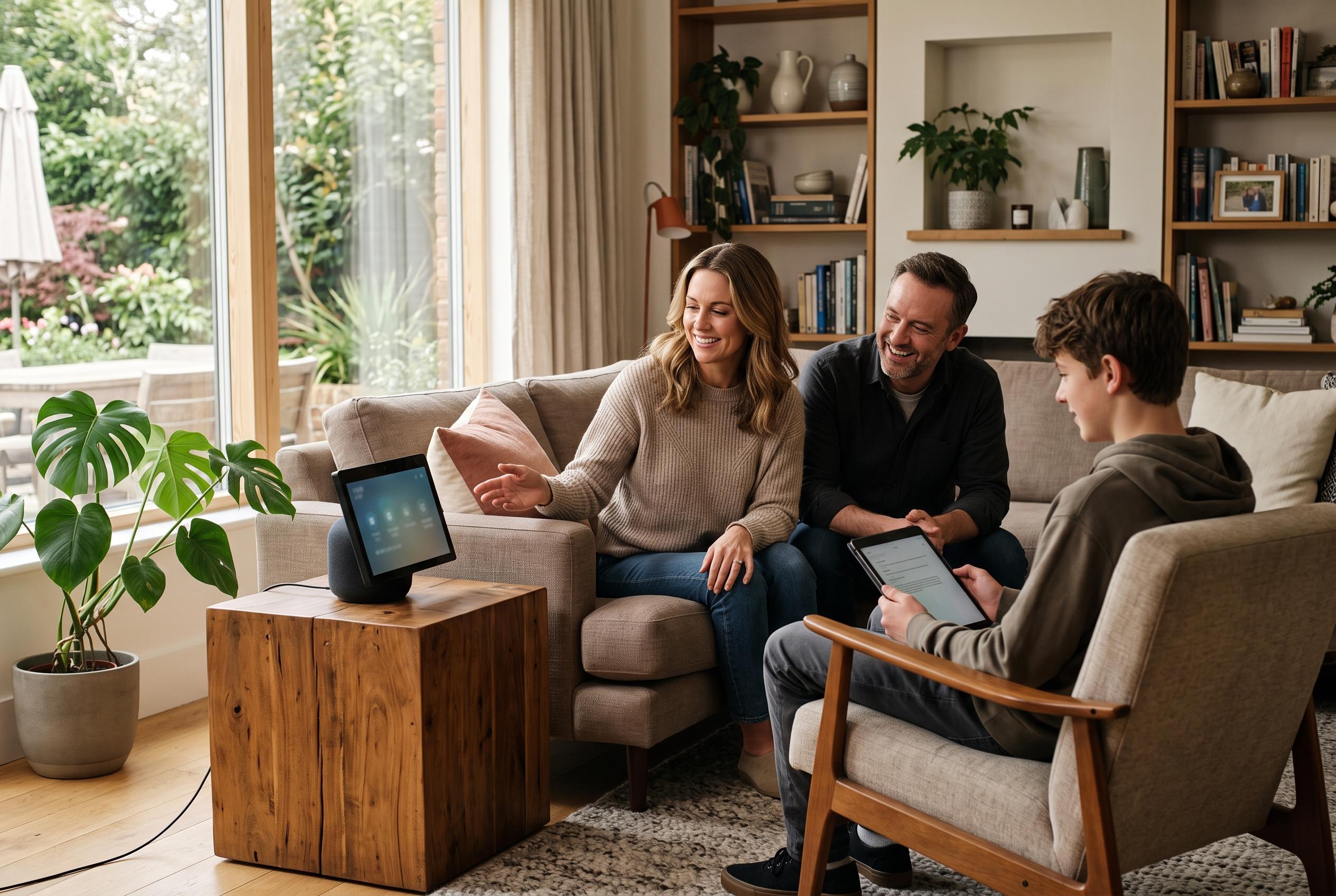

Apple has unveiled HomeView, a $299 smart display designed to combine personalised information with shared household controls, as it expands its connected-home ambitions.
Apple has used its latest home event to make a broader pitch for the connected house, with HomeView at the centre of it. The new smart display sits alongside an updated Apple TV 4K, a refreshed HomePod mini and a wider Home Collection of accessories developed with LG Electronics and Schneider Electric. According to Apple’s newsroom announcement, HomeView is built around a 7-inch Liquid Retina display, Siri AI and facial recognition for up to six people, with a starting price of $299 and availability from 13 November 2026.
That matters because Apple is not presenting HomeView as another tablet on a stand. The company says the device is meant to act as a shared household interface, handling home controls, entertainment and communication while tailoring what appears on screen to the person standing in front of it. In Apple’s view, the point is not simply to add another display, but to give the home a dedicated control point that feels personal without exposing private information to everyone in the room.
The hardware design reflects that aim. Apple offers the device in silver, starlight, rose pink and space grey, and the company has also prepared a wall-mounted version for installations where a counter-top unit would not suit the space. The launch presentation placed heavy emphasis on scale, materials and usability, with the device positioned as something intended to sit naturally in kitchens, hallways and bedrooms rather than dominate them. A review from View the Vibe, based on a first look in New York, said that the device appeared smaller and more refined in person than in product images and that the room’s reaction grew noticeably once HomeView was unveiled.
Apple’s software pitch is equally important. The company says HomeView can recognise who is using it and present personal content accordingly, while still allowing guests to carry out shared tasks such as checking the weather, adjusting devices or setting timers. That distinction is central to Apple’s privacy argument. According to the company, private material such as messages or calendar items remains gated behind identity verification, while home functions stay available to the rest of the household. MacRumors and Tom’s Guide both reported that the system is designed to let a family share the same screen without collapsing everyone’s information into one account.
The strongest practical demonstration appears to be in the kitchen. Apple showed HomeView presenting recipes in a step-by-step format, helping users keep track of ingredients and timers while moving through a cooking task hands-free. Tom’s Guide reported that Siri AI can draw on context from a paired iPhone, allowing the display to surface a recipe that was previously texted to the user, which makes the device more useful as an assistant than a passive panel. That is also where Apple’s broader home strategy becomes clearer: the same screen can double as a recipe board, a message centre, a photo frame and a control hub, depending on who is using it.
Apple’s other home announcements extend that logic into entertainment and accessories. The new Apple TV 4K brings an A19 chip, hands-free Siri support and updated remote-finding tools, while HomePod mini gets an S10 chip and new colour options. The Home Collection, meanwhile, includes products made with LG and Schneider Electric, covering cameras, thermostats, a smart lock, room sensors and a floodlight camera. According to Apple, the accessories are integrated into Apple Home rather than controlled through separate apps, and the company says the system remains end-to-end encrypted. Several products will ship first in the US and Canada, with some accessories arriving later and others reaching more markets.
For Apple, the wider significance is strategic. Axios noted that the company is trying to revive the smart-home category at a time when consumers have often found connected devices fragmented and awkward to use. That is the case Apple now wants to make against its rivals: if AI can remove enough friction, a dedicated home screen may finally make sense. HomeView is therefore more than a new product category for Apple. It is a test of whether the company can persuade households that a fixed shared display is still useful in a world already built around phones, laptops and televisions.
Disclaimer: This content is intended for informational purposes only. Readers are advised to exercise their own judgement, conduct due diligence, or consult a qualified expert before acting on any information provided.



