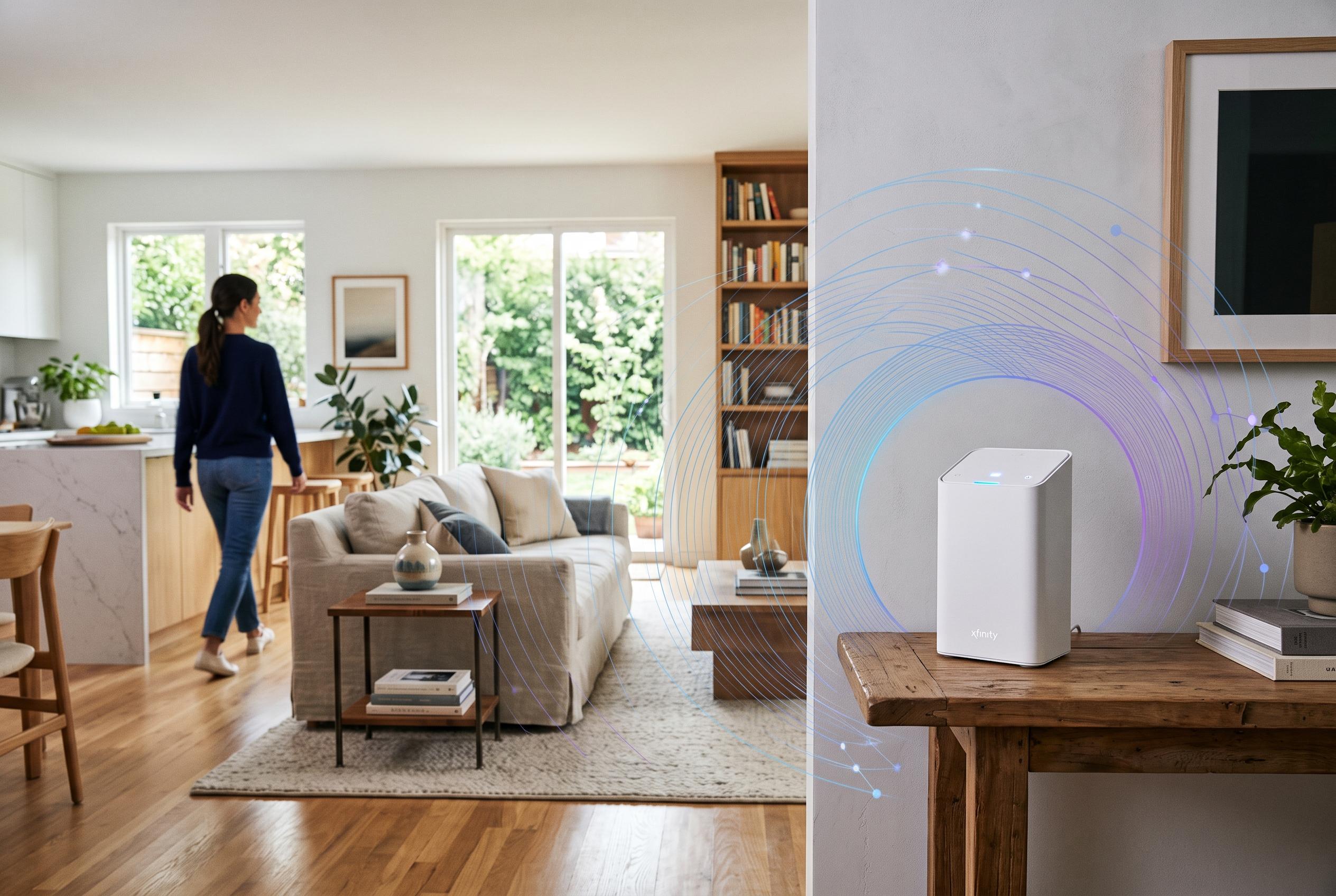

Comcast’s new WiFi Motion feature leverages standard Wi-Fi signals for home movement detection, sparking privacy concerns and signalling a shift towards integrated wireless sensing in broadband hardware.
Comcast has begun bundling a motion-sensing feature into its Xfinity Shield security package, using ordinary home Wi-Fi signals rather than cameras or dedicated sensors. The service, called WiFi Motion, is available on XB7 gateways and newer, and it sends alerts through the Xfinity app when it detects movement between the gateway and connected devices. Comcast says it is an opt-in feature and is included at no extra cost for eligible internet customers.
The company frames the system as a convenience and basic intrusion alert, not a monitored alarm service. Its support material says WiFi Motion relies on the gateway, optional extenders and Wi-Fi-connected devices already in the home, and that placement, building materials and signal strength can affect performance. Comcast also says it does not guarantee detection accuracy and does not monitor the motion events themselves.
The broader significance is that WiFi Motion sits inside a much larger shift in wireless networking. In September 2025, the IEEE published 802.11bf-2025, the standard that formalises wireless LAN sensing across licence-exempt spectrum from 1GHz to 7.125GHz, and above 45GHz. The amendment covers how devices negotiate sensing and exchange results, turning a capability long used for link quality into an explicit feature of the Wi-Fi stack.
That has raised privacy concerns because Wi-Fi sensing can reveal far more than whether a packet was received. Reporting on Comcast’s feature noted that motion data may be linked to law enforcement requests and other disclosures under the company’s terms, while privacy critics argue that occupancy patterns and movement histories can expose household behaviour. Comcast says the service is not professionally monitored, but the data it produces still describes when and where movement occurs in the home.
The technology is also no longer confined to one provider. Xfinity’s own documentation and the reporting on Cisco-compatible gateways suggest WiFi Motion is part of a wider vendor ecosystem built on existing broadband hardware, with the underlying sensing functions embedded in equipment rather than added later as separate devices. That makes the feature easier to deploy, but also harder for users to separate from the rest of their network equipment.
Disclaimer: This content is intended for informational purposes only. Readers are advised to exercise their own judgement, conduct due diligence, or consult a qualified expert before acting on any information provided.