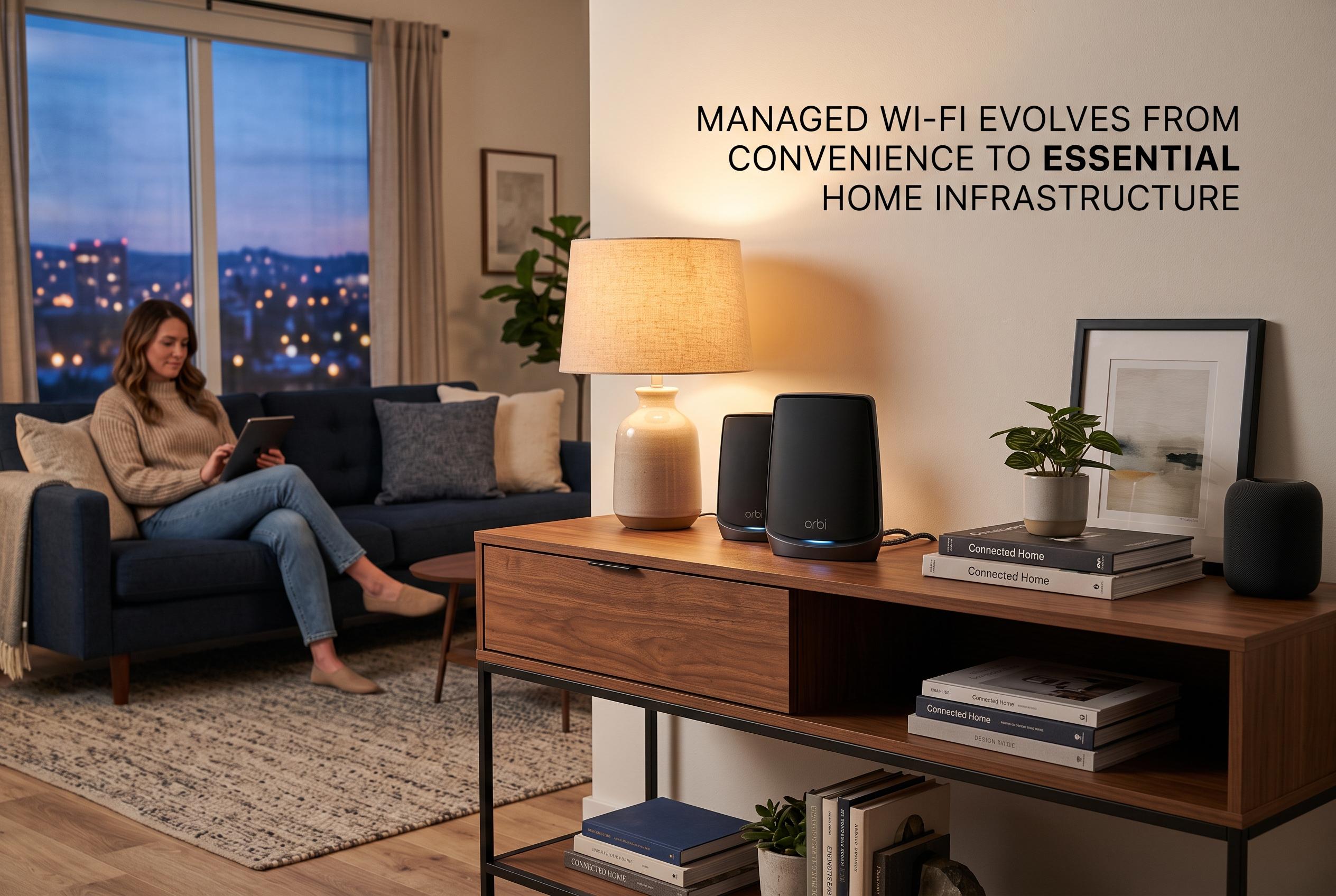

As households embrace a multitude of connected devices, internet providers are reimagining ‘Instant On’ services from simple access solutions to sophisticated, household-focused infrastructure using the latest Wi-Fi technology.
Instant On began as a practical answer to a narrow problem: giving new residents working broadband on day one. That model made sense when a home connection was mainly expected to support a small number of devices and basic streaming. But as households have filled with laptops, tablets, cameras, smart speakers, thermostats and consoles, internet service has become a central utility for work, study and entertainment rather than a simple on-off connection.
Sarah Jordan, director of connected communities at Quantum Fiber from AT&T, said the original pitch was shaped around the idea of “hotel Wi-Fi”, with equipment already installed and activation kept simple. She added that this approach solved an earlier need, but no longer matches the demands of modern living. The shift reflects a wider change in the market: residents increasingly want visibility, control and support that reaches beyond mere access.
That evolution is also visible in the technology itself. Quantum Fiber says its 360 WiFi service uses Wi-Fi 7, the latest wireless standard, with stronger coverage, lower latency and support for more devices at once. AT&T says its All-Fi service similarly uses mesh technology to extend coverage and offers real-time prioritisation, while built-in security features are meant to help block threats and manage connected devices. In practical terms, the promise is not just speed, but a network that can adapt to heavy use across an entire home.
Jordan said the company now sees value in linking service to the household rather than treating it as a one-time install. That allows providers to share updates, respond more proactively when faults arise and offer features such as device detection, content filtering, alerts and parental controls. For families, that matters as much as bandwidth: a connected home is now an ecosystem, and the network has to protect and organise it as well as carry traffic.
The larger lesson is that managed Wi-Fi has moved from convenience to infrastructure. A system designed to support a single move-in moment is being reworked for homes that never truly go offline. In that sense, Instant On has grown up with the market it serves: not just helping people get online, but helping them manage the increasingly complex digital life that follows.
Disclaimer: This content is intended for informational purposes only. Readers are advised to exercise their own judgement, conduct due diligence, or consult a qualified expert before acting on any information provided.