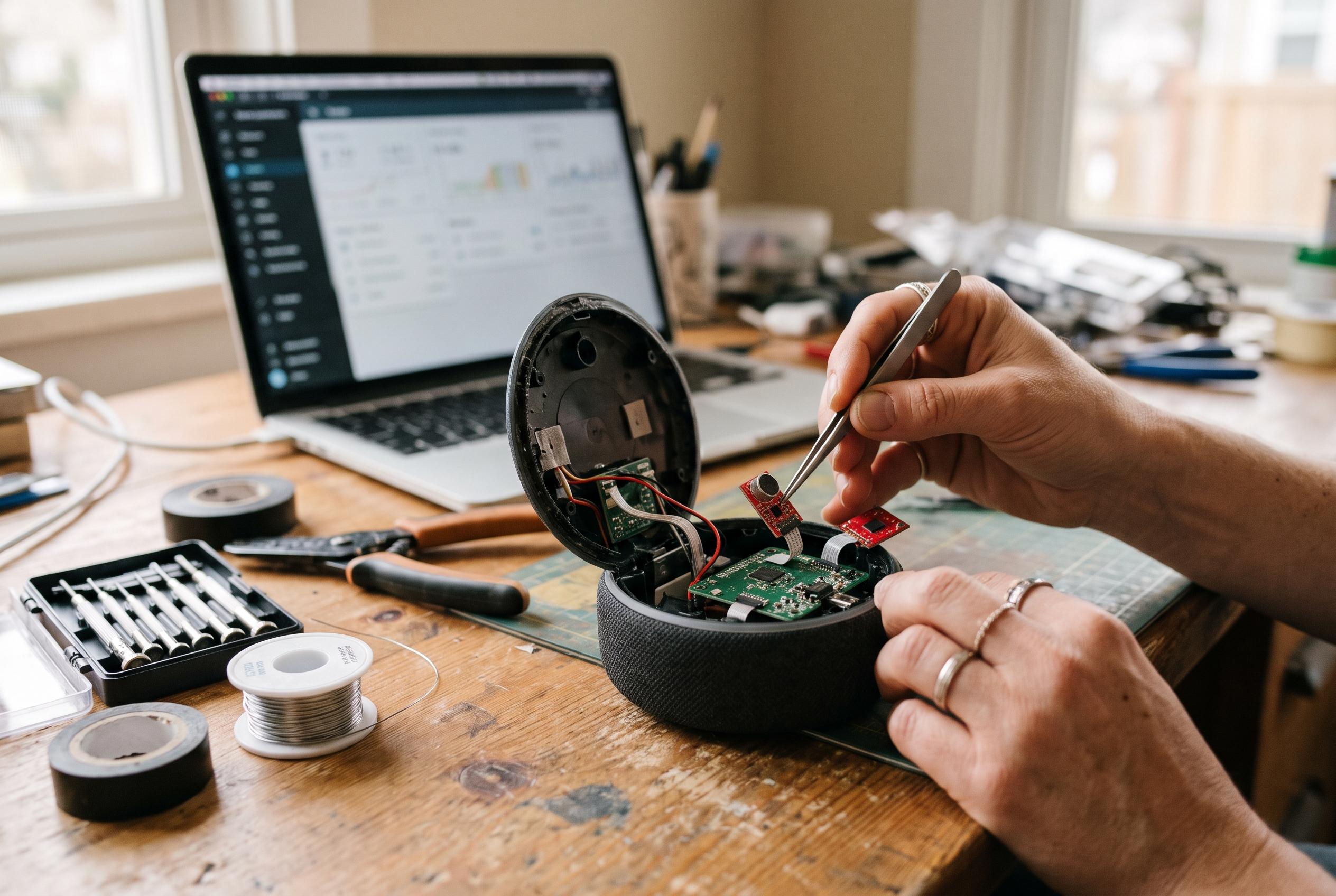

A rooted 2018 Echo Dot can serve as a local Home Assistant voice satellite, but the hardware modification is risky and speech recognition can be slow.
A 2018 third-generation Amazon Echo Dot has been turned into a local Home Assistant voice satellite after being rooted, in a project that highlights how much life can be extracted from consumer smart speakers once they are freed from Amazon’s software stack. Hackaday reported that the device was repurposed by [Andy], who documented the process in a video and a companion blog post. The end result is a speaker and microphone unit that can work with Home Assistant rather than relying on Alexa and Amazon’s cloud services.
The procedure is not straightforward on this model, because the Echo Dot has no external USB socket. Andy’s guide says the case must be opened and a USB connection soldered on to board test pads before the device can be accessed properly. His write-up also stresses that the method applies to the 2018 D9N29T revision and not to later refreshes or the clock version, an important distinction for anyone tempted to follow along with a similar-looking device.
Once root access is in place, the Echo can be fitted with software that replaces Alexa and links it to Home Assistant as an ESPHome-style satellite. The project uses hassmic, software developed by Julian Imhof, and the public code repository describes support for selected Echo models, including the Echo Dot 3, Echo Dot 2 and Echo 2. The same repository says the aim is to let Home Assistant discover the speaker as a local voice device without sending commands to Amazon.
The experiment also illustrates the practical limits of running voice control locally on modest hardware. Andy reported that Whisper-based transcription felt slow in his testing, to the point that simple commands could take an uncomfortably long time to complete. Switching to Speech-to-Phrase improved responsiveness, which matches Home Assistant’s own guidance that Whisper is more flexible but heavier, while Speech-to-Phrase is faster for common home-control requests. Home Assistant’s technical documentation explains that a local voice setup typically involves wake-word detection, speech-to-text, a conversation engine and text-to-speech, whether those parts run on a satellite, on Home Assistant hardware or elsewhere.
There are still clear cautions. Andy describes the project as unaudited and warns that rooting can brick the device. The GitHub documentation for the broader Echo-to-Home-Assistant effort similarly urges users to check compatibility and understand the risks before attempting any modification. Even so, the project underlines a wider pattern: older smart speakers can sometimes be redirected from cloud-tethered consumer gadgets into useful local interfaces for home automation.
Disclaimer: This content is intended for informational purposes only. Readers are advised to exercise their own judgement, conduct due diligence, or consult a qualified expert before acting on any information provided.