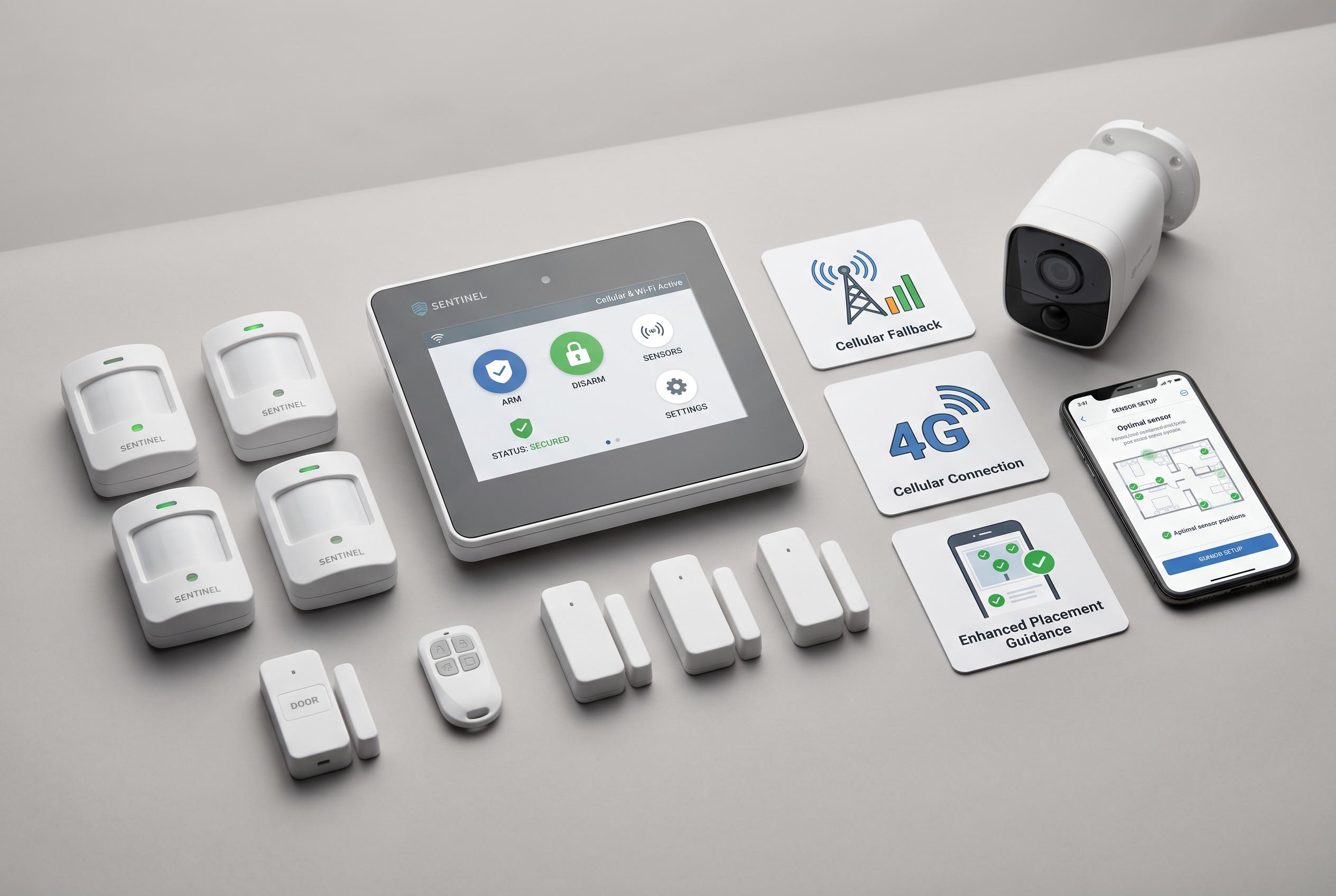

Advances in wireless home alarm technology now enable self-installation with enhanced placement guidance, battery life, and cellular fallback options, shifting responsibility from professionals to homeowners seeking reliable security solutions.
Installing a wireless home alarm is now a largely self-managed task, provided the system is planned carefully. Modern kits are built around a central hub, which acts as the controller for sensors, sirens and communications. According to industry guidance on wireless alarm architecture, the hub typically also handles battery backup and, in newer systems, GSM or 4G failover if the broadband connection fails. That makes placement important: it should be discreet, central enough for good radio coverage, and close to the router if Wi-Fi is part of the setup.
The main devices are usually simple to fit, but correct positioning matters. Door and window contacts should be fitted to the most exposed entry points, while motion detectors need a clear field of view and enough height to read movement properly. Ring says its motion sensor should be mounted about seven feet off the ground, with sensitivity reduced where pets are present, while Ajax notes that its indoor siren can work for up to five years on batteries and supports app-based alerts across iOS and Android. These details matter because poor placement is a common cause of false alarms or weak coverage.
For most homes, installation can be completed without drilling or complex wiring. Somfy’s Home Alarm Advanced uses Wi-Fi, GSM and LTE, with wireless communication on 868 MHz to 870 MHz, radio-interference detection and tamper protection. The system also supports a night mode, allowing some sensors to remain active when people are at home, and includes a panic button for immediate alerts. That combination reflects the broader shift towards alarms designed for self-installation rather than professional fitting.
Battery life and communications should be checked before purchase, not after installation. Ajax says its HomeSiren can operate for up to five years, while Ring lists a base station battery life of up to 24 hours and contact and motion sensors lasting up to three years, depending on use. Ring also notes that its devices in the UK and EEA use 868 MHz Z-Wave. In practice, that means buyers should weigh convenience against resilience: a system that depends only on home broadband is easier to run, but one with cellular fallback offers better protection during outages or deliberate interference.
The choice between self-monitoring and a paid monitoring service remains the key decision. Ajax says its system can send push notifications, SMS messages and calls, and can also be linked to a private monitoring station. Somfy likewise offers a monitoring option, which it says starts at €9.99 a month, although the company presents this as an add-on rather than a requirement. For a flat or average-sized house, a kit such as Somfy’s Home Alarm Essential is aimed at users who want a complete package without committing to a long contract; for larger properties, expandable systems with more sensors and cameras are a better fit.
Disclaimer: This content is intended for informational purposes only. Readers are advised to exercise their own judgement, conduct due diligence, or consult a qualified expert before acting on any information provided.