

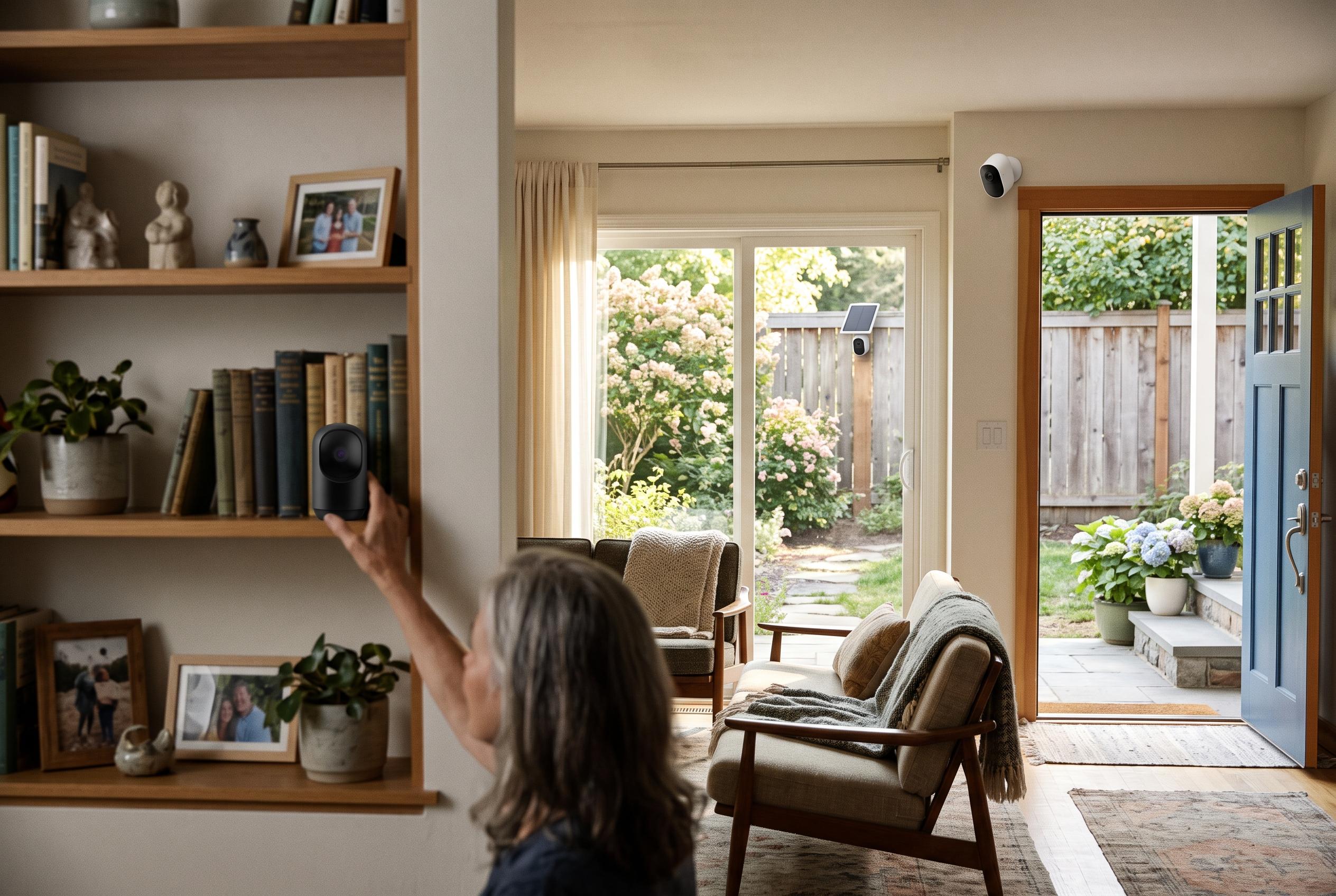

From subscription-free indoor models to solar-powered outdoor kits, the best smart security camera now depends more on placement, power and platform compatibility than brand alone.
Smart home security cameras now divide less by brand than by use case. The strongest systems still balance image quality, mounting flexibility, alert quality and storage terms, but the market is also moving towards clearer specialisation. Some buyers want a compact indoor camera with local recording and no subscription; others want solar power, wider outdoor coverage or a doorbell camera that works as part of a larger bundle. The Arlo Pro 2K HDR Wireless Security Camera remains the most adaptable premium choice in the group, while the Wyze Cam v4 is the most straightforward single-camera option for mixed indoor and outdoor use, and the AOSU D1 Classic 4-Cam Kit is the most convincing solar-powered package for larger outdoor coverage.
That shift matters because not every camera is trying to solve the same problem. TechRadar recently reported on the Eufy E10 Window Camera, which is aimed at indoor use on a window, offers 2.5K resolution, AI detection for people, pets and vehicles, and local microSD storage without a subscription. Its limitation is the same one that applies to many wired cameras: placement depends on where a power cable can realistically reach. That is a useful reminder that the best camera is often the one that can be installed in the right place without compromising coverage, rather than the one with the highest headline resolution. In that sense, compact plug-in cameras such as Blink Mini 2K+ still have a strong case for homes that need clear indoor monitoring without battery upkeep.
Outdoor buying decisions are now being shaped by two competing priorities: convenience and endurance. T3 reported on EZVIZ’s CB30 Dual Kit, a solar-powered camera with a dual-lens design, a 180-degree horizontal field of view, 3K resolution and built-in spotlights for colour night vision and active defence. That mirrors the appeal of products such as the Tapo SolarCam C402 and the AOSU D1 Classic 4-Cam Kit, which reduce charging chores and suit exposed locations where wiring is awkward. By contrast, Blink’s outdoor and doorbell bundles remain better suited to buyers who want a coordinated entry-point system, even if they must accept 2.4GHz-only Wi-Fi, non-rechargeable batteries and, in some cases, a subscription for smart detection and cloud storage.
The wider smart-home ecosystem is also making camera choice more dependent on what platform already runs the house. Tom’s Guide’s smart display round-up underlines how many households now manage cameras through Alexa, Google Home or Apple Home, whether via an Echo Show, a Nest Hub or Apple’s Home app on an iPad. That makes compatibility more than a convenience feature: it affects how quickly live video appears, whether two-way talk is easy to use, and how well a camera fits into routines and voice control. It also helps explain why products such as Arlo, Wyze, Blink and Anona advertise broad assistant support, since camera hardware is increasingly judged by how smoothly it fits into the rest of the home.
Recent discounting has also sharpened the value argument. Tom’s Guide noted heavy Amazon promotions on Blink hardware, including the Mini 2K+ and Blink Outdoor models, which can change the cost equation for buyers who are prepared to live with subscription prompts and narrower feature sets. Even so, the core selection logic has not changed. Buyers should first decide whether they need indoor or outdoor coverage, then choose between plug-in, battery or solar power, and only then compare resolution, storage and app features. A four- or five-camera kit only makes sense if the property actually needs that many viewpoints; otherwise, a smaller camera with better placement and clearer recording terms can be the more practical purchase. On that basis, the strongest recommendations in this group remain the Arlo Pro for premium wireless flexibility, the Wyze Cam v4 for versatile single-camera monitoring, and AOSU for subscription-free solar coverage.
Disclaimer: This content is intended for informational purposes only. Readers are advised to exercise their own judgement, conduct due diligence, or consult a qualified expert before acting on any information provided.



