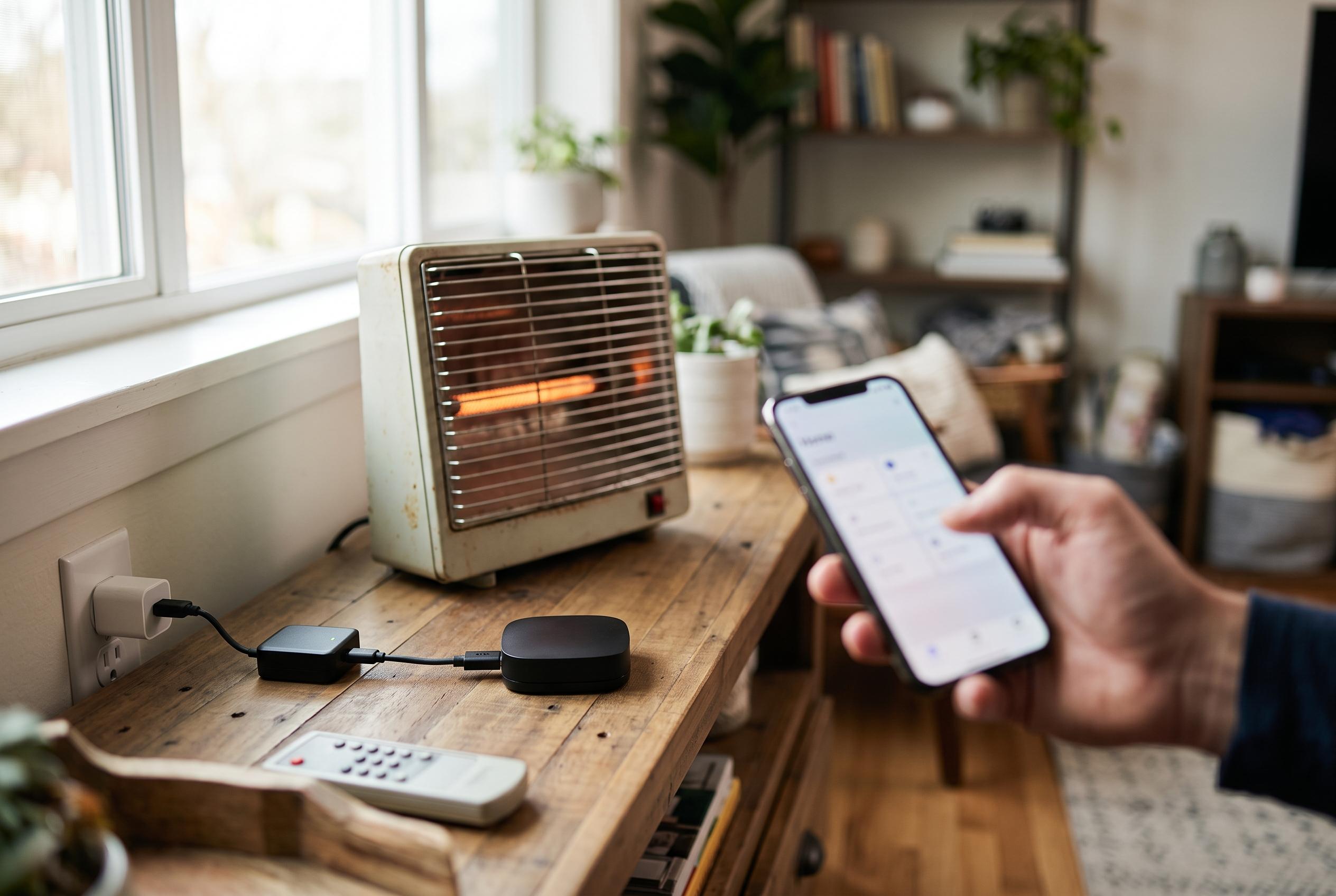

The Tapo H110 offers a practical retrofit solution to bring app control and automation to legacy appliances, enabling smarter home management without hardware replacement.
The Tapo H110 is aimed at a simple problem with a practical answer: it brings app control to older infrared appliances without forcing a replacement. In use, that makes the device less like a flashy smart-home accessory and more like a useful bridge between conventional hardware and modern automation. The review sample was used with a Daikin air conditioner in a child’s bedroom, and that setup showed the clearest benefit: the room can be cooled or warmed before the family returns home, rather than after a tired child has already been carried inside. TP-Link positions the H110 as a smart IR and IoT hub for this kind of everyday control, with support for 18 device types and more than 8,000 brands, refreshed every three months.
Physically, the hub is small enough to sit almost anywhere near a power source, but the box is spare. TP-Link includes the hub itself, a 3M adhesive pad, a USB-C power cable and a quick start guide, while the USB power adaptor must be bought separately. That omission is worth noting because it affects where the unit can be installed. The H110 also relies on infrared, so placement still matters: it needs a reasonably direct line to the appliance it is controlling, just as a conventional remote would. The result is a product that can be unobtrusive in a room, but it is not a whole-house solution for devices hidden behind walls or spread across multiple rooms.
Setup is one of the H110’s stronger points. TP-Link says the hub can be controlled through the Tapo app, by voice through Siri, Alexa or Google Assistant, and through schedules, location-based routines and other automation. It is also Matter-certified, which lets compatible appliances and Tapo sensors participate in broader smart-home ecosystems, though a suitable Matter controller is still required for setup. The company also says the hub can continue operating on the local network even if the internet is down. That local control is useful, but third-party reporting notes an important limitation: learned remote buttons generally remain inside the Tapo app rather than becoming fully portable across other platforms, and some appliance status readings may not always be exact.
In day-to-day use, those constraints are easier to accept because the H110 is doing one job well. It replaces the need to juggle several remotes, and it gives older appliances a place in schedules and automations without changing the hardware itself. That makes it particularly attractive for a device such as an air conditioner, where remote start can save time and improve comfort immediately. There are other possibilities too, from fans to some gate systems, although any automation that could create a safety risk needs careful consideration. At a listed US price that TP-Link has pitched as modest for the category, the H110 is best understood as a practical retrofit rather than an ambitious smart-home centre.
Disclaimer: This content is intended for informational purposes only. Readers are advised to exercise their own judgement, conduct due diligence, or consult a qualified expert before acting on any information provided.