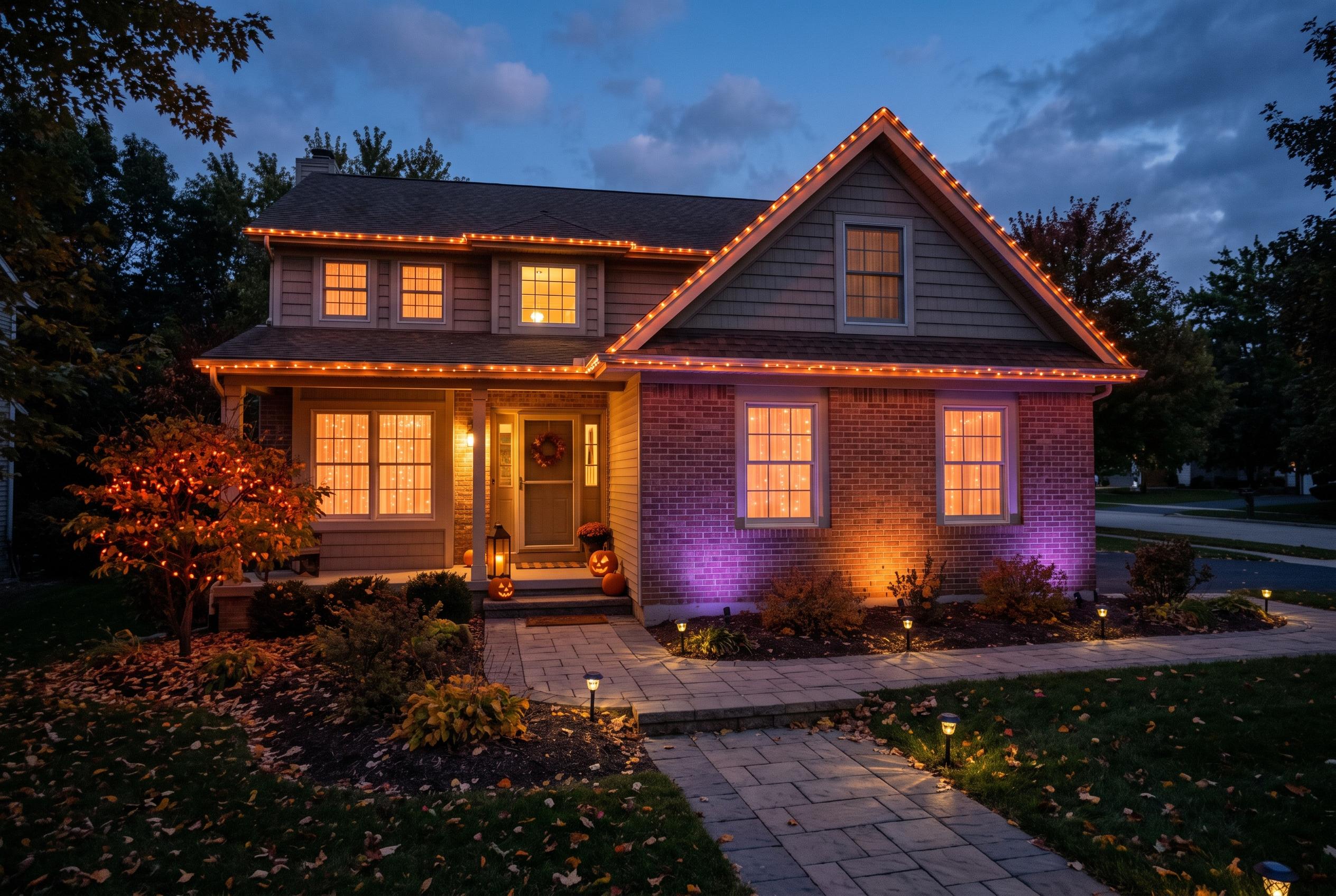

From roofline strings and window curtains to façade-washing floodlights and cord-free solar spotlights, the right Halloween display starts with the surface and power plan , not the LED count.
Halloween smart lights work best when they match the surface you want to dress, not just the number of LEDs on the box. The lead article’s overall message is clear: long strings suit rooflines and fences, curtain lights suit windows and backdrops, floodlights colour broad surfaces, and solar spotlights solve cord-free yard accents. Related round-ups of smart bulbs, window lights, plugs and string lights reinforce the same practical point: the strongest purchase decision is usually format first, effects second, and app control last. For buyers planning a seasonal display in 2027, that means thinking less about novelty and more about whether the lights will sit on a porch rail, a façade, a fence post or a window panel.
The Brizled Smart Halloween String Lights remain the most straightforward seasonal choice because they are built around orange and purple rather than asking the user to dial in a Halloween palette from a full RGB menu. Their 98.4-foot lit run is long enough for rooflines, porches and perimeter work, while app, voice and button controls give them more flexibility than a simple decorative strand. The ODEETRONIC strand follows the same logic, but with a similar length and a stronger emphasis on animated effects such as chasing and twinkling. That makes both products appealing to decorators who want a ready-made look, not a year-round lighting system that has to be reconfigured every October.
For larger or more technical displays, the article’s strongest case is for selecting by installation type rather than by headline brightness. The MELPO Bluetooth floodlights are designed to wash broad exterior surfaces with colour, which makes them a better fit for façades, hedges and similar areas than a string light would be. By contrast, the Brizled outdoor fence lights trade continuous coverage for individually mountable points, giving more control over posts and fixed sections of wall. The related Halloween light guides point in the same direction: when a space needs to be outlined precisely, a string or fence light works better; when the goal is to colour a larger surface, a floodlight or spotlight is the more efficient tool.
Power planning is just as important as colour choice. The lead article’s solar Linkind SL5C spotlight stands out because it avoids the need to run a cord across the garden, which is a major advantage for tombstone props, entry features and trees. Its IP67 rating is stronger than the IP44 protection found on many corded strings, and the adjustable aiming makes it more useful for targeted accents than for tracing long edges. The related smart-plug article also underlines a practical truth often overlooked by shoppers: if the lights are not in the right place or the power connection is not safely arranged, even the best control features become irrelevant.
For buyers who want flexibility rather than a single built-in seasonal look, RGB strings remain the most adaptable option. The OZS two-pack gives two separate 75-foot strands, which is valuable when one display area is on a porch and another sits on a fence or balcony. TW SHINE is the more expandable single-run option because it can connect with additional sets, while Dazzle Bright’s 98-foot RGB string offers a well-defined length with app and remote control in one package. The smarter smart-light guides all reach the same conclusion: length, spacing and whether strands can be joined matter as much as the LED count itself, because a long but awkward layout can be less useful than a shorter run with better control.
That leaves curtain lights and compact panels for decorators who want a dense backdrop rather than a linear border. Dazzle Bright’s curtain-style display and LumBelle’s fixed panel are both better suited to windows, walls and Halloween photo corners than to railings or trees. The related window-light roundup strengthens that distinction, showing that vertical formats are most effective when the target surface is flat and the display is meant to be seen head-on. For most shoppers, the simplest rule is still the best one: choose the format that matches the surface, confirm the power plan, and then decide whether you want a dedicated Halloween palette or a reusable RGB system.
Disclaimer: This content is intended for informational purposes only. Readers are advised to exercise their own judgement, conduct due diligence, or consult a qualified expert before acting on any information provided.