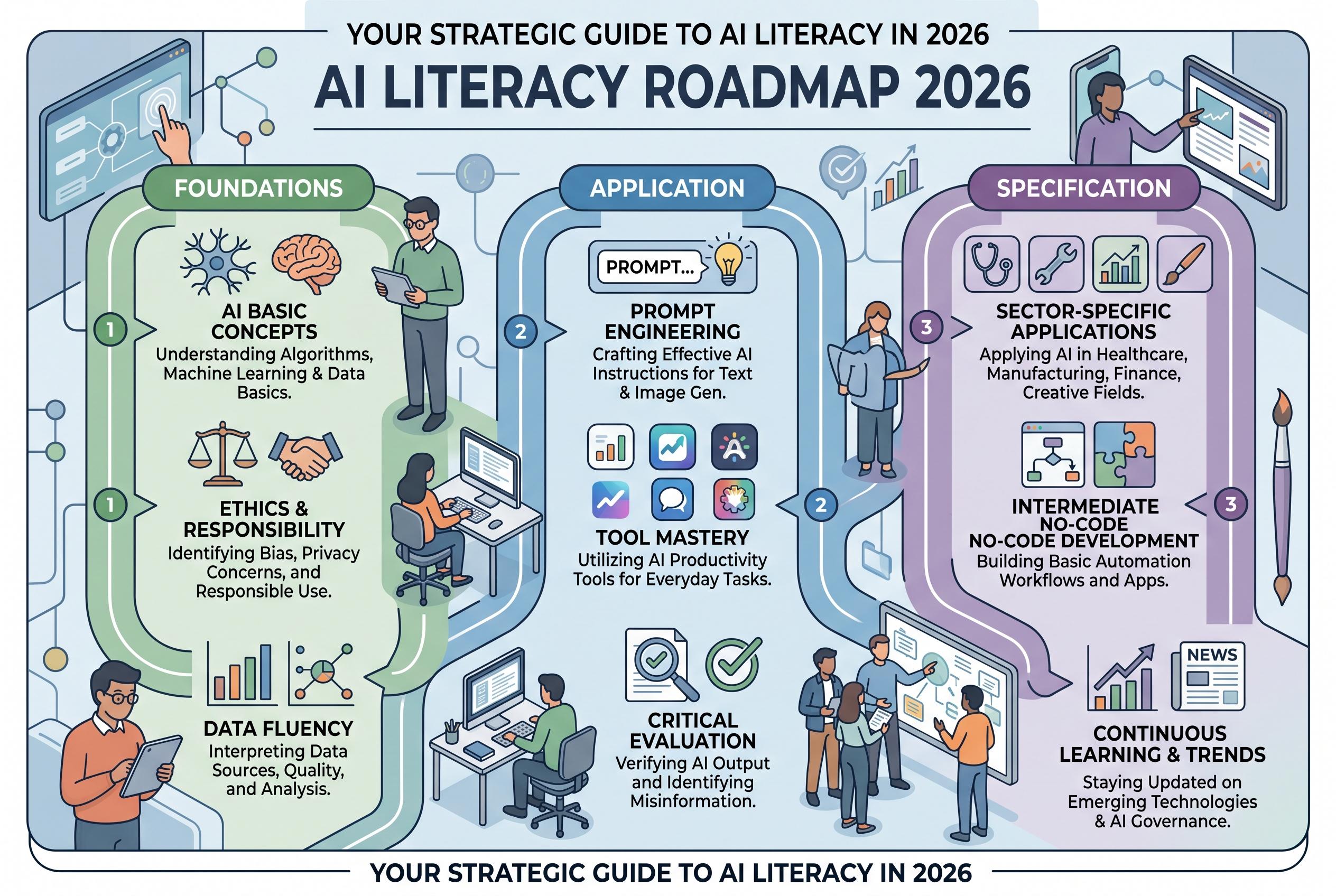

As AI becomes embedded in everyday tools, experts recommend structured learning focused on core concepts to safely and effectively leverage the technology, emphasising practical skills over mere credentials.
Artificial intelligence is no longer a specialist subject confined to laboratories and software firms. It is now embedded in search engines, navigation apps, spam filters, customer service systems and workplace software, which is why beginners often encounter it long before they understand it. A practical way to approach the subject in 2026 is to treat AI as a set of tools and methods rather than a single mysterious technology.
At its simplest, AI refers to systems that perform tasks usually associated with human judgement, such as recognising patterns, generating text or making predictions from data. The distinction between artificial intelligence, machine learning and generative AI matters. Machine learning is the data-driven technique that helps systems improve at tasks without being explicitly programmed for every outcome. Generative AI is the branch that creates new text, images, audio or code from learned patterns. For newcomers, understanding those basic categories is often more useful than memorising technical jargon.
Several beginner guides published this year make the same point: the fastest route into AI is structured learning, not random experimentation. The Blockchain Council recommends a step-by-step roadmap built around Python, data fundamentals, core machine-learning ideas and small projects, with a 6- to 12-month plan to build confidence. Global Tech Council similarly argues that visible skills matter more than credentials alone, especially in a market where employers want proof that a candidate can apply AI in real business settings. That approach reflects a broader shift in hiring, where practical experience, project work and certifications can carry significant weight.
For people starting from scratch, the main risk is not that AI is too advanced, but that the field feels crowded and inconsistent. Beginners can spend weeks moving between tutorials, tools and headlines without learning the underlying concepts. The more effective path is to focus on a narrow foundation: how AI uses data, what machine learning actually does, where generative models fit and how to test outputs critically. As several 2026 guides note, the goal is not to become a research scientist overnight. It is to gain enough technical literacy to use AI tools safely, evaluate them sensibly and build skills that remain useful as the technology continues to move into everyday work.
Disclaimer: This content is intended for informational purposes only. Readers are advised to exercise their own judgement, conduct due diligence, or consult a qualified expert before acting on any information provided.