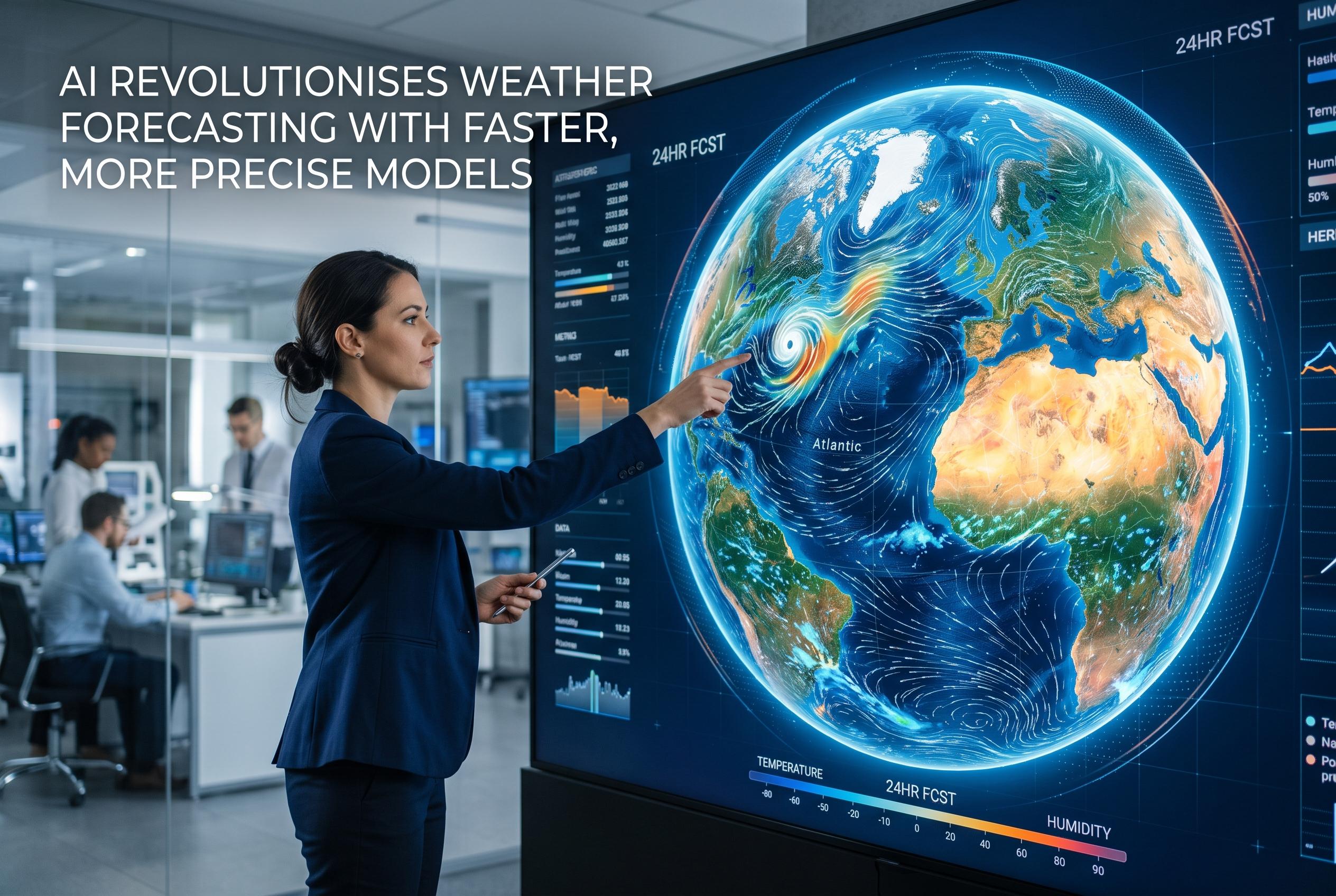

DeepMind’s new generative model dramatically improves weather predictions by producing ensemble forecasts up to 15 days ahead, transforming consumer and emergency response applications while remaining cautious alongside traditional physics-based models.
The weather app on a smartphone may look almost unchanged, but the forecasting engine behind it has been rewritten. The biggest shift in recent years has not come from new satellites. It has come from machine learning systems that are trained on decades of historical weather data and can produce ensemble forecasts, meaning multiple possible outcomes rather than a single prediction.
For many years, conventional forecasting has relied on physics. Supercomputers split the atmosphere into a grid and solve equations for pressure, temperature and moisture repeatedly across that grid. That approach remains powerful, but it is costly and slow, especially when forecasters want several runs to estimate uncertainty. Google DeepMind’s GenCast takes a different route. According to DeepMind, it is a generative model trained on reanalysis data and can forecast up to 15 days ahead at global scale. The company says it outperformed the European Centre for Medium-Range Weather Forecasts ensemble on 97.2% of verification targets and on 99.8% of targets beyond 36 hours, while producing a 15-day forecast in under eight minutes on a single TPU v5 chip.
That progress is already filtering into consumer products. Google says WeatherNext 2 now powers forecasts in Google Search, Gemini and the Pixel Weather app, with the system producing results up to eight times faster than the model it replaced. The same underlying models also feed Google’s Weather API for developers. Apple has taken a quieter route, but its WeatherKit service uses high-resolution models and machine learning to provide hyperlocal forecasts through Swift and REST APIs, along with current conditions, 10-day hourly forecasts, minute-by-minute precipitation for the next hour and severe weather alerts in selected regions. Apple says location data is used only to provide forecasts and is not tied to personal identity.
The result for users is the increasingly specific forecast: not just whether rain is coming, but when it is likely to begin and stop. That kind of precision matters most when severe weather threatens. During the 2025 hurricane season, DeepMind’s cyclone model reportedly outperformed the National Hurricane Center’s official track forecasts from 12 hours to 72 hours ahead, with especially strong results for Hurricane Erin in the first three days. Google has also said the model improves forecasts for extreme conditions, not just routine day-to-day weather.
Even so, forecasters are not treating AI as a replacement for physics-based modelling. Operational teams in 2026 still compare machine learning systems with established deterministic models such as ECMWF HRES and GFS before issuing public forecasts. That caution is important because AI systems learn from the past, which can leave them weaker when a storm behaves in a way the training data never captured. The most accurate reading is that weather forecasting has become a hybrid discipline: AI is now a major voice in the room, but not the only one.
Disclaimer: This content is intended for informational purposes only. Readers are advised to exercise their own judgement, conduct due diligence, or consult a qualified expert before acting on any information provided.