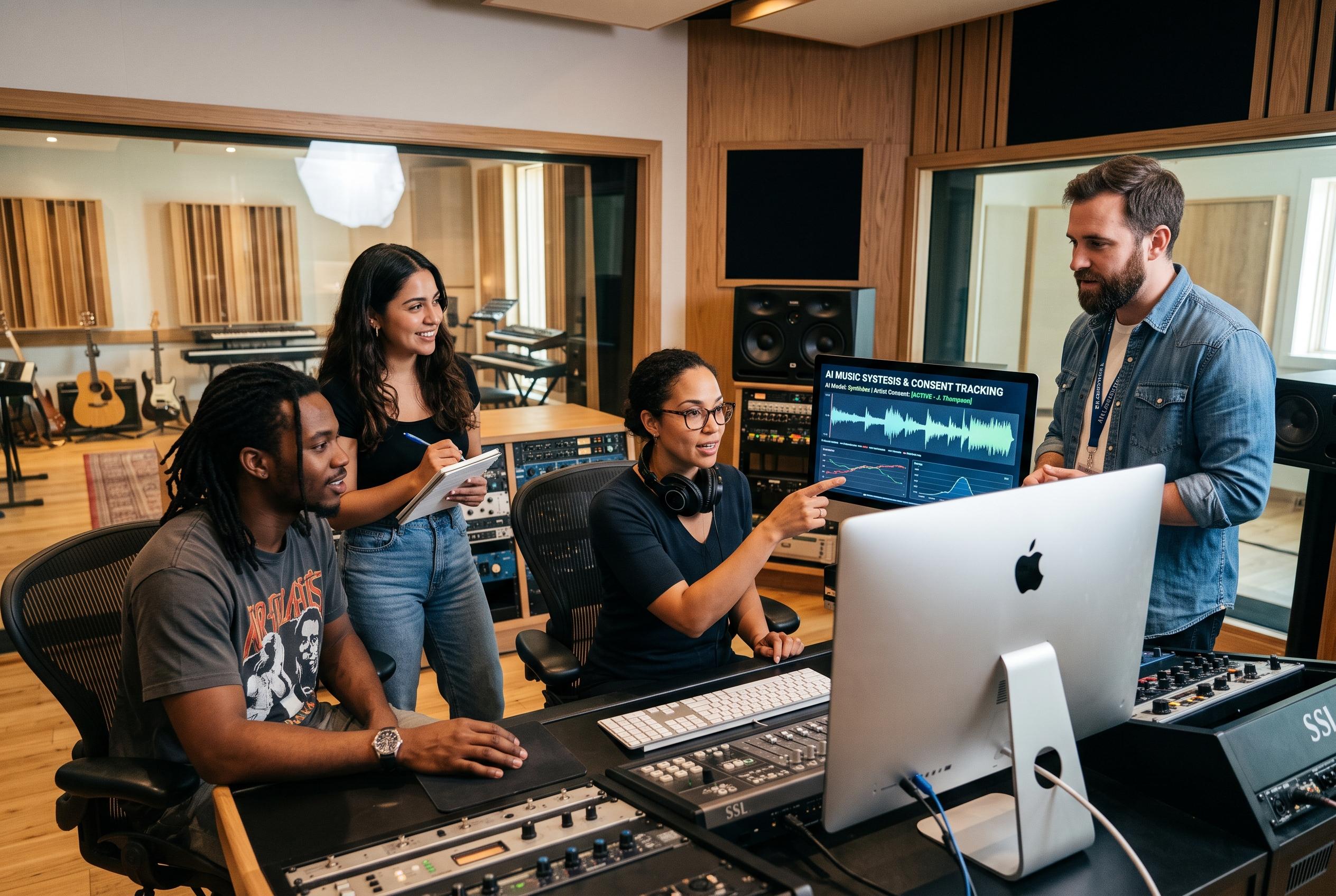

As AI becomes increasingly integrated into music production, artists and industry stakeholders grapple with issues of disclosure, consent, and authentic representation, reshaping how we understand musical creativity in the digital age.
Artificial intelligence is no longer a shadowy afterthought in popular music. It is now part of the public conversation, as artists begin to discuss exactly how they use it, where they draw the line and what listeners are entitled to know. The shift is less about whether machines are present in the studio than about how openly that presence is acknowledged.
Tyga has become one of the clearest examples of that change. In an interview with VIBE, the rapper said AI helped shape his new album, $TARFACE, particularly in building an 1980s-influenced sound. He said the technology was used for elements such as synthesiser parts and guitar solos rather than to write lyrics or replace his own vocals. His view is that AI functions as a production tool, not a substitute for performance. He also compared the current backlash to the early criticism of Auto-Tune, which was once treated as a threat before becoming a routine studio device.
The more difficult question is not simply whether AI was used, but how much of it was hidden. That issue has surrounded Fenix Flexin’s single “Rubberz”, a glossy synth-pop departure from his usual work. XXL Mag and Complex reported that Flexin denied using AI, saying the track was built with auto-tune, reverb and a fake UK accent. Other reports, including commentary from producers who examined the song, suggested the track may have been linked to the generative music platform Treblo, formerly Sonauto, which later released an AI detection tool that flagged the song as likely model-generated. Flexin has since acknowledged some AI involvement while saying he recorded the vocals himself and learned about the AI element later. The dispute underlines a broader point: listeners may tolerate new tools, but they react more sharply when they feel the method was obscured.
Some artists are going further and embracing the technology in plain sight. Luke Steele of Empire of the Sun told iHeartRadio Canada that he uses AI and sees it as a highly capable creative aid, likening it to a very intelligent guitar pedal. Timbaland has moved beyond personal experimentation and into business building, partnering with Suno and launching Stage Zero, a company focused on AI-created artists. Its first project, TaTa Taktumi, was presented as an explicitly AI-generated act. That is a much bigger claim than using software to polish a track: it suggests AI is becoming a platform for constructing entire public identities.
There are, however, examples in which AI has been used in ways that are widely seen as more defensible. The Beatles’ “Now And Then”, released in 2023, relied on machine-assisted audio separation to isolate John Lennon’s voice from an old demo so the surviving members could finish the song. The technology did not invent Lennon’s performance; it recovered what was already there. Randy Travis presents an even clearer case for consent. After his stroke in 2013, AI helped enable “Where That Came From” in 2024, with Travis and his team approving the project and using the technology to rebuild a vocal presence he had lost. Imogen Heap has taken a similar approach with her own voice model, ai.Mogen, arguing that artists may be better protected if they control official versions of their voices rather than leaving them to be copied without permission.
What is emerging is a more precise debate than the crude question of whether music is “AI” or not. The real issues are disclosure, consent, training data, compensation and ownership. An AI tool used to clean up a vocal stem is not the same thing as a system trained on unauthorised recordings to imitate a living artist. Nor is a privately approved voice model equivalent to a fake collaboration uploaded without consent. As Reuters has reported in its coverage of the sector, those distinctions are becoming central as labels, producers and performers try to define what counts as legitimate use.
The industry’s next phase is therefore likely to be shaped less by technical capability than by transparency. Artists such as Tyga, Flexin, Steele, Timbaland, Heap and the estates behind legacy recordings show that AI is already embedded in music-making in very different ways. The remaining question is not whether the technology has arrived. It has. The question is who controls it, who benefits from it and whether audiences are told the truth about what they are hearing.
Disclaimer: This content is intended for informational purposes only. Readers are advised to exercise their own judgement, conduct due diligence, or consult a qualified expert before acting on any information provided.