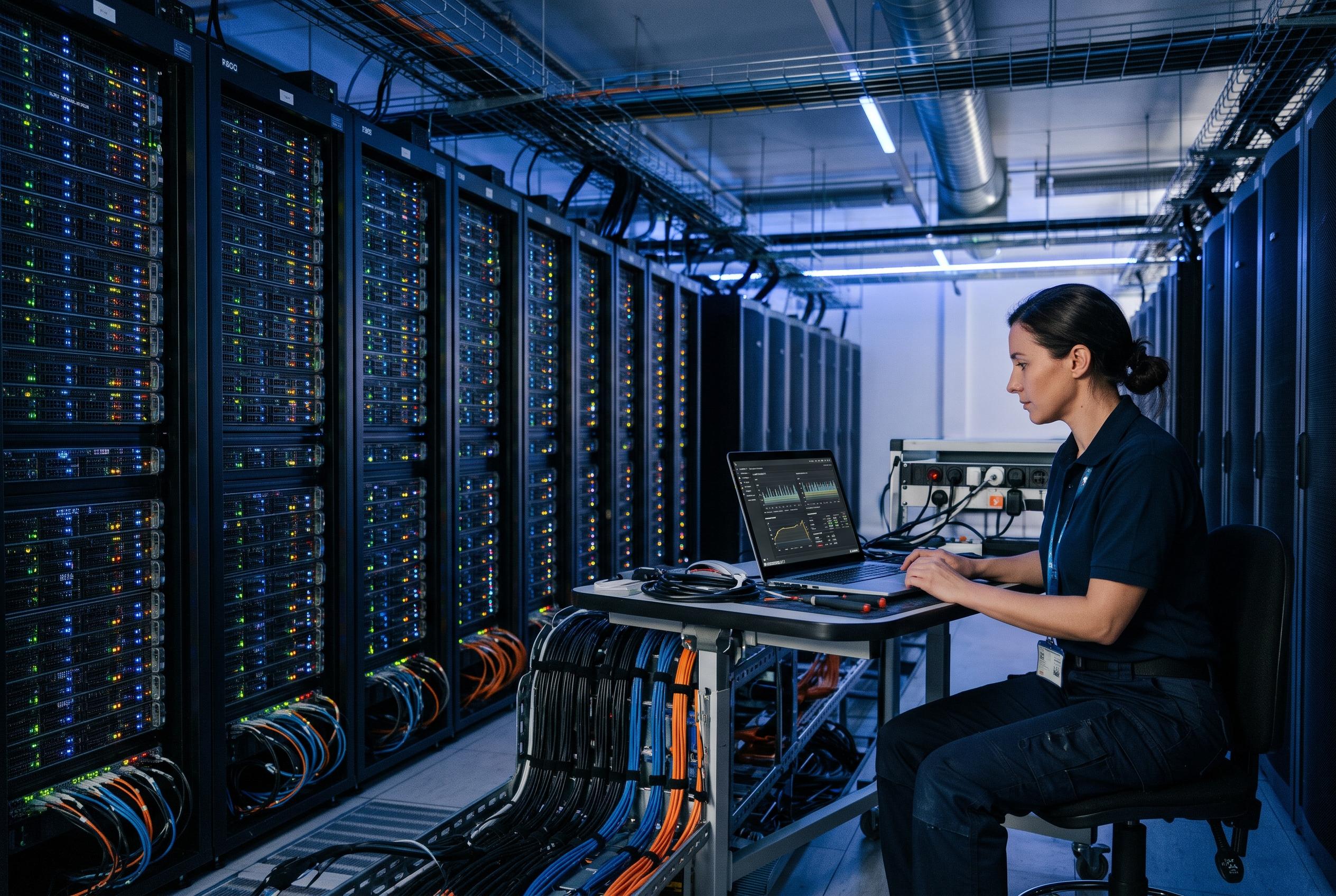

Researchers say electricity demand patterns can reveal AI model training without access to a data centre’s systems, raising new possibilities for regulation and auditing.
Researchers have shown that power-consumption data from a data centre can reveal whether it is training artificial intelligence models, even when the operator does not disclose what is running on its machines. In simulations, the method detected at least 96% of training runs when no deliberate concealment was used, while the false-alarm rate was about 1%, according to Notebookcheck’s summary of the study.
The approach works by looking for characteristic changes in electricity demand rather than inspecting software or relying on a company’s own reporting. That matters because, as the study frames it, AI regulation faces a basic verification problem: how can authorities confirm what a company is computing if they cannot trust its claims? By measuring a physical side effect of computation, the researchers say they can observe training activity without needing access to internal systems.
The team also tested eight ways of hiding the signal. Those countermeasures were described as costly and time-consuming, suggesting that simple obfuscation may not be enough to defeat external monitoring. That makes the technique potentially useful for regulators, grid operators and auditors trying to distinguish ordinary data-centre workloads from large-scale model training.
The work arrives as concern grows over the electricity demand of AI infrastructure. Tagesschau has reported that German researchers are already trying to cut the power draw of AI systems, including a project at the German Research Centre for Artificial Intelligence that reduced consumption by nearly 90% in experiments while maintaining performance. Separate reporting from Tagesschau and LBBW notes that AI is increasing pressure on power grids, driving up cooling needs and changing how energy is distributed inside data centres, particularly because GPU-based workloads are far more intensive than traditional CPU-based processing.
That broader context helps explain why power signatures are attracting attention. If AI training continues to spread, electricity use will become not only an operational cost but also a compliance issue, especially where operators must disclose environmental impacts or grid demand. The study’s significance lies less in a perfect detection tool than in showing that the electrical footprint of AI may be harder to hide than the computation itself.
Disclaimer: This content is intended for informational purposes only. Readers are advised to exercise their own judgement, conduct due diligence, or consult a qualified expert before acting on any information provided.