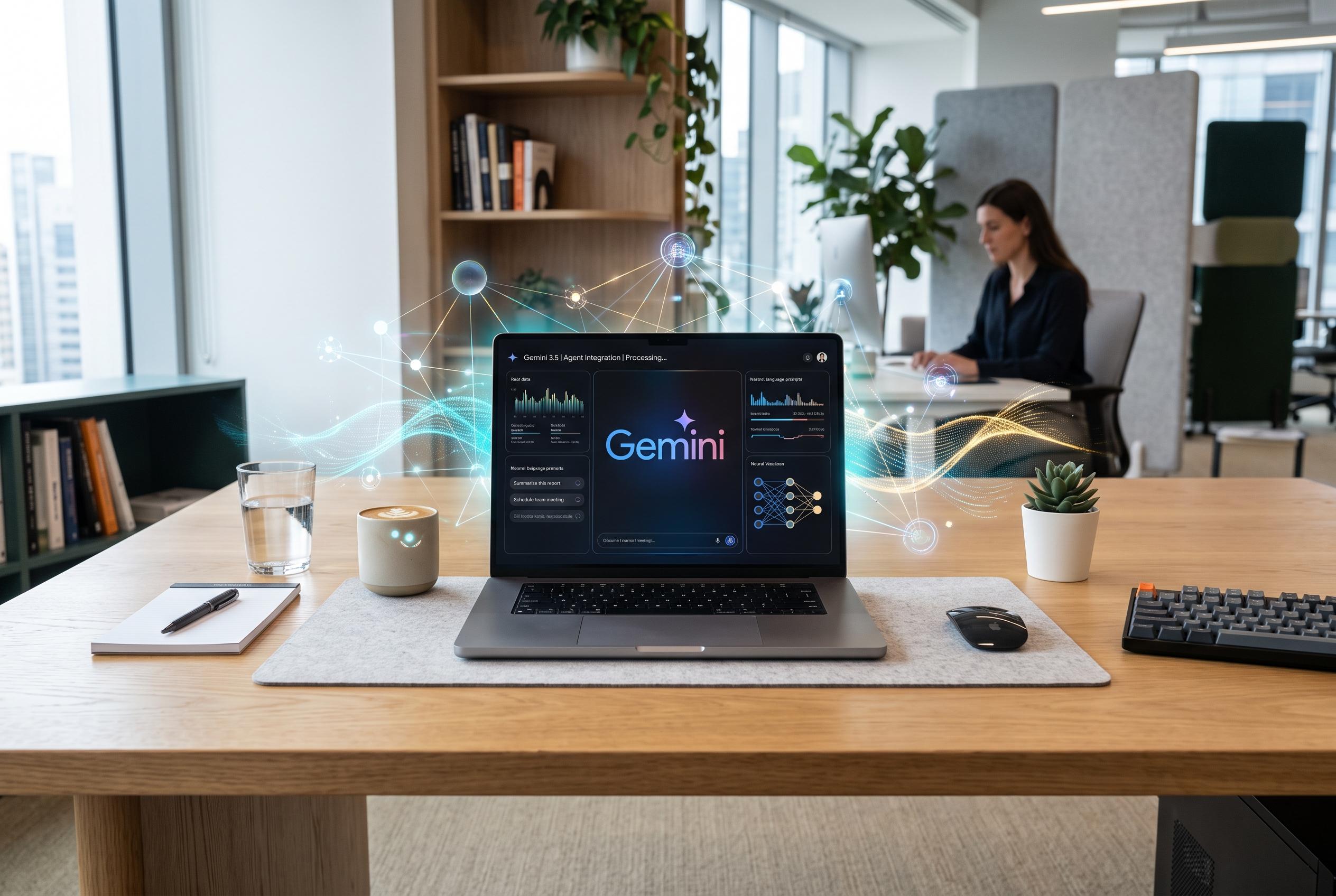

Google’s latest Gemini 3.5 update signals a strategic shift towards multifunctional, agent-driven AI integration across its ecosystem, with new tools like Gemini Flash, Omni, and Spark transforming enterprise and consumer applications.
Google has turned Gemini 3.5 into a wider platform push rather than a routine model update. Announced at Google I/O 2026, the release brings together Gemini 3.5 Flash, Gemini Omni, Spark, Daily Brief and a new Neural Expressive design direction, while also extending the company’s agent framework for developers and enterprise users. The emphasis is less on a single chatbot and more on how Gemini fits into Google’s products, from the consumer app to Workspace and API tooling.
The centrepiece is Gemini 3.5 Flash, which Google presents as its flagship model for fast, capable interactions. Reporting from TechCrunch and Digital Trends suggests the model is aimed at agentic work such as coding, research and other multi-step tasks, with Google positioning it as a system that can do more than answer prompts. TechTimes reported that the model is available across the Gemini API, Google AI Studio, Antigravity, Vertex AI, the Gemini app and AI Mode in Search, underlining how broadly Google wants it embedded.
The rest of the release adds new layers around the model itself. Gemini Omni brings multimodal video output and is beginning to roll out to Google AI Plus, Pro and Ultra subscribers. Spark is described by Google as a 24/7 personal agent that connects with Workspace tools, while a macOS Gemini app with a Spark-enabled desktop experience is planned. Daily Brief adds personalised morning summaries, and Neural Expressive appears intended to reshape how users navigate Gemini’s interface and understand its capabilities.
For businesses, the practical effect is that Gemini is becoming less of a single destination and more of an operating layer across Google’s software. That matters for companies already tied to Workspace, where Spark may be the most immediate change, and for developers who will have to track how Antigravity 2.0 and Managed Agents alter agent workflows. The rollout also appears uneven by design, with some features limited to certain subscription tiers and others still in staged release, so organisations will need to distinguish what is live from what is only planned.
The broader direction is clear: Google is betting that the next phase of AI adoption will be shaped by agents, multimodal creation and connected tools rather than plain text chat. That shift could make Gemini more useful in day-to-day work, but it also raises the usual enterprise questions about control, governance and feature availability. In that sense, Gemini 3.5 is not just a new version number. It is a sign that Google wants AI to sit deeper inside its product stack and become harder to separate from the rest of its ecosystem.
Disclaimer: This content is intended for informational purposes only. Readers are advised to exercise their own judgement, conduct due diligence, or consult a qualified expert before acting on any information provided.