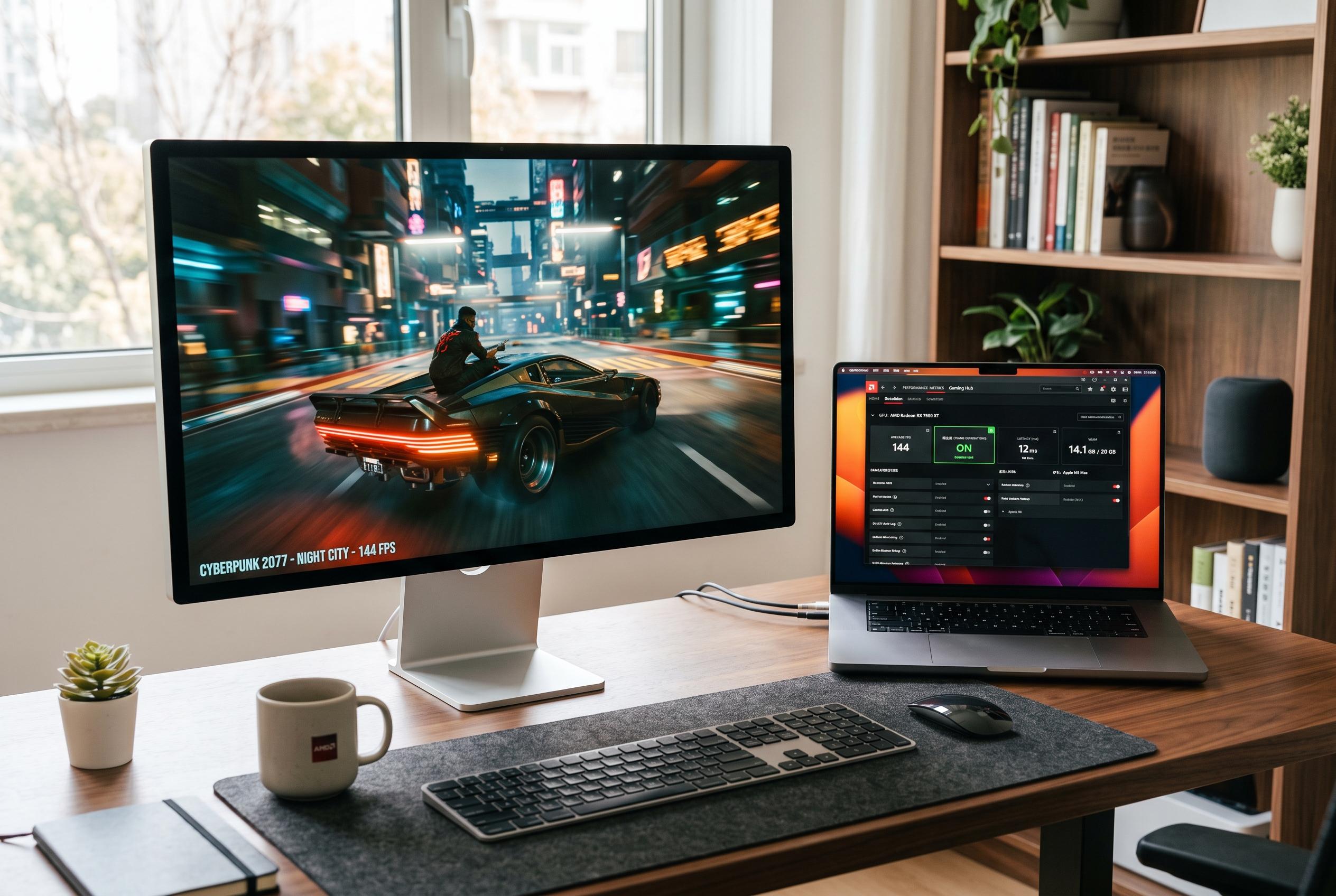

A solo developer has launched Adrenaline, a free Mac application aiming to introduce AMD’s frame generation features to Apple computers , highlighting both potential and current limitations of gaming on macOS.
An independent developer has released a Mac application called Adrenaline that tries to bring frame generation to Apple computers, highlighting both the appeal and the limits of gaming on macOS. According to the developer’s own description shared on Reddit and reported by Jagatplay, the free app is intended to improve frame rates in games that do not natively support the feature on Mac hardware.
The idea is technically interesting because AMD designed its FidelityFX Super Resolution line to be relatively open and widely compatible. TechRadar notes that FSR first arrived in 2021 as an upscaling system, with later versions adding more advanced rendering tools, including frame generation in FSR 3 and machine learning features in FSR 4. More recently, AMD has been reworking the branding so that “FSR” now covers a broader set of graphics technologies rather than only upscaling.
But the Mac experiment is not a direct equivalent of AMD’s newest Windows-side features. Jagatplay says Adrenaline relies on FSR 1, which is an older spatial upscaling method rather than modern frame generation, while Tom’s Hardware and ComputerBase report that AMD’s own current work is moving towards AI-assisted frame generation, ray regeneration and related rendering tools. Those newer systems are built to handle motion and image reconstruction more cleanly than older approaches.
That matters because frame generation is only as good as the motion data it receives. If the base game already runs poorly or shows unstable frame pacing, the added frames can produce artefacts, ghosting or motion that looks unnatural. ComputerBase’s analysis of AMD’s Redstone implementation found that even official frame generation can still struggle with consistent frame delivery, which underlines how difficult it is for a third-party Mac tool to match native implementations.
The wider context is that Apple’s hardware is increasingly capable, but its gaming ecosystem still lacks the same depth of support seen on Windows, where technologies such as DLSS and FSR are more broadly integrated. AMD is continuing to expand its own graphics stack, with reports of experimental multi-frame-generation settings and references to future AI-driven rendering features, but those advances are still being developed for AMD’s platform rather than for macOS. For now, Adrenaline looks more like a proof of concept than a finished solution, but it does show that community developers are trying to close one of the Mac’s most persistent gaming gaps.
Disclaimer: This content is intended for informational purposes only. Readers are advised to exercise their own judgement, conduct due diligence, or consult a qualified expert before acting on any information provided.