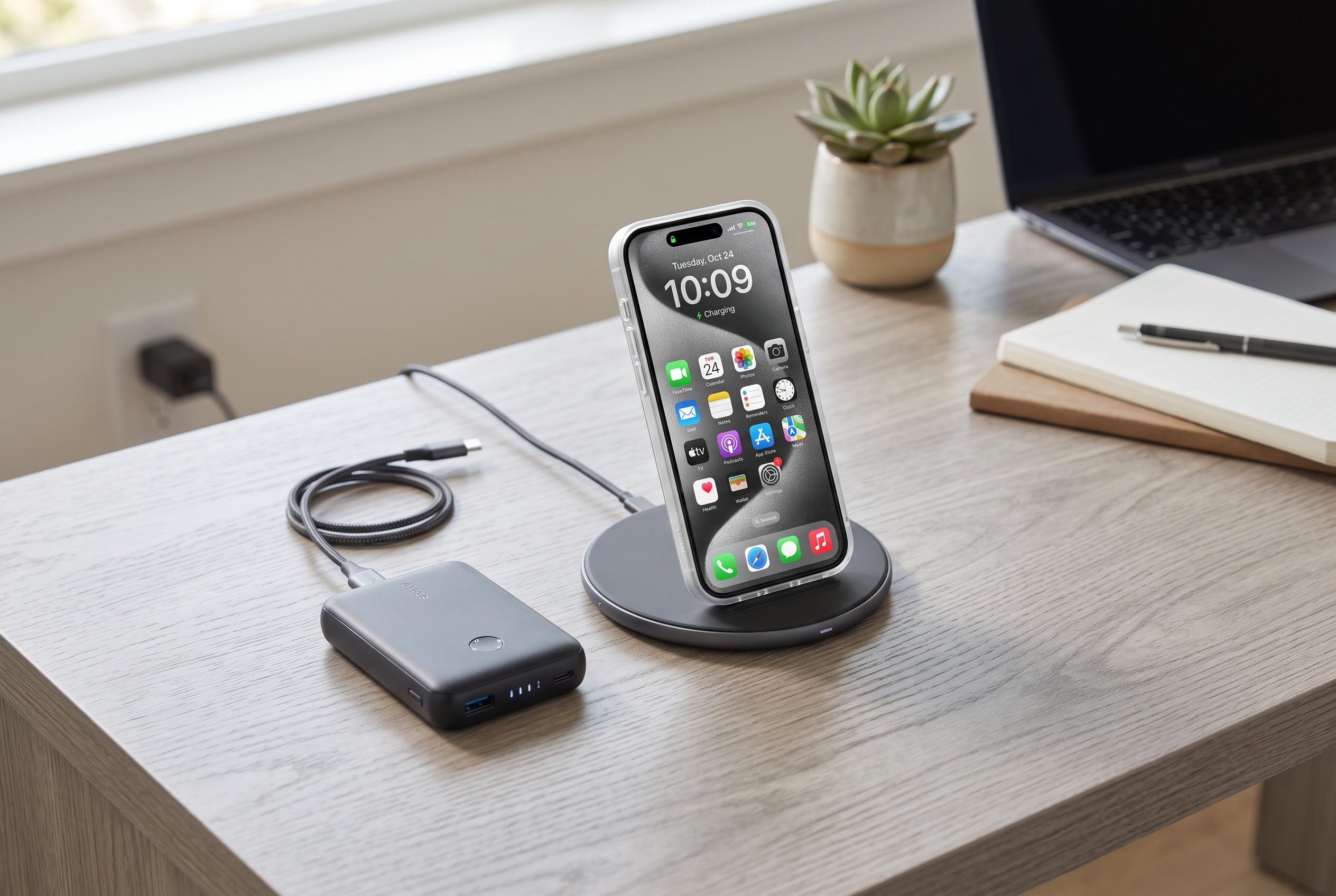

For iPhone owners, the synergy of portable power banks and stationary wireless charging pads creates a flexible, efficient charging system tailored to diverse daily needs, from travel to routine use.
Portable charging gear has become a practical part of iPhone ownership, especially for people who move between home, work and travel. Power banks and wireless charging pads solve different problems, but together they cover most day-to-day charging needs. One is built for mobility, the other for routine use in a fixed place.
A power bank stores energy for later use, which makes it useful when a wall socket is not nearby. Capacity is the first detail to assess. Smaller models are easier to carry in a pocket or bag, but they hold less charge. Larger units can recharge a phone several times, though they are heavier and less convenient to transport. For occasional emergencies, a compact model may be enough. Frequent travellers often need a higher-capacity battery.
Ports matter as much as size. Some power banks offer only one output, while others support several devices at once. USB-C is now especially important because Apple’s newer iPhones support faster charging through USB-C Power Delivery, making a compatible wired power bank more efficient than older alternatives, according to guidance from power bank and accessory reviewers. Users should also keep the battery topped up before leaving home, since a flat power bank is no help on the move.
Wireless charging pads serve a different purpose. They are designed for desks, bedside tables and other fixed locations. The phone simply rests on the pad and charging begins through aligned coils that transfer energy by electromagnetic induction. The main benefit is convenience: there is no cable to connect each night and the phone is ready by morning. For many users, that can make charging more consistent.
Case choice can affect wireless charging performance. Most cases designed for it will work, but thick cases, metal parts and some accessories can interrupt the connection. If charging is unreliable, removing the case is a simple test. Safety and battery care also matter. TechRadar has noted that wireless charging generally produces more heat than wired charging, so certified chargers and proper alignment remain important.
For most iPhone users, the most practical approach is not to choose one method over the other. A power bank covers travel, commuting and power cuts. A wireless charging pad handles daily charging at a desk or bedside. Used together, they create a flexible system that is simple, portable and better matched to real-world use than any single charger on its own.
Disclaimer: This content is intended for informational purposes only. Readers are advised to exercise their own judgement, conduct due diligence, or consult a qualified expert before acting on any information provided.