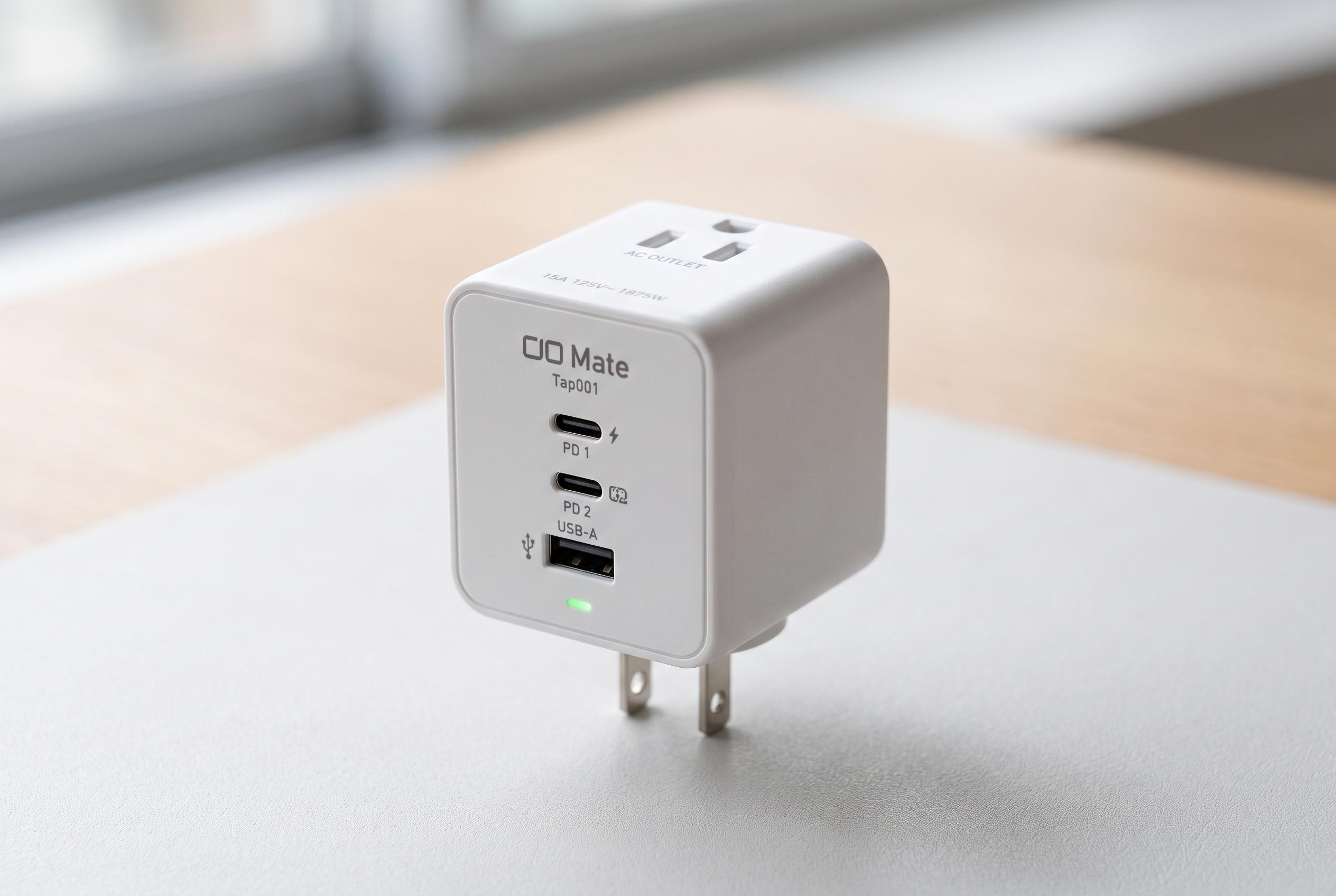

A Japanese reviewer applauds the CIO Mate Tap001, a compact cube with built-in AC sockets and USB ports, as a practical, multi-device travel companion that balances power and portability.
A Japanese reviewer has described an impulse purchase that is unusual even in a market crowded with portable chargers: a wall adapter with built-in AC sockets. In ASCII.jp, the writer said the CIO Mate Tap001 stood out because it combines three AC outlets with two USB Type-C ports and one USB Type-A port in a compact cube measuring about 50 x 50 x 44.1 mm. The appeal, the review argued, is not raw power but practicality for travel, where a single adapter can keep a hotel or office wall socket from being tied up by several separate chargers.
The Tap001 is positioned as a modest but flexible option rather than a high-output charging brick. ASCII.jp said the USB-C ports top out at 20W, while USB-A reaches 18W and the combined USB output drops to 15W when more than one port is used. A separate article summarising the same review noted that the adapter also supports PD 3.0, QC 3.0 and PPS, with an AC load limit of 1,500W on AC alone and 1,300W when USB power is in use. The reviewer’s practical point was that this level of output is often enough for smartphones, watches and other small devices, even if it would look modest beside larger GaN chargers now common in the market.
That argument is backed up by the charging test the writer described with a Galaxy Z Fold7. According to ASCII.jp, the phone took 1 hour and 9 minutes to reach full charge from 29% with the Tap001, compared with 1 hour and 2 minutes from 33% using a 65W charger. The difference was small enough to suggest that higher wattage does not always translate into a dramatically shorter wait. Research published by Maplee Tech also shows why: the Galaxy Z Fold7 does not continually draw maximum power, with charging input falling as the battery fills and thermal limits take effect. In other words, once a phone is past the earliest phase of charging, the gap between a 20W adapter and a much stronger one can narrow sharply.
The review also makes the case for the Tap001 as a multi-device travel companion rather than a single-purpose fast charger. ASCII.jp said the author used it to charge two smartphones and a Rokid smart AI glasses battery at the same time, which mirrors the kind of hotel-room or office setup many users face. The article further noted that the Tap001 weighs about 84g, against 126g for an older 65W Anker charger, making the CIO Mate unit easier to carry when a laptop is not part of the trip. That trade-off reflects a broader pattern in current charger design: third-party product listings and charger round-ups on sites such as Nekmit, Walmart and TechYorker continue to emphasise compact 20W to 45W USB-C adapters for phones and small devices, while heavier high-wattage models remain better suited to notebooks and power users.
Disclaimer: This content is intended for informational purposes only. Readers are advised to exercise their own judgement, conduct due diligence, or consult a qualified expert before acting on any information provided.