

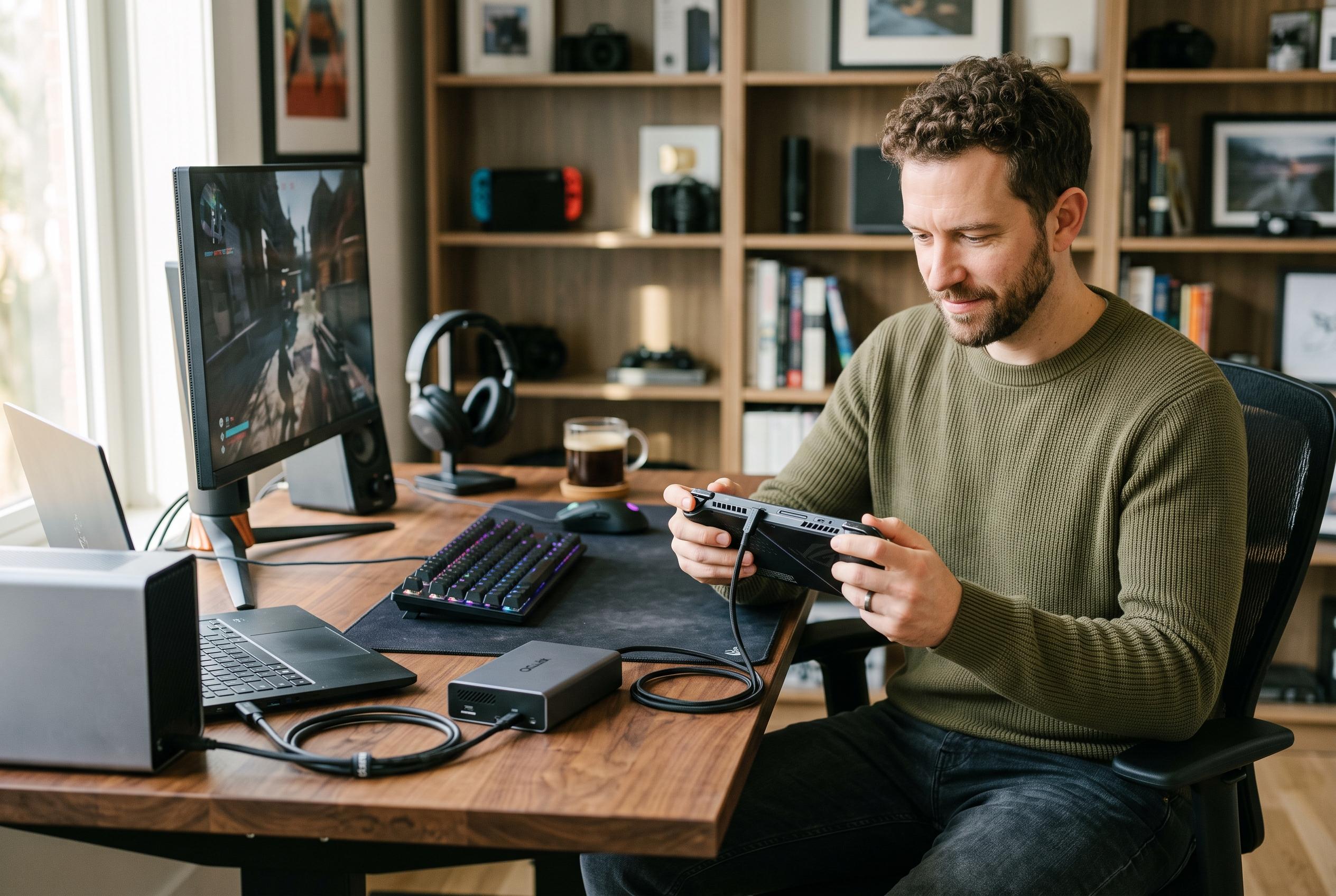

External graphics docks are turning handheld gaming PCs into credible desktop replacements, but benchmark results show that buyers must choose between OCuLink’s higher performance and Thunderbolt’s easier setup.
Handheld gaming PCs have made portable play far more capable, but their internal graphics hardware still limits what they can do at higher resolutions and in demanding titles. That is where an external GPU enclosure can make a meaningful difference. By offloading graphics work to a desktop-class card, these docks can turn a compact device into something much closer to a fixed gaming system, while preserving the option to disconnect and travel.
The market now splits into several clear categories. Thunderbolt 4 and USB4 enclosures remain the simplest to use because they rely on familiar USB-C ports and generally offer broader compatibility across handhelds, laptops and mini PCs. OCuLink docks appeal to performance-focused buyers because they connect more directly to PCIe lanes and avoid the tunnelling overhead of Thunderbolt. There are also all-in-one units with a built-in mobile Radeon GPU, which reduce setup complexity for users who do not want to source a graphics card and power supply separately.
Among the most prominent updates is Razer’s return to the market with the Core X V2. According to Tom’s Hardware, the enclosure supports full-size PCIe Gen 4 cards, including quad-slot models, and uses Thunderbolt 5, but it no longer includes a built-in power supply or legacy I/O such as USB ports and Ethernet. That stripped-down approach makes the enclosure more modular, but it also pushes the total system cost higher once an ATX power supply, a separate dock and a graphics card are added. The same reporting noted that the company is pairing it with a separate Thunderbolt 5 dock for expansion.
Performance comparisons continue to favour OCuLink where raw speed matters most. Tom’s Hardware reported on benchmark testing that showed OCuLink outperforming Thunderbolt 5 in gaming workloads, with the latter trailing by around 13% to 14% on average in one set of tests. The reason is straightforward: OCuLink offers a more direct PCIe connection, while Thunderbolt 5 still carries protocol overhead despite its improved bandwidth and convenience. For handheld owners, that trade-off matters. If the aim is the highest possible frame rates, OCuLink remains the stronger interface, provided the device supports it.
That said, convenience still has value. Complete Thunderbolt and USB4 kits remain attractive because they arrive with a power supply, cables and a case, reducing the amount of matching and compatibility work required. For many users, that matters more than theoretical top-end speed. These systems are also easier to recommend for mixed-use setups, particularly when the same dock may move between a handheld, a laptop and a mini PC.
All-in-one eGPU units sit in a different category altogether. NIMO’s RX 7600M XT-based docks combine graphics hardware, power delivery and a compact chassis in one package. That makes them easier to deploy than a traditional empty enclosure, especially for buyers who want a ready-made upgrade rather than a building project. The trade-off is obvious: the graphics chip is fixed, so there is no upgrade path in the same way there is with an empty shell that accepts a desktop card.
Open-frame OCuLink docks are the most flexible option for enthusiasts. They support large desktop GPUs, standard ATX or SFX power supplies and, in some cases, very high-end cards. But they are also the least forgiving. OCuLink generally does not support hot-plugging, so the device must be powered down before disconnecting, and buyers need to check both the physical dimensions of the card and the compatibility of the handheld itself. In practice, these docks are best for users who are comfortable assembling a semi-custom system and who prioritise bandwidth over convenience.
The wider direction of travel is clear. External graphics for handhelds are no longer niche accessories; they are becoming a practical upgrade path for players who want a single portable device that can still drive demanding PC games on a desk. According to reporting from Tom’s Hardware and related benchmark coverage, the key choice is no longer whether eGPUs work, but which connection standard and product style best matches the way the device will be used. For most buyers, that comes down to a simple question: whether they want the easiest setup, the fastest connection, or the most future-proof hardware.
Disclaimer: This content is intended for informational purposes only. Readers are advised to exercise their own judgement, conduct due diligence, or consult a qualified expert before acting on any information provided.



