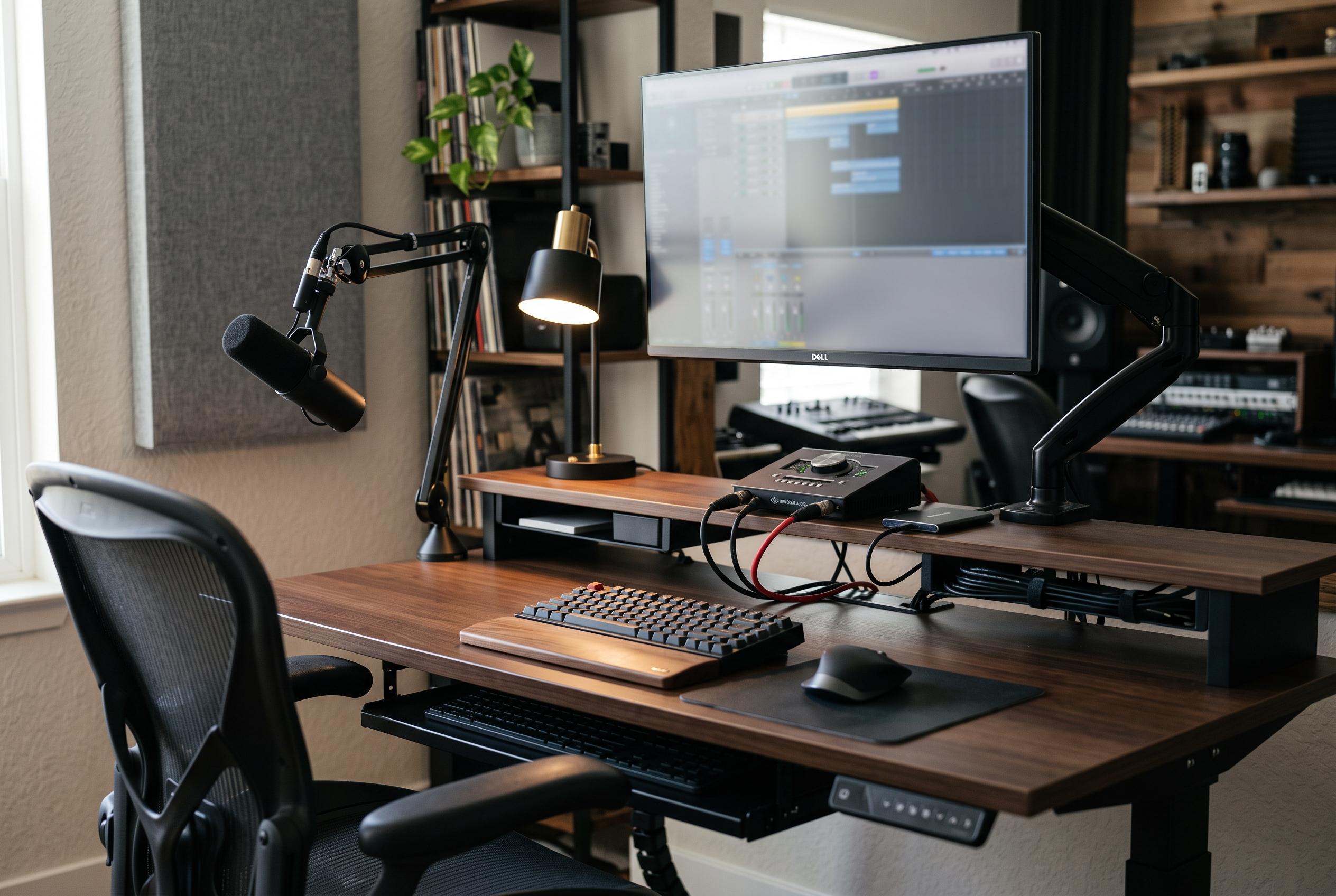

With a range of options from budget to professional models, studio desks in 2026 focus on enhancing workflow, comfort, and efficiency, tailored to the varied needs of producers and home studios.
A music production desk is more than a piece of furniture. It is a workspace built around the physical demands of recording, mixing and writing music. MusicRadar’s guide to studio desks notes that the best models do three things well: keep monitors in the right listening position, give MIDI controllers a proper surface or shelf, and provide space for analogue gear that would otherwise crowd a standard desk. In practice, that means a desk can improve both comfort and speed by keeping the tools producers use most often within easy reach.
For most home studios in 2026, the strongest all-round option remains the Output Platform. Its birch-wood build, 9U of rack space, full-size keyboard tray and monitor bridge suit producers who need a serious but compact command centre. That combination matters because it reduces the stop-start rhythm that comes from reaching across the room for interfaces, preamps or controllers. In a small studio, that kind of efficiency can make the difference between a setup that merely holds gear and one that supports sustained work.
Budget buyers are not short of workable choices. The On-Stage WS7500 offers a practical route into proper studio furniture, giving producers the basics without forcing a large upfront spend. At the other end of the market, larger desks such as the Argosy Dual 15 and Gustav Sessiondesk are aimed at users with substantial hardware collections. MusicRadar’s coverage points to exactly this split in the market: some desks are designed to simplify lean laptop-based setups, while others are built to carry serious rack-mounted inventories without turning the room into a tangle of stands and cables.
That distinction is important because a production desk should match the way a studio is actually used. A producer working mainly in the box may need little more than a flat surface, sensible cable routing and a decent speaker position. Someone using synthesiser racks, compressors and patch bays needs depth, weight and clear access to hardware. The right choice is therefore less about appearance than about workflow: how far your hands need to travel, where your monitors sit, and whether the desk supports long sessions without forcing poor posture.
Even simple desks can work if they are adapted carefully. A minimal table, paired with separate monitor stands and a well-planned keyboard layout, can be enough for smaller setups. Likewise, standing desks appeal to producers who want more flexibility during long sessions. MusicRadar’s desk guide treats these options as part of the same decision process: the best furniture is the one that fits the room, the gear and the producer’s habits, rather than the one that looks most like a showroom installation.
The practical lesson is straightforward. Measure the room, list the gear, and decide how much of the workflow depends on hardware that needs a fixed place. A production desk is not mandatory for making music, but it can remove friction at the point where ideas are turned into tracks. For producers comparing options in 2026, that makes the choice less about decoration and more about how efficiently the workspace can support the work itself.
Disclaimer: This content is intended for informational purposes only. Readers are advised to exercise their own judgement, conduct due diligence, or consult a qualified expert before acting on any information provided.