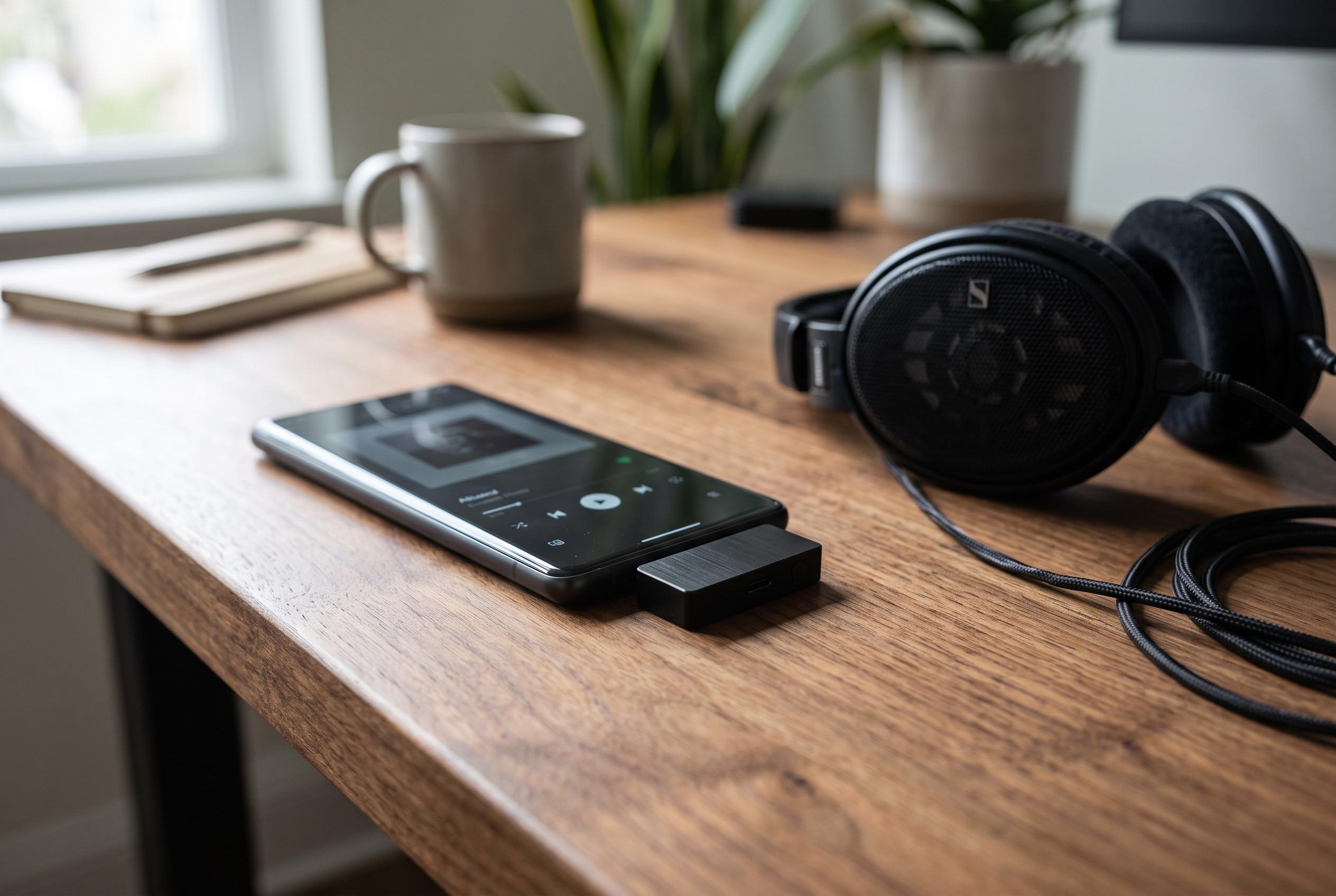

Compact USB-C DACs are offering smartphone users a cleaner alternative to dangling dongles, reviving interest in wired listening after the headphone jack’s disappearance.
A familiar annoyance has returned to the centre of smartphone audio: the gap between convenience and wired sound. Brady Snyder, writing for MakeUseOf and discussed by WebProNews, found that the usual USB-C dongle solution still left cables hanging from the handset and catching on pockets, bags and hands. His answer was a compact digital-to-analogue converter, or DAC, that plugs directly into the phone and sits almost flush with the body.
That approach matters because the problem is not only aesthetic. Since Apple removed the 3.5mm jack from the iPhone 7, the industry has steadily pushed users towards wireless earbuds or USB-C adapters. Manufacturers have pointed to slimmer designs, better water resistance and the commercial appeal of wireless accessories. Yet the persistence of workarounds shows that many listeners still want a wired connection without the mess that usually comes with it.
Snyder’s first test, the FiiO KA11, showed why this category has gained attention. Android Central says the device offers strong output for its size, with enough power to drive most in-ear monitors, but its attached cable remains a practical drawback. That short lead may be less intrusive than a full dongle, yet it still creates the same basic problem: the audio solution hangs away from the phone rather than disappearing into it.
He ultimately preferred the Kiwi Ears Allegro Mini. According to Linsoul, the DAC supports playback up to 32-bit/384kHz and DSD128, and includes both 3.5mm and 4.4mm balanced outputs. Review-rating.com says users have praised the model for its clarity, build quality and value, while noting that its neutral tuning may not suit every genre. For Snyder, the decisive feature was its shape: the unit plugs directly into the USB-C port and leaves only a minimal protrusion, which helps it work with a phone case.
That small detail makes the device far more usable in day-to-day life. Snyder reportedly paired the Allegro Mini with Samsung’s Carbon Magnet Case on a Galaxy Z Fold 8 and found the fit clean enough for regular use. In practical terms, the appeal is obvious. The DAC stays attached during normal handling, avoids the snagging effect of a hanging cable and still offers the kind of wired audio quality that many listeners prefer over Bluetooth compression.
The broader market response suggests the headphone jack debate has never really ended. Recent hardware experiments show how determined users have become. One How-To Geek project described by WebProNews involved a custom case that preserved a headphone socket while leaving USB-C free for charging, proving that some users are willing to build their own answer if manufacturers will not provide one. Others have taken the opposite route and converted old wired headphones into USB-C devices with low-cost soldering kits.
Audio enthusiasts continue to argue that wired listening has clear technical advantages. It avoids Bluetooth codec limits, removes the need to charge headphones separately and can support higher-resolution playback when paired with the right DAC. That point has become more relevant as music services and phones increasingly support lossless or high-resolution audio, but the experience still depends heavily on the quality of the adapter and the software path used by the device.
This is why the market for compact external DACs remains active. Models from FiiO, Kiwi Ears and others now target users who want serious audio performance without the inconvenience of a traditional dongle. Some offer extra power for more demanding headphones, while others add balanced outputs or sturdier enclosures. The common aim is straightforward: preserve the benefits of wired audio while making it less awkward to live with.
For now, that appears to be the compromise the industry has settled on. Major phone makers show little sign of restoring the analogue jack to their flagship lines, and wireless audio remains the default for mass-market buyers. But Snyder’s experience suggests the jack’s disappearance was never fully accepted. With a well-designed flush-fitting DAC, many users can recover the simplicity of wired listening without the clutter that made dongles unpopular in the first place.
Disclaimer: This content is intended for informational purposes only. Readers are advised to exercise their own judgement, conduct due diligence, or consult a qualified expert before acting on any information provided.