

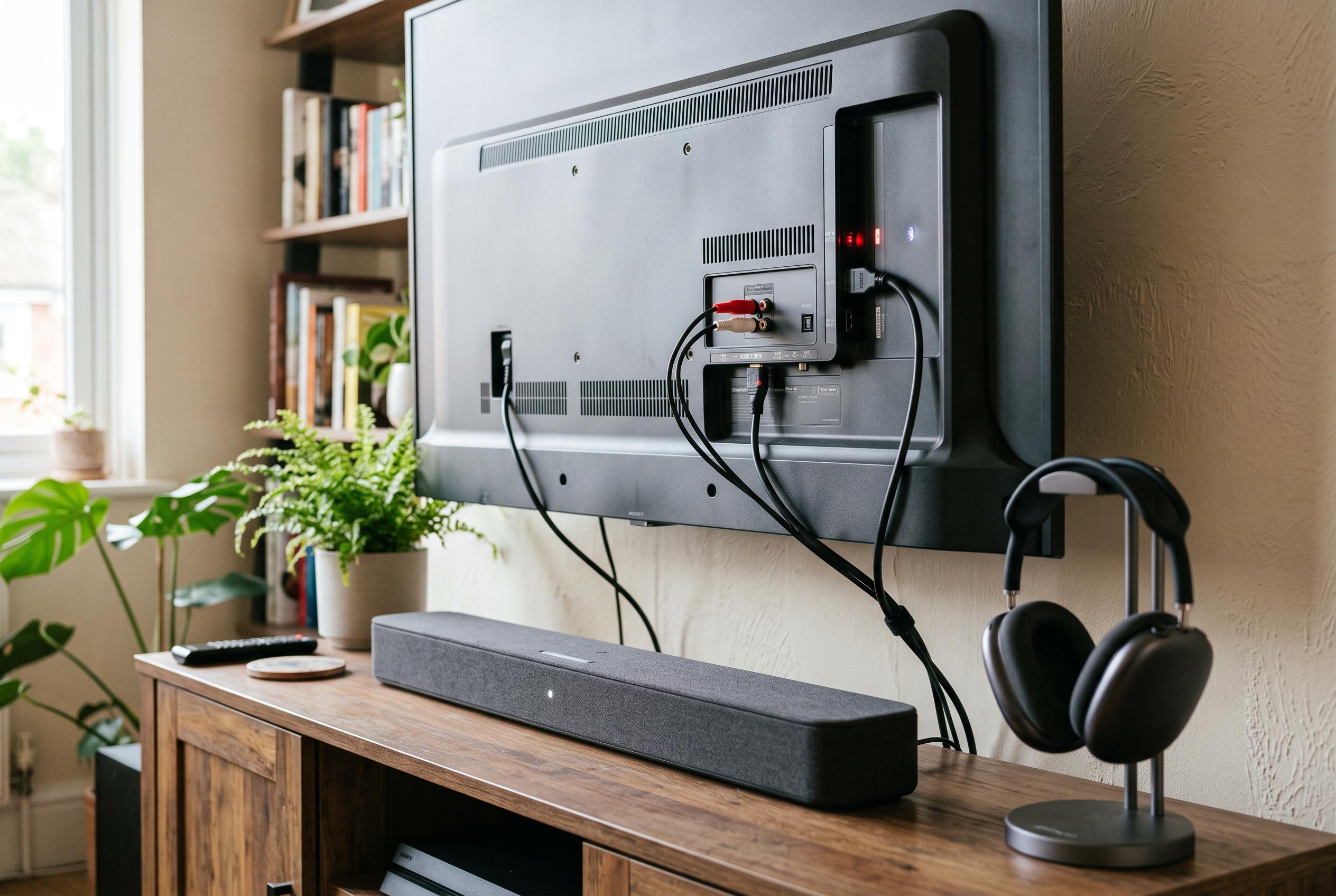

From optical and RCA to HDMI ARC and Bluetooth, the connection on the back of a TV determines which headphones will pair smoothly and whether a soundbar can keep playing.
The right wireless headphones for a television are determined less by brand than by the connection on the back of the set. Some televisions still offer optical digital audio out or a 3.5mm headphone jack. Others rely on RCA sockets, while newer models may provide only HDMI ARC or built-in Bluetooth. That matters because the best choice is the one that matches the TV’s output without adding adapters or unnecessary setup.
According to Avantree’s product information, the Duet is built for households that have optical or 3.5mm output and want two listeners to share the same screen. It uses a 2.4GHz wireless link rather than Bluetooth, supports Clear Voice processing and volume boost, and includes optical passthrough so a soundbar can remain active at the same time. Avantree also says the set is not compatible with TVs that only have HDMI ARC or Bluetooth, and that optical connections may need the TV’s digital audio output format changed to PCM.
For newer televisions that have moved to HDMI ARC, Avantree’s Crescendo 3D is the more direct fit. Avantree’s support material says it can be configured so headphones and an HDMI ARC soundbar both play at once, using the transmitter’s bypass output and the correct ARC input mode. The same product family also supports optical output with TV speakers, provided the television is set to PCM. Avantree and retail listings also point to practical extras such as active noise cancellation, a replaceable battery and claimed battery life of up to 60 hours. For televisions with built-in Bluetooth, the HT41899 is the simpler option: Avantree says the headphones can pair directly to a smart TV, with the transmitter switched off entirely if it is not needed.
Older televisions remain a different category. The Sennheiser RS 120-W is aimed at sets with RCA or 3.5mm output, which still covers a large number of older living-room televisions. Sennheiser’s product details emphasise that the transmitter doubles as a charging dock and that the headphones offer three listening modes: Speech, Music and Neutral. SIMOLIO’s SM-823D Pro is more specialised, because it is designed for users who want the headphones to share an optical output with a soundbar or AV receiver. SIMOLIO says the unit supports optical, RCA and 3.5mm inputs, but that HDMI ARC-only televisions need an external converter and Bluetooth-only sets are not supported.
In practice, setup is usually straightforward. The transmitter is connected to the matching port, powered from the television or a wall adapter, and paired with the headphones. On some optical connections, the audio menu must be changed from Dolby or DTS to PCM before sound will pass correctly. If a soundbar must continue working, the model needs passthrough or bypass support. That is why the Duet, Crescendo 3D and SM-823D Pro stand out in different use cases: each solves a different connection problem rather than trying to be universal. For most households, the decision comes down to the port available on the television, whether a soundbar also needs to stay active, and whether one or two listeners need independent volume control.
Disclaimer: This content is intended for informational purposes only. Readers are advised to exercise their own judgement, conduct due diligence, or consult a qualified expert before acting on any information provided.



