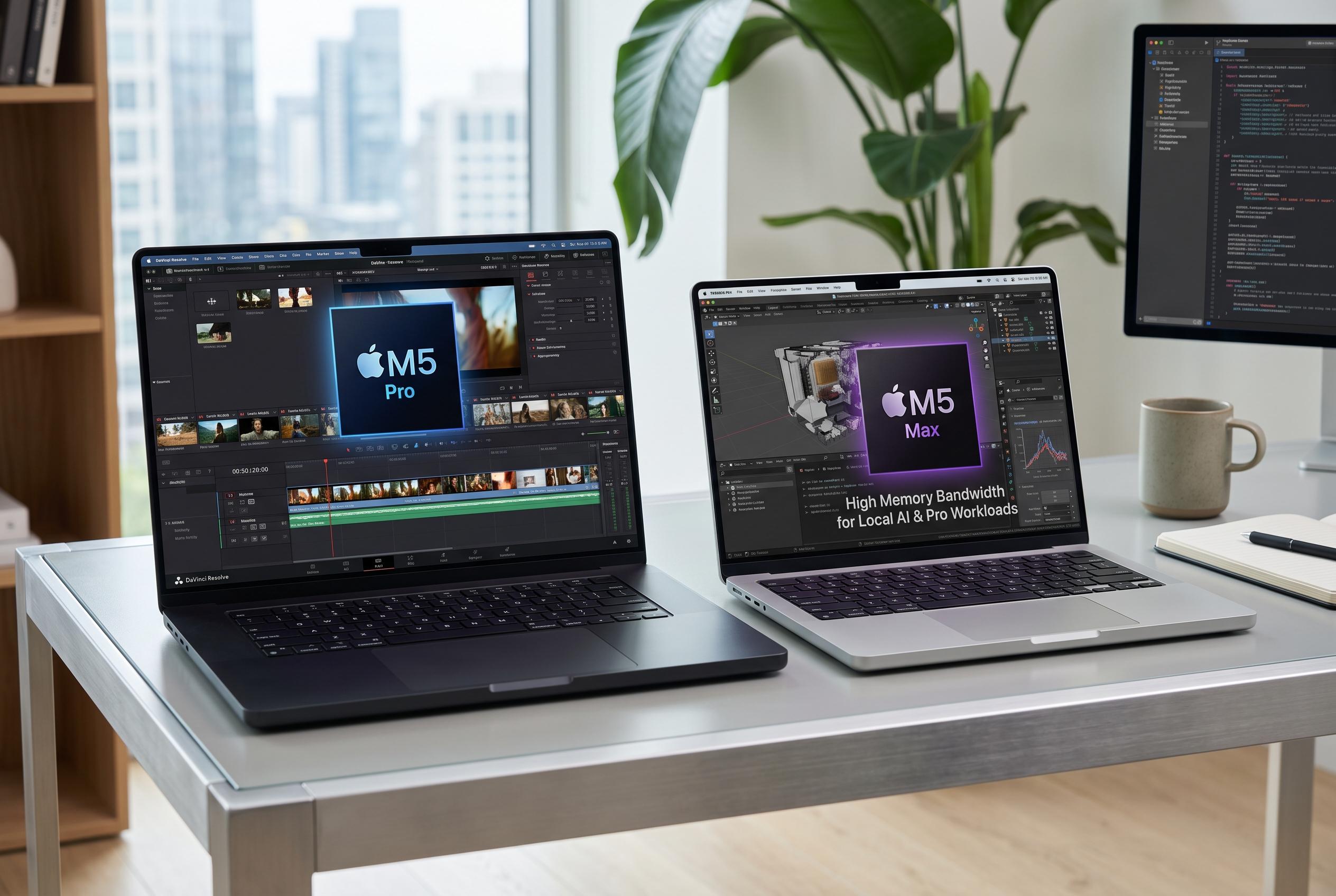

Apple introduces its most powerful MacBook Pro generation yet, featuring M5 Pro and M5 Max chips designed to optimise local AI processing and heavy-duty professional tasks, with a focus on high memory bandwidth and on-device neural inference.
Apple’s latest MacBook Pro generation is being positioned as the company’s strongest laptop line yet for local AI work and other sustained pro workloads, with the new M5 Pro and M5 Max chips pushing memory bandwidth and on-device neural processing further than the M4 series. Apple said the 14-inch and 16-inch models use a new Fusion Architecture that combines two dies in a single system on a chip, while adding a Neural Accelerator to each GPU core to speed up AI tasks such as prompt prefill.
On paper, the M5 Pro raises unified memory bandwidth to 307GB/s and supports up to 64GB of unified memory. The M5 Max goes much further, reaching 460GB/s on the 32-core GPU version and 614GB/s on the 40-core GPU version, with support for up to 128GB of unified memory. Apple says both chips include an 18-core CPU, a 16-core Neural Engine, hardware-accelerated ray tracing and up to 2x faster SSD performance than the previous generation.
For users building local large language model setups, the most important practical constraint remains memory. Apple has not made its Macs upgradeable after purchase, so configuration choices have to be made up front. That makes the high-memory versions of the M5 Pro and M5 Max especially relevant for people running models that benefit from large unified memory pools and high bandwidth between the processor, GPU and memory subsystem.
The MacBook Pro is not the only option. Apple’s desktop line still includes Mac Studio systems with higher aggregate bandwidth in some configurations, and the current high-end desktops are aimed at users who need maximum throughput and can tolerate larger machines. But the newest MacBook Pro models narrow the gap for portable use, especially for developers, researchers and creators who need a machine capable of handling on-device inference without relying on cloud services.
Cost and availability remain the main trade-offs. Apple says the new MacBook Pro models were available for pre-order from March 4 and reached customers from March 11. For buyers trying to balance price, storage and RAM, the article’s broader advice is clear: prioritise memory first, then choose the fastest chip you can justify, and use external Thunderbolt storage where possible rather than paying for every gigabyte of internal SSD capacity.
Disclaimer: This content is intended for informational purposes only. Readers are advised to exercise their own judgement, conduct due diligence, or consult a qualified expert before acting on any information provided.