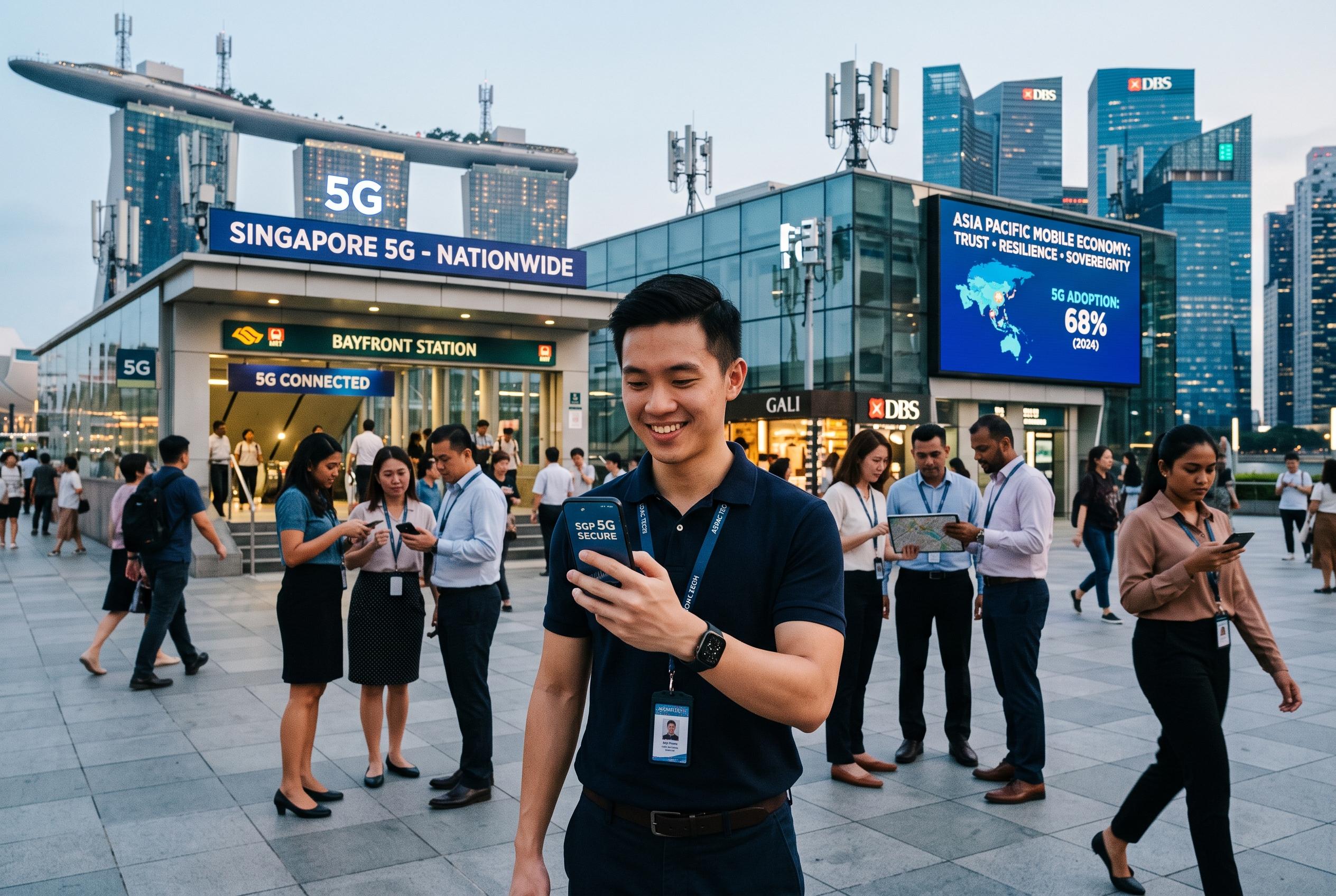

The GSMA reports that Asia Pacific’s mobile sector has become a key driver of economic growth, with a rising emphasis on trust, security, and sovereignty as 5G and AI expand regionally, despite lingering inclusion challenges.
Asia Pacific’s mobile sector is moving from a connectivity story to a wider economic one. The GSMA says mobile technologies and services generated $1 trillion in value across the region in 2025, equal to 5.9% of GDP, and that contribution is forecast to rise to $1.4 trillion by 2030. The association’s latest regional analysis also says the mobile ecosystem is becoming more central to productivity, investment and public services at a time when governments are trying to harden their digital infrastructure.
That growth is increasingly tied to 5G, artificial intelligence and connected devices. According to the GSMA, productivity gains delivered the largest share of mobile’s economic impact in 2025, while manufacturing and services are expected to capture more than half of the value created by 5G and its wider ecosystem by 2030. The report also says commercial 5G standalone networks are already live in seven Asia Pacific markets, with 5G on course to account for about half of mobile connections in the region by the end of the decade.
The same transition is pushing operators into a broader enterprise role. The GSMA argues that network owners are no longer selling only access, but are also packaging cloud, compute, security and data-centre capacity for industrial customers. That shift is particularly relevant for sectors such as logistics, healthcare and manufacturing, where private 5G networks can support automation, analytics and connected equipment in controlled environments.
Trust is becoming just as important as scale. The GSMA says the share of ASEAN consumers who reported being scammed rose from 31% in 2024 to 45% in 2025, while threats including voice cloning, deepfakes and synthetic identities are making fraud harder to detect. At the same time, the association says about two-thirds of surveyed operators in Asia Pacific have adopted a proactive security approach, a higher share than the global average, as cybersecurity spending in the region is projected to reach $60.6 billion by 2028.
Resilience and sovereignty are now shaping investment decisions as well. The GSMA says operators are directing an increasing share of more than $200 billion in planned capital expenditure towards sovereign and AI-ready infrastructure between 2025 and 2030. It also warns that Asia Pacific still faces an inclusion gap: while mobile broadband coverage is near universal, more than 1 billion people remain offline because of affordability, skills and trust barriers. The association says closing that usage gap, alongside sensible spectrum policy and stronger public-private coordination, will be central to the region’s next phase of digital growth.
Disclaimer: This content is intended for informational purposes only. Readers are advised to exercise their own judgement, conduct due diligence, or consult a qualified expert before acting on any information provided.