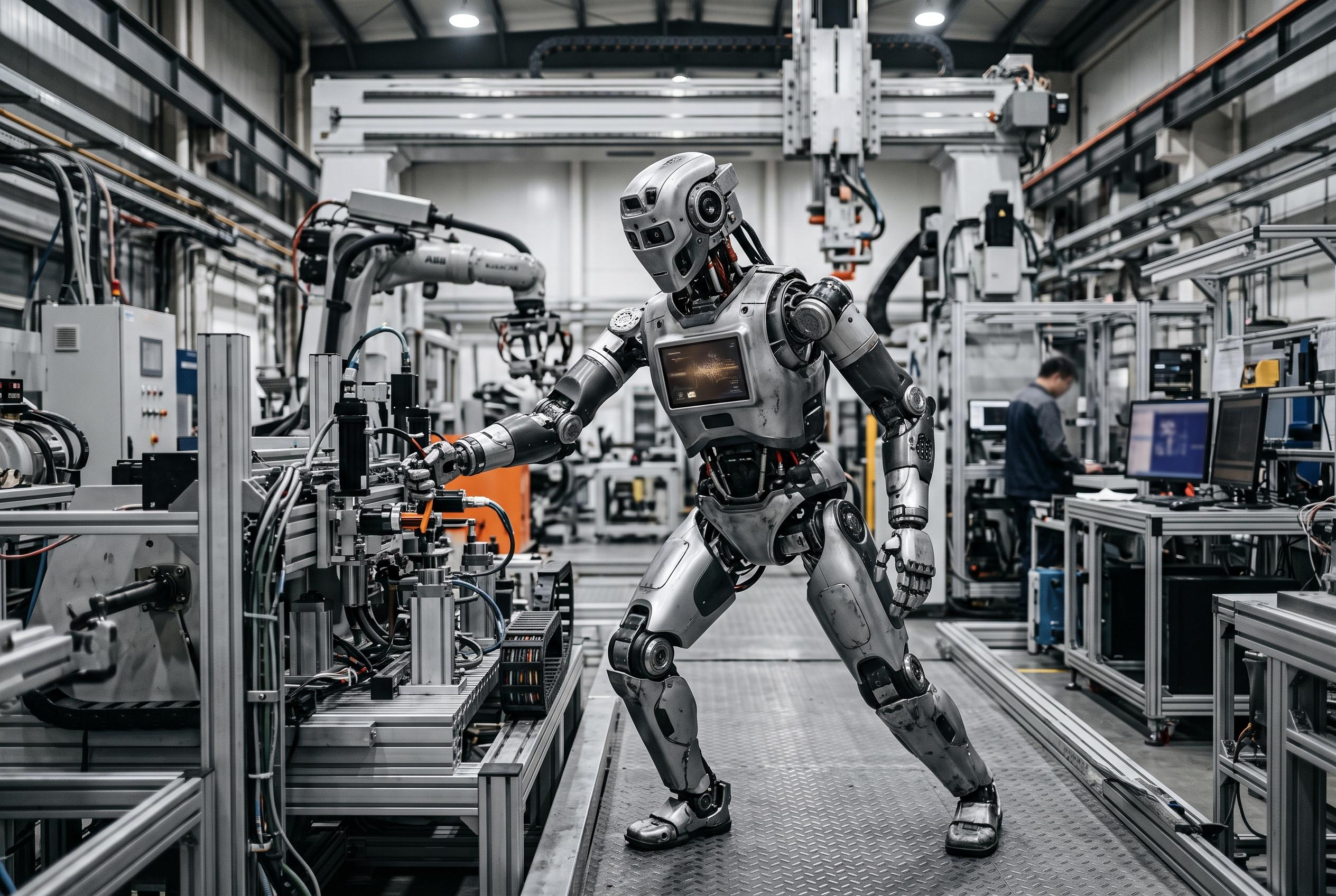

China showcases rapid advancements in humanoid robotics at Beijing competition, highlighting a shift from experimental designs to emerging industrial applications amid technological and ethical challenges.
China’s rapid push into humanoid robotics was on display in Beijing this month, where the World Humanoid Robot Games brought together 666 teams from 16 countries and 2,056 robots for events ranging from football and tennis to boxing and taijiquan. The competition, held from 22 to 26 August, also produced eye-catching results on the track, including a 100m time of 9.32 seconds, although the spectacle also underlined how far the technology still has to go, with some machines still tumbling on corners or throwing sparks after falls.
The event reflected China’s broader industrial ambition. A recent report from the South China Morning Post said China accounted for more than 80% of global humanoid robot installations in 2025, while Chinese state-linked data cited by other outlets put global shipments at around 18,000 units that year, with Chinese manufacturers led by AgiBot and Unitree Robotics. The figures suggest a market moving quickly from experimentation towards early commercial deployment, especially in logistics, manufacturing and automotive work.
At the same time, specialists say the field is not developing in only one direction. Professor Shigeki Sugano of Waseda University said China has built an edge in lighter, faster and more flexible machines, drawing on technologies associated with drones and athletic demonstrations. Japan and the United States, he argued, have tended to focus more on stability, strength and practical use. In Japan, that has meant attention to tasks such as putting on socks, helping people stand up and supporting cooking, rather than merely building robots that can imitate human movement.
Companies are already trying to move humanoid robots into real workplaces. In Kyoto, HACARUS said it began helping firms teach robots required motions and support their first on-site operations from April. Chief executive Takashi Someta said the company had received about 20 to 30 enquiries, though only a few projects were progressing because of hardware constraints. He said human-shaped robots are attracting interest because they may fit into existing factory layouts without major changes to equipment.
Experts also identify three major turning points in the field: the arrival of microcomputers in the 1980s, which made it possible to embed computing in machines; the development of spring-based mechanisms around 2000, which gave joints more natural compliance; and the rise of generative AI in the late 2010s, which broadened what robots could learn to do. That progress has also revived a central question: why make robots human-shaped at all? Sugano’s answer is that the built world is already designed around people, from door handles to stairs, and that humanoid form becomes useful if the goal is a machine that can work across human environments.
For Yoshie Lee, chief expert at Nomura Research Institute, the likely path is gradual but accelerating. She sees robots first taking on dangerous and repetitive work, then entering factories and warehouses within three to five years, and later moving into broader public settings over the following decade. She also suggested that adoption could jump sharply around 2028 if a breakthrough equivalent to ChatGPT’s effect on generative AI arrives in robotics.
Even so, the obstacles are significant. Sugano pointed to three barriers: the technical challenge of giving robots hands with convincing sensitivity and force control, the environmental burden of the energy required for AI and robotics, and social questions over trust, liability and ethics, especially in areas such as healthcare. For now, the humanoid robot race remains part engineering contest, part industrial strategy and part test of how much of human work society is willing to hand over to machines.
Disclaimer: This content is intended for informational purposes only. Readers are advised to exercise their own judgement, conduct due diligence, or consult a qualified expert before acting on any information provided.