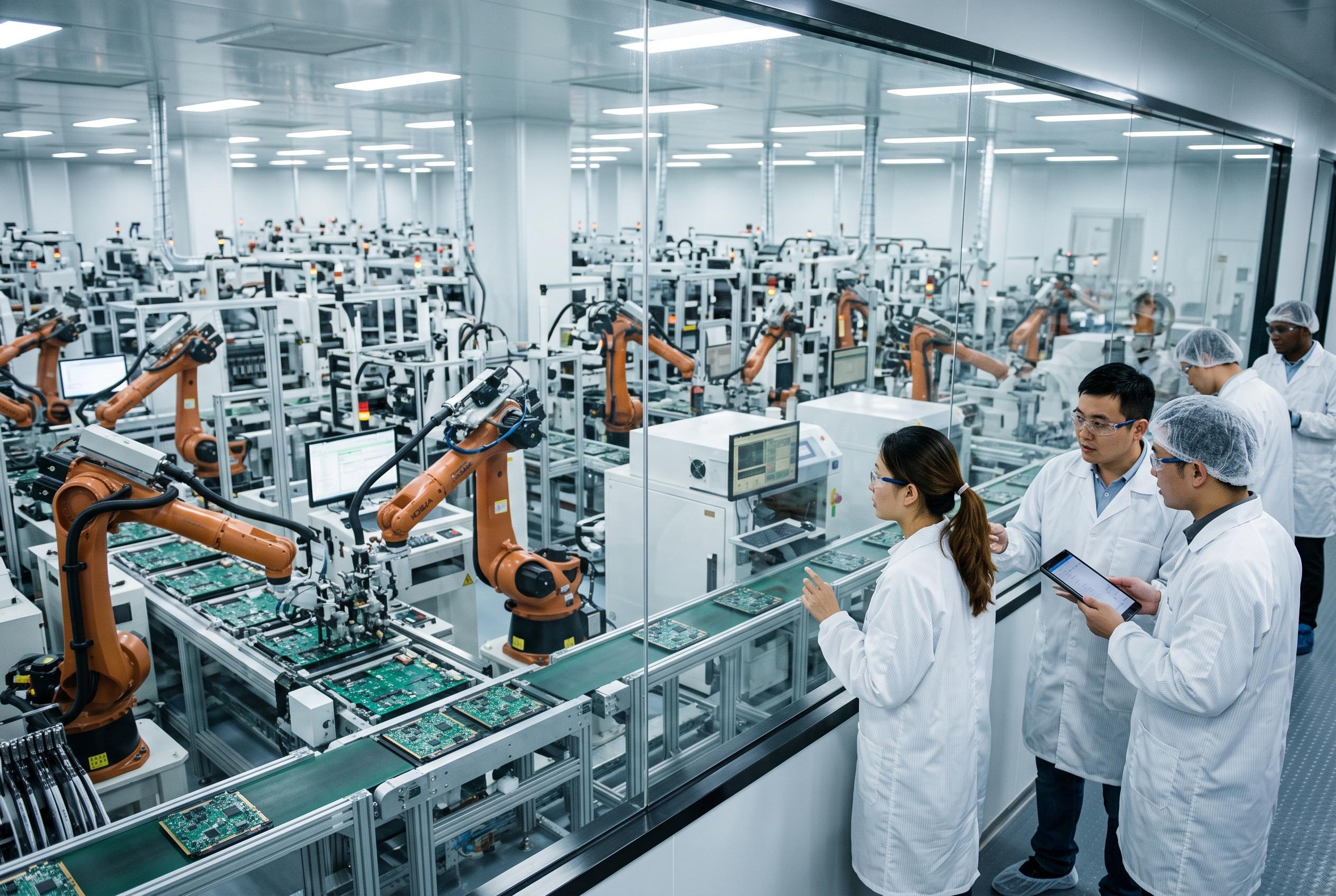

China has announced a comprehensive five-year plan to transform its electronic information manufacturing sector, integrating AI advancements, aiming for over 30 trillion yuan in revenue and bolstering global competitiveness by 2030.
China has set out an ambitious new roadmap for its electronic information manufacturing industry, with officials and analysts framing it as both an industrial policy and an AI strategy. The plan, issued jointly by the Ministry of Industry and Information Technology and the National Development and Reform Commission, covers the 15th Five-Year Plan period from 2026 to 2030 and seeks to place the sector at the centre of the country’s next phase of technological development.
According to the plan, by 2030 the industry’s combined revenue from firms above designated size should exceed 30 trillion yuan, rising from 17.4 trillion yuan in 2025. It also sets a research and development investment intensity target of 3.5% and expects wider adoption of new-generation intelligent terminals. Officials want stronger capabilities in integrated circuits, advanced computing, consumer electronics, basic electronics and energy electronics, alongside the emergence of more internationally competitive companies.
The move comes amid a broader push to harden China’s digital industrial base. In a separate plan released earlier this month, the Ministry of Industry and Information Technology outlined goals for the information and communications sector, including a next-generation network with broad coverage and leading performance by 2030. The government has also already set out measures to accelerate digital transformation in electronic information manufacturing, including higher automation in key production processes and deeper use of advanced computing and artificial intelligence.
Industry experts say the new plan reflects the growing overlap between manufacturing and AI. Li Hongwei, chief engineer at the China Centre for Information Industry Development, said AI will reshape consumer electronics through new products such as AI phones, AI computers, AI glasses and AI toys, while also raising demand for on-device models, AI chips, high-bandwidth memory and other components. Ao Li, vice-president of the China Academy of Information and Communications Technology, said progress in large models, multimodal systems, deep reasoning and embodied intelligence is increasing demand for AI accelerators, advanced packaging, high-speed optical interconnects and liquid cooling.
Disclaimer: This content is intended for informational purposes only. Readers are advised to exercise their own judgement, conduct due diligence, or consult a qualified expert before acting on any information provided.