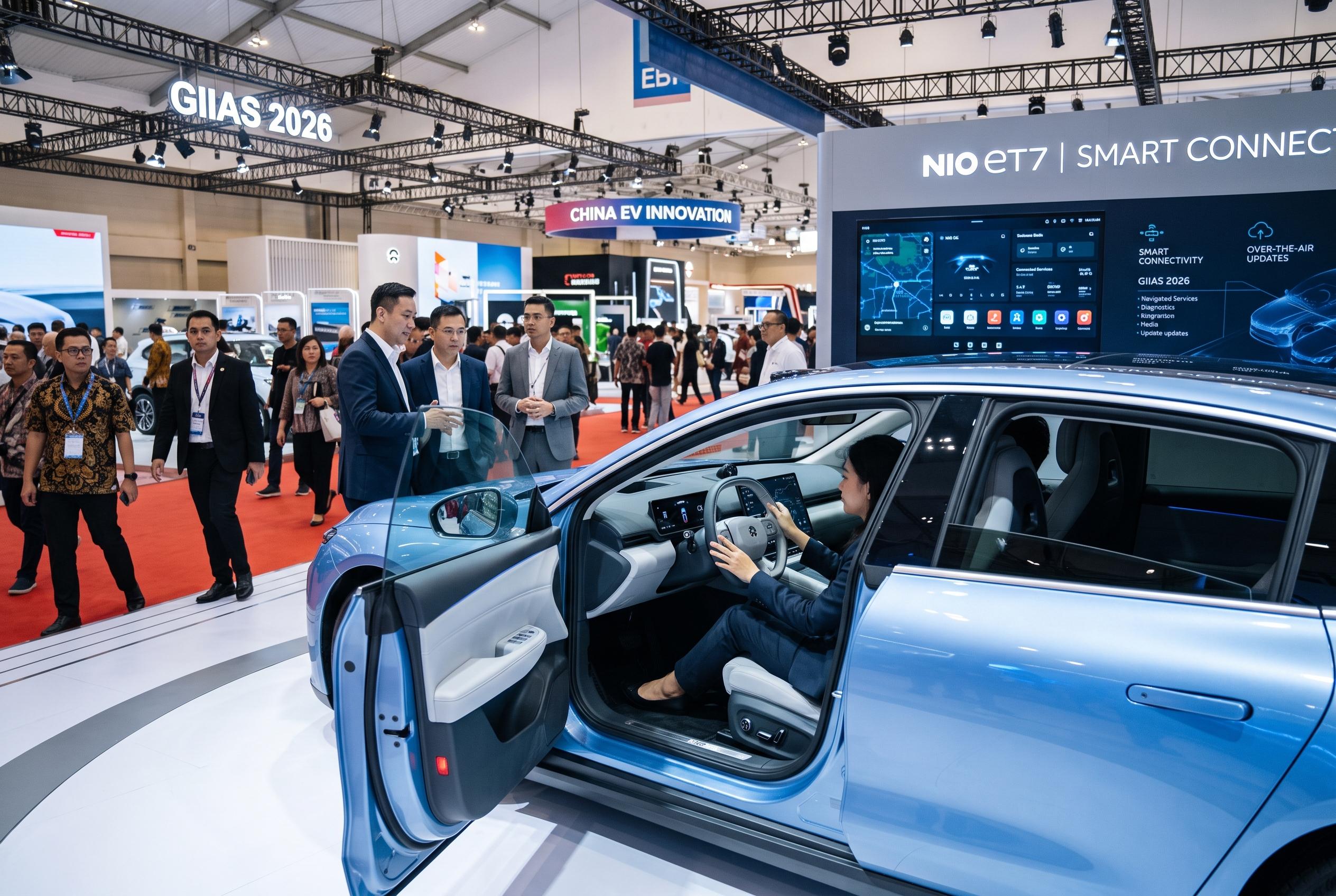

At the 2026 Gaikindo Indonesia International Auto Show, Chinese carmakers signal a strategic shift from price competition to a focus on software, connected services, and regional ecosystem development, highlighting the accelerated evolution of the EV market in Southeast Asia.
At the 2026 Gaikindo Indonesia International Auto Show in Tangerang, Chinese carmakers used the region’s biggest motor show to signal a broader ambition in South-east Asia: not just to sell cheaper vehicles, but to compete on software, charging systems, driver-assistance features and connected services. VietnamPlus reported that more than 60 brands took part, with BYD, Wuling, Chery, Geely, GAC, GWM, XPeng, BAIC, Jetour and Leapmotor all bringing electric and hybrid models to the event.
The shift is significant because it reflects how the market is changing. According to VietnamPlus, manufacturers are moving away from price-led competition and towards a technology-led pitch, as Indonesia’s slower car market growth makes the contest for buyers more intense. Companies are now pairing battery-electric vehicles with plug-in hybrids and digital features designed to improve the driving experience, a sign that the region is becoming a test bed for Chinese automotive software and mobility platforms as well as for the cars themselves.
Several exhibitors used the show to underline their local ambitions. Wuling unveiled its Eksion sport utility vehicle in both fully electric and hybrid forms, while BYD drew strong visitor interest with vehicles across multiple segments. Beijing Automobile Works also made a notable move at GIIAS 2026 by entering Indonesia’s right-hand-drive market with a five-model line-up and a local subsidiary, a step that suggests long-term commitment to the country and the wider region.
The broader backdrop is one of rapid expansion. In January 2025, GAC International and Grab announced a plan to deploy 20,000 electric vehicles across six South-east Asian countries within two years, showing how Chinese manufacturers are increasingly linking up with platform operators to build demand. The International Energy Agency has also said Chinese EV makers are playing a leading role in the global electric-car industry, with exports rising and South-east Asia emerging as an important growth market. Taken together, the developments at GIIAS point to a regional competition that is no longer defined only by manufacturing scale, but by the ability to build an integrated EV ecosystem.
Disclaimer: This content is intended for informational purposes only. Readers are advised to exercise their own judgement, conduct due diligence, or consult a qualified expert before acting on any information provided.