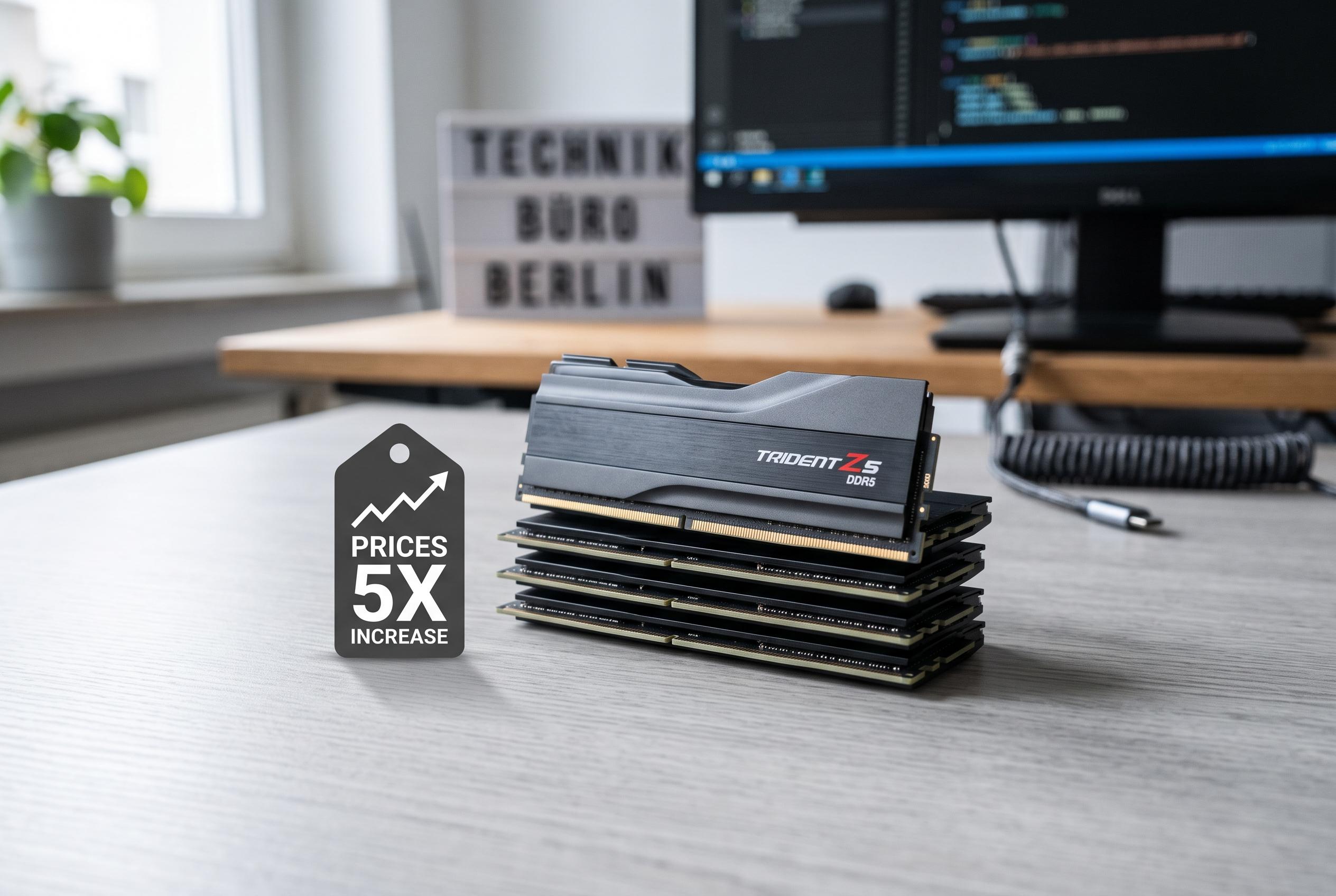

German retail data reveals DDR5 modules are now five times more expensive than a year ago, signalling a persistent industry shortage driven by AI hardware focus and supply constraints, with prices projected to remain high until at least 2030.
DDR5 memory prices are rising sharply again in Germany, adding fresh evidence that the cost of PC components is still moving in the wrong direction. Market data tracked by 3D Center and highlighted by Wccftech shows that mid-August retail prices for DDR5 had climbed to 486% of their July 2025 level, leaving modules roughly five times more expensive than before the current shortage began. That was up from 445% in the previous monthly reading and 419% the month before, with prices 16% higher than in mid-June alone.
The same German retail figures show that internal SSDs are also becoming more expensive, with month-on-month prices up 7.7%. Those drives are now 2.2 times their pre-crisis cost. The broader pattern fits the wider PC memory market, which Tom’s Hardware described as still under severe pressure in mid-2026 after a year of AI-driven demand and tighter supply. It said 32GB DDR5 kits that were once mainstream now often cost more than $450, while even 16GB kits can exceed $200.
The supply squeeze is being reinforced by manufacturers shifting capacity towards enterprise and AI hardware. Tom’s Hardware reported that Micron has stepped back from consumer memory to focus on higher-margin high-bandwidth memory, further reducing availability for mainstream buyers. At the same time, DDR4 has become a partial fallback, although that market has also seen steep inflation. Tom’s Hardware added that some DDR4 kits which once sold for under $50 are now approaching $200, making the older standard a temporary but costly alternative.
There is also a longer-term warning for storage. According to reporting cited by TechRadar from Taiwan’s Commercial Times, Phison chief executive Pua Khein-Seng said a recent discussion with a NAND supplier suggested that the move from investment to mass production could take four years rather than two. If that timeline proves accurate, the industry may have to wait until around 2030 for meaningful relief in NAND supply. Counterpoint Research data cited by Tom’s Hardware adds context: enterprise SSDs accounted for 48% of all NAND bits shipped in the second quarter of 2026, up from 26% a year earlier, showing how heavily AI infrastructure is now absorbing production.
Disclaimer: This content is intended for informational purposes only. Readers are advised to exercise their own judgement, conduct due diligence, or consult a qualified expert before acting on any information provided.