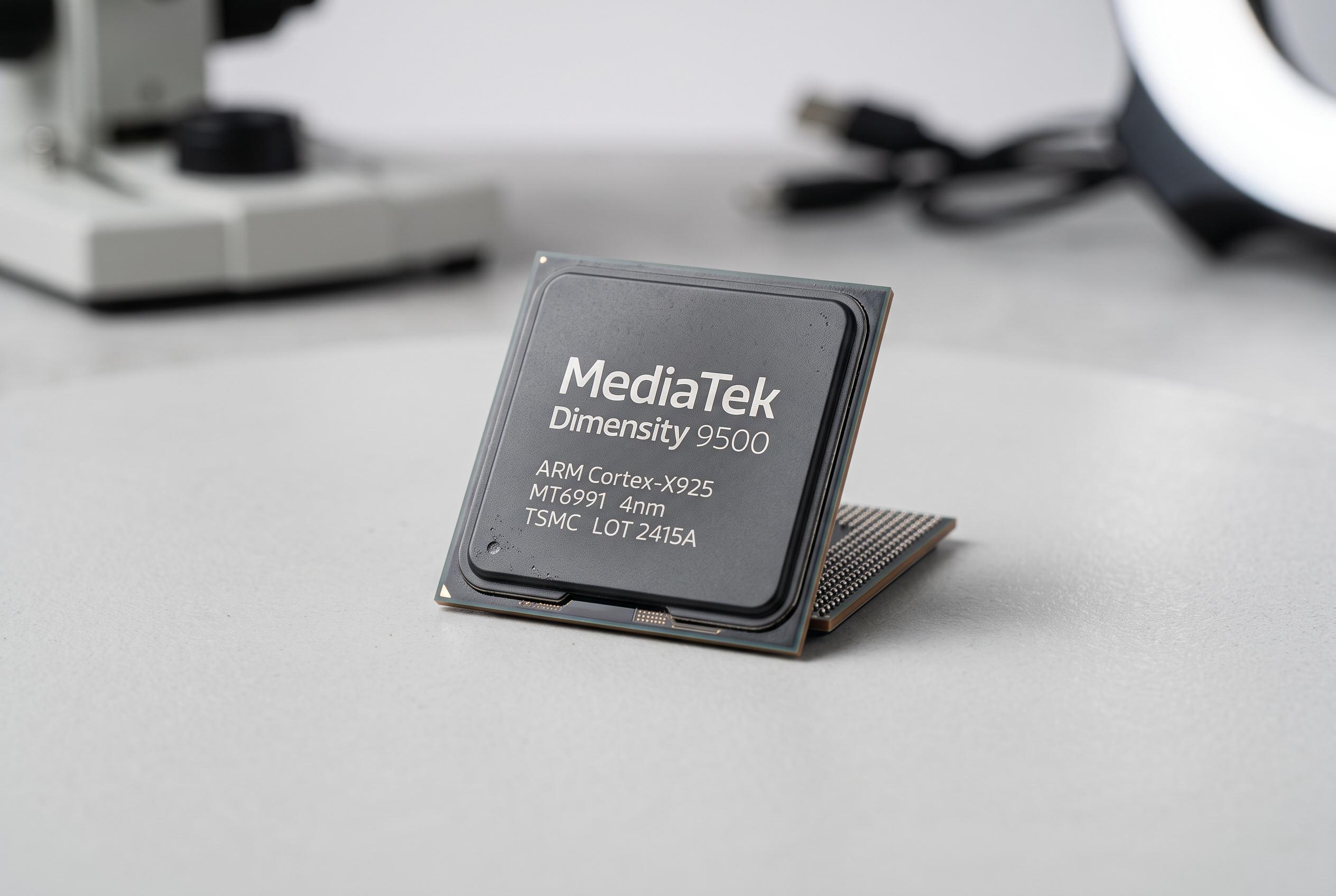

A Geekbench listing hints at a future where flagship chips like MediaTek’s Dimensity 9500 could be sold with varying GPU configurations, potentially affecting performance and product segmentation.
A new Geekbench result has strengthened the case that flagship smartphone chips may soon be sold in more than one GPU configuration under the same model name. The listing, for a vivo device identified as V2573A, appears to match MediaTek’s Dimensity 9500 on CPU layout, but shows an 11-core Mali-G1 Ultra MC11 graphics unit rather than the 12-core MC12 arrangement listed by MediaTek for the standard chip. The device is widely believed to be the iQOO Neo 11 Extreme Edition, although its final specifications have not been confirmed.
The benchmark, run on Android 16 and Geekbench 6.7.1, produced scores of 3,445 in the single-core test and 10,517 in the multi-core test. What stands out is not the CPU, which aligns closely with MediaTek’s published Dimensity 9500 design, but the GPU count. MediaTek says the Dimensity 9500 uses one Arm C1-Ultra core at 4.21GHz, three C1-Premium cores at 3.5GHz and four C1-Pro cores at 2.7GHz, paired with a 12-core Arm Mali-G1 Ultra MC12 graphics processor.
That difference matters because it suggests a possible case of binning, the industry practice of disabling parts of a chip that do not meet the highest specification and selling the rest as a lower-tier part. In this case, the GPU appears to have one fewer core, while the rest of the silicon remains unchanged. The same approach is already being discussed around MediaTek’s Dimensity 9500s, which has turned up in reports with both 12-core and 11-core GPU variants in different phones.
If those configurations reach retail unchanged, buyers could eventually see phones carrying the same Dimensity 9500s branding but different graphics hardware underneath. That would not automatically create a dramatic performance gap, but it would make the processor name alone a less complete guide to what is inside a handset. It would also complicate comparisons for buyers who care about gaming or sustained graphics performance.
The broader context is important. Qualcomm has already introduced a Snapdragon 8 Elite Gen 5 variant with a reduced Adreno GPU while keeping the rest of the platform largely intact. Qualcomm says the chip still targets high-end phones, with improvements in CPU, GPU and neural performance, showing that trimmed GPU configurations can still fit flagship products. That makes the idea technically credible for MediaTek as well, even if the companies are not following the same strategy for the same reasons.
For manufacturers, the appeal is clear. A reduced GPU configuration can allow more chips from a single wafer to be used, cutting waste and giving chipmakers more flexibility in how they segment products. For phone makers, the advantage is equally practical: they can keep a flagship CPU, modem and AI engine while adjusting graphics resources for devices that are not centred on gaming. But the real effect on performance remains uncertain. GPU speed does not scale in a simple one-core-to-one-core way, and clock rates, memory bandwidth, thermal limits and software tuning all matter.
For now, the evidence remains incomplete and based on benchmark leaks rather than final retail specifications. The vivo V2573A listing is a clue, not proof of a permanent shift in MediaTek’s product strategy. Even so, together with the Dimensity 9500s reports and Qualcomm’s own reduced flagship GPU, it points to a future in which the chip name on a spec sheet may no longer tell the full story.
Disclaimer: This content is intended for informational purposes only. Readers are advised to exercise their own judgement, conduct due diligence, or consult a qualified expert before acting on any information provided.