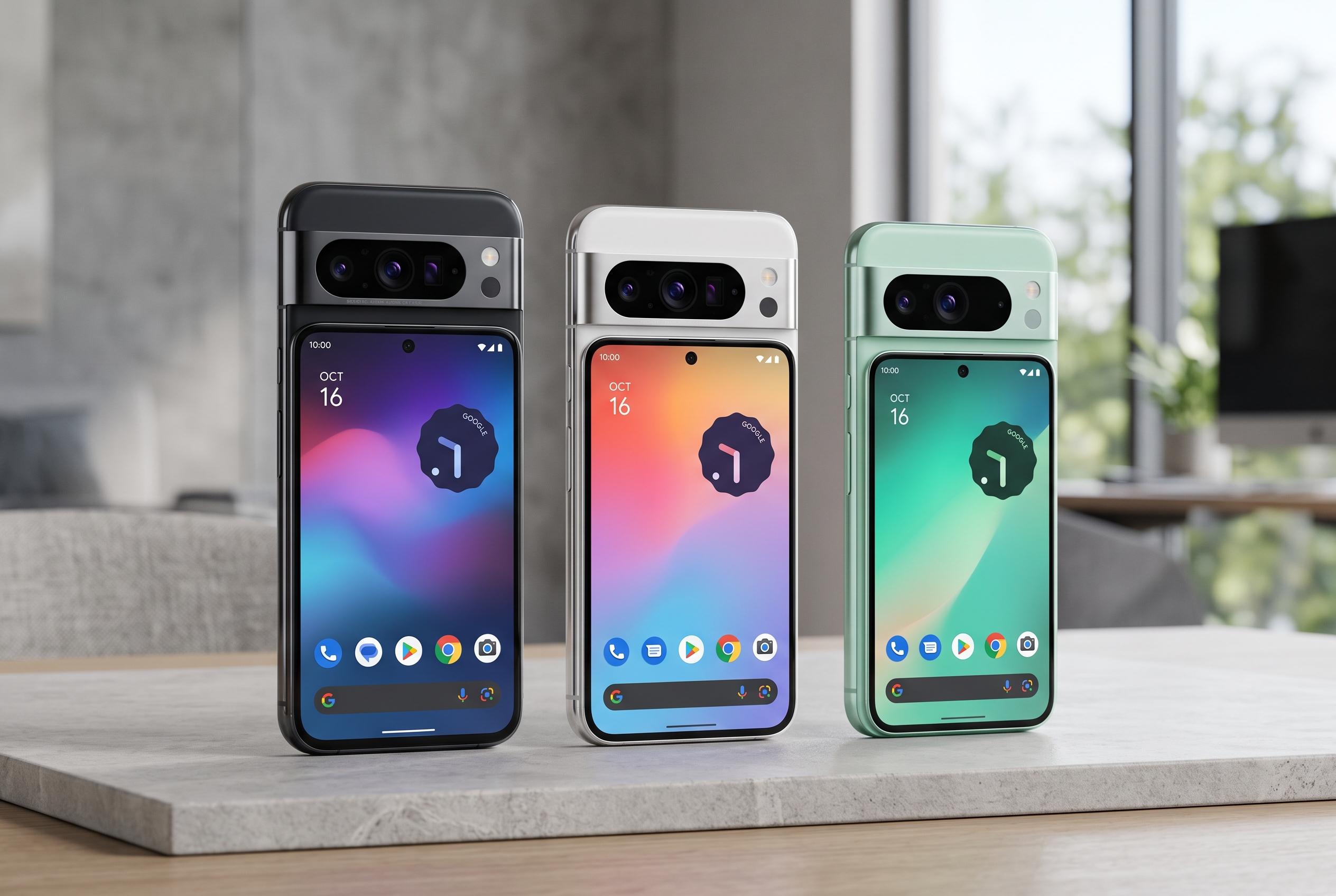

Leaks ahead of Google’s August launch unveil the Pixel 11 range’s new processors, brighter displays, enhanced cameras, and a foldable model, signalling a significant evolution despite familiar design.
Google’s next flagship phones are already taking shape in leaks ahead of the company’s August 12 launch event in New York, with the Pixel 11 range expected to span four models: the Pixel 11, Pixel 11 Pro, Pixel 11 Pro XL and Pixel 11 Pro Fold. The broad outline suggests continuity rather than reinvention, but the internal changes could be substantial, especially in processing power, wireless connectivity and artificial intelligence features.
According to the leaks reported by “Kod Durova”, Google is not planning a major visual overhaul. The new phones are said to keep the flat-sided Pixel design language introduced in recent generations, alongside the familiar horizontal camera bar. Live images of the Pixel 11 Pro XL appear to confirm that the device will look close to its predecessor, although the camera module seems slightly larger and more pronounced. The reports also suggest that Google may trim thickness a little, but not enough to be obvious without side-by-side comparison.
The most important upgrade is expected to be the Tensor G6 chip, which is said to be built by TSMC on a 2nm process. That would mark a notable step up for Google’s in-house silicon and, in theory, should improve efficiency as much as speed. The leaked core layout points to a 1+4+2 configuration, with the CPU reportedly offering up to 16% better performance than Tensor G5. More striking than raw speed may be battery life and thermals, areas where Pixel hardware has often faced criticism. Google is also expected to switch modem suppliers, moving away from Samsung parts to MediaTek’s M90, a change that could reduce power draw and improve network stability.
Display brightness is also set to rise. The standard Pixel 11 is rumoured to reach a peak brightness of 3,000 nits, while the Pixel 11 Pro and Pixel 11 Pro XL could climb to 3,600 nits. Screen sizes are expected to stay largely the same, but Google is said to be raising the base storage tier to 256GB across the main models, a practical response to larger photos, video files and on-device AI tools. Some leaks also claim that certain Pro variants may ship with 12GB of RAM rather than 16GB, depending on the market or storage configuration.
Camera hardware remains a central part of the Pixel pitch. The base Pixel 11 is tipped to gain a 48-megapixel main camera, a 13-megapixel ultrawide lens and a 10-megapixel telephoto lens, giving even the entry model optical zoom capability. The Pro phones are expected to carry a 50-megapixel main sensor, paired with 48-megapixel ultrawide and periscope cameras, plus a front camera with a 42-megapixel sensor and a wide 103-degree field of view. Google’s software processing is likely to do much of the heavy lifting, with the Pro models reportedly supporting up to 120x zoom through a mix of optical data, cropping and AI reconstruction.
A more visible change may come in the hardware beside the cameras. Leaks indicate that the temperature sensor used on earlier Pixel Pro models will be replaced by a new system called HiLight, which appears to use RGB lighting for colour-based feedback. Its exact purpose remains unclear, but the component is already visible in live images and may be tied to camera functions, AI features or other system alerts. Google is also expected to keep its magnetic Pixelsnap accessory system, which works with the Qi2 standard and should remain compatible with magnetic chargers and stands.
The folding model is likely to remain the least camera-focused of the group, with a simpler triple-camera setup and two 10-megapixel selfie cameras for the outer and inner displays. Charging speeds are expected to vary by model, with 30W wired charging on the Pixel 11, Pixel 11 Pro and Pixel 11 Pro Fold, and 45W on the Pro XL. All four phones are also expected to support Qi2. Pricing leaks point to a higher starting cost across the range, with the Pixel 11 beginning at $899 in the US and the Pixel 11 Pro Fold at $1,899. Sales of the non-folding models are expected to begin on August 20, with the foldable possibly arriving at the same time.
Disclaimer: This content is intended for informational purposes only. Readers are advised to exercise their own judgement, conduct due diligence, or consult a qualified expert before acting on any information provided.