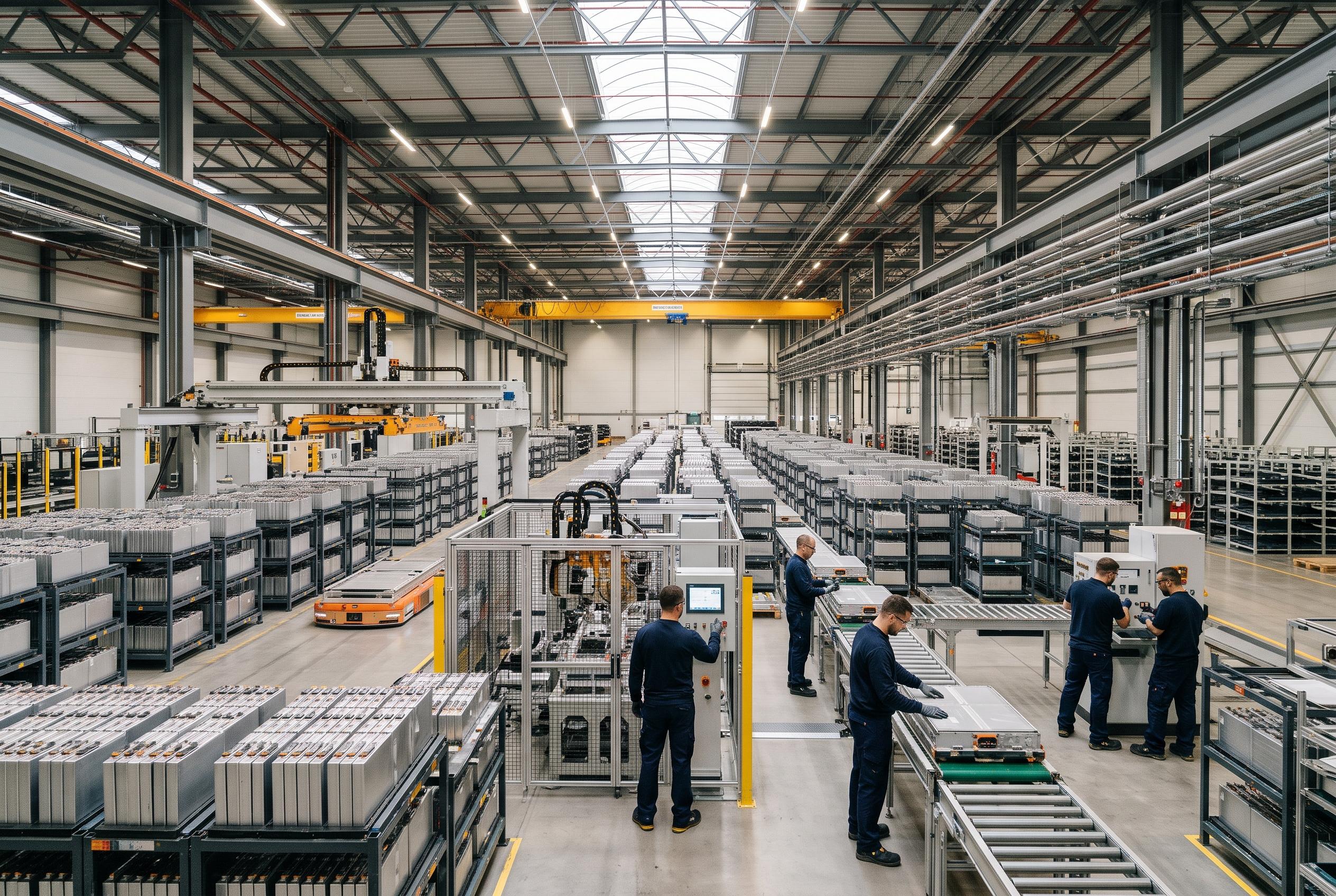

Only 1 GWh of the 40 GWh awarded under India’s flagship battery-cell incentive scheme has been installed, with no beneficiary yet receiving a payment as projects face technical, supply-chain and pricing hurdles.
India’s attempt to create a domestic battery cell manufacturing base is still moving far more slowly than policy makers had hoped, despite an ₹18,100-crore incentive programme launched to build 50 GWh of advanced chemistry cell capacity. More than five years on, the gap between ambition and execution remains wide, with only a fraction of the awarded capacity translated into installed plant and no beneficiary yet drawing an incentive payment under the scheme, according to the Ministry of Heavy Industries. The weakness is particularly significant because battery cells are central to electric vehicles and grid storage, both of which are expected to underpin India’s clean-energy expansion.
The scheme, introduced in 2021, was meant to cut import dependence by rewarding large-scale production and domestic value addition. Companies winning allocations were expected to start with at least 25 per cent local value addition, rising to 60 per cent over five years. Of the 50 GWh targeted, 40 GWh was awarded in two tranches to four beneficiaries: Ola Cell Technologies; Reliance New Energy Battery Storage; Reliance New Energy Battery; and ACC Energy Storage, the Rajesh Exports venture. A later 10 GWh round did not close the shortfall, and the government has since sought fresh bidding for the balance.
Execution has lagged badly. In February, the ministry told Parliament that only 1 GWh of the 40 GWh awarded had been installed, at Ola’s facility in Krishnagiri, Tamil Nadu. That plant began pilot output in March 2024 and was still working towards stable commercial production. The latest public milestone is therefore far below the original objective, and it matches the broader industry picture described by Wood Mackenzie, which says domestic battery manufacturing still accounts for less than 1 per cent of India’s 260 GWh demand pipeline in 2026.
Industry executives argue that the delays are not just a matter of corporate underperformance. Ankur Khaitan, managing director and chief executive of TACC Ltd, a subsidiary of HEG Advanced Materials, said cell manufacturing is among the most technically demanding industrial segments and that India is trying to assemble it from the ground up. He pointed to restrictions on the export of critical equipment and knowhow from major global manufacturing hubs, as well as a steep fall in world cell prices, which has raised the threshold for new projects. Khaitan also said imported anode and cathode materials still account for more than 60 per cent of a cell’s cost, meaning local factories will remain structurally exposed to foreign supply chains until that upstream layer is built in India.
Vinay Rustagi, chief business officer at Premier Energies Ltd, said one possible way to reduce that dependency is to move towards newer chemistries such as sodium-ion batteries, though he cautioned that commercialising any new technology is expensive and slow. Even so, Khaitan said there are signs of momentum, with several projects shifting from construction to commissioning and announced investments now totalling 178 GWh outside the PLI framework. The central question, however, is whether the sector can convert announced capacity into bankable output before patient capital runs out and policy support weakens.
That uncertainty has widened with the government’s latest tender for large battery systems to support renewable integration and grid balancing. The Ministry of Heavy Industries issued the call in July, but the process has already drawn criticism over clarity and responsiveness. In a roughly 90-page reply to pre-bid queries, officials reportedly relied heavily on standard wording, with 261 of 265 questions answered using stock phrases. One bidder’s request for clarification on what counted as a “cell” in vanadium redox flow batteries, and whether domestic manufacture of key components would satisfy the value-addition requirement, appears to have received no substantive guidance. The bid deadline, first set for October 13, was later extended to November 10, with technical bids due to open on November 11. Industry sources say the extension reflected weak interest, underscoring the broader problem: India has policy intent, but still lacks a fully convincing manufacturing ecosystem.
Disclaimer: This content is intended for informational purposes only. Readers are advised to exercise their own judgement, conduct due diligence, or consult a qualified expert before acting on any information provided.