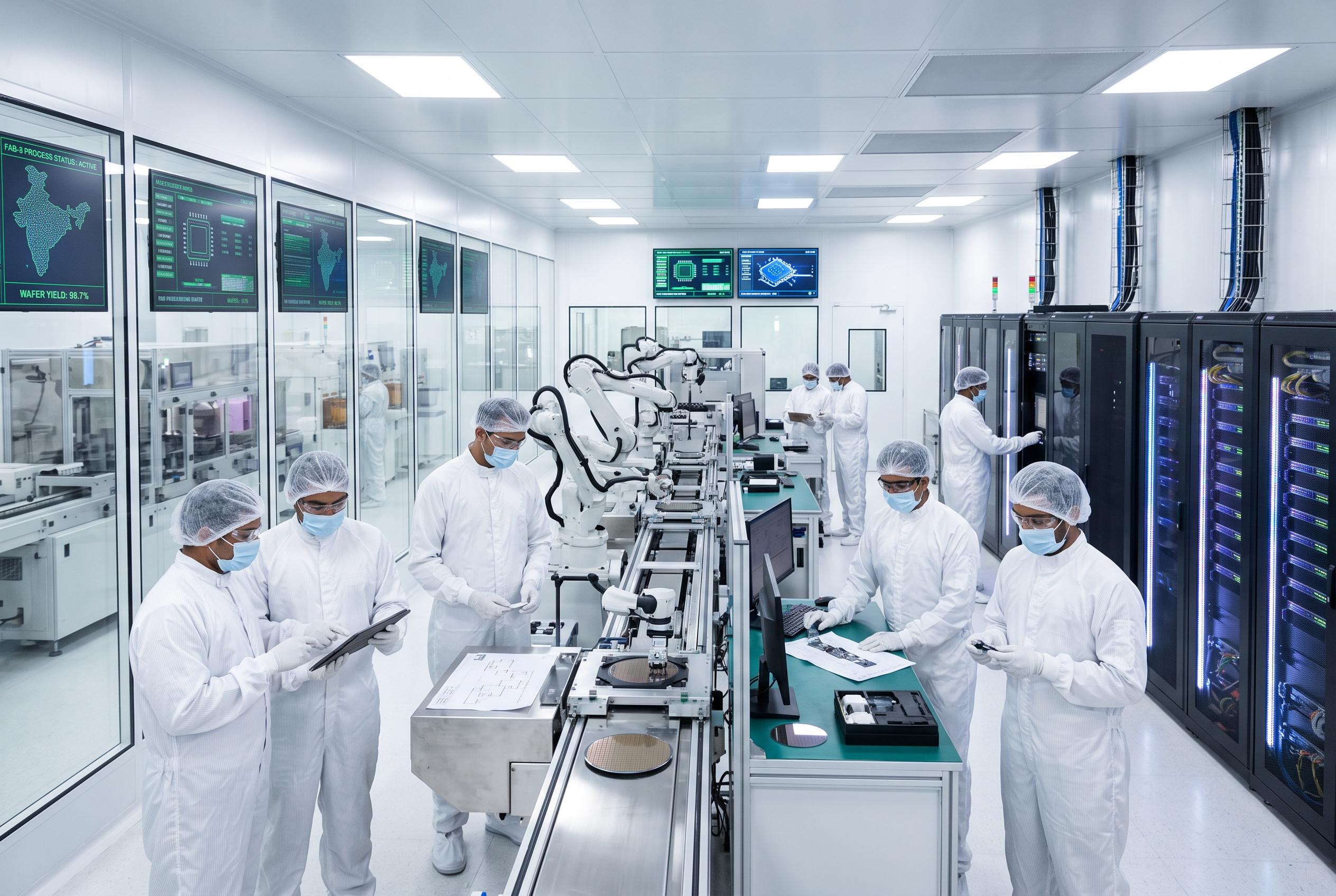

India’s semiconductor market is entering a transformative phase, with rapid growth driven by government policies, expanding domestic capabilities, and a strategic move into upstream materials and front-end fabrication, signalling a shift towards a more complete and self-reliant industry ecosystem.
India’s semiconductor market is entering a more industrial phase, with market researchers and industry reports pointing to a rapid expansion in both demand and domestic capability. IMARC Group estimates that the market was worth USD 59.78 billion in 2025 and could reach USD 180.20 billion by 2034, implying a compound annual growth rate of 11.95% between 2026 and 2034. The same report says logic devices remain the largest component category, while consumer electronics is still the main end-market, reflecting the scale of India’s device-upgrade cycle and 5G adoption. South India continues to lead the sector, anchored by Bengaluru’s design base and Hyderabad’s research capacity.
That growth is being shaped by a deliberate policy shift. Business Standard reported in February 2026 that the Union Budget for 2026-27 set out India Semiconductor Mission 2.0, which is intended to deepen local production of equipment, materials and full-stack intellectual property. The paper said the government has put aside ₹1,000 crore for the new phase in the current financial year, alongside support for research and training centres. Earlier industry estimates cited by the newspaper placed the Indian semiconductor market at about $45 billion to $50 billion in 2024-25, with a projected rise to $100 billion to $110 billion by 2030.
The pipeline of projects is also broadening beyond assembly and testing. India Briefing reported in May 2026 that 13 semiconductor projects were operational or under development, including an ATMP/OSAT facility in Bhiwadi, Rajasthan, which it said was the first semiconductor unit outside the India Semiconductor Mission framework. The same report said Tata Electronics and ASML agreed to work towards India’s first front-end fabrication plant in Gujarat, underscoring the country’s attempt to move further up the value chain. That trend matters because the sector’s next stage depends not only on final assembly, but also on access to advanced equipment, process technology and skilled engineers.
IMARC’s related analysis of semiconductor materials points to a smaller but still growing upstream market. It estimates that India’s semiconductor materials market was worth USD 5.3 billion in 2025 and could rise to USD 8.3 billion by 2034. The report describes these materials as central to production because they combine properties such as high electron mobility and low energy use, which are essential for modern chips. The broader implication is that India’s semiconductor push is no longer limited to finished devices; it is increasingly extending into the inputs that support manufacturing itself.
The commercial opportunities are likely to remain concentrated in a few segments. IMARC says logic devices lead the market, while consumer electronics remains the largest user base, supported by more than 600 million internet users moving onto 5G networks. Industry commentary also suggests stronger demand from automotive, telecoms, data centres and healthcare, where chips are becoming more specialised and more deeply embedded in equipment. For investors and manufacturers, the immediate story is less about a single plant or programme than about the gradual formation of a more complete domestic ecosystem.
Disclaimer: This content is intended for informational purposes only. Readers are advised to exercise their own judgement, conduct due diligence, or consult a qualified expert before acting on any information provided.