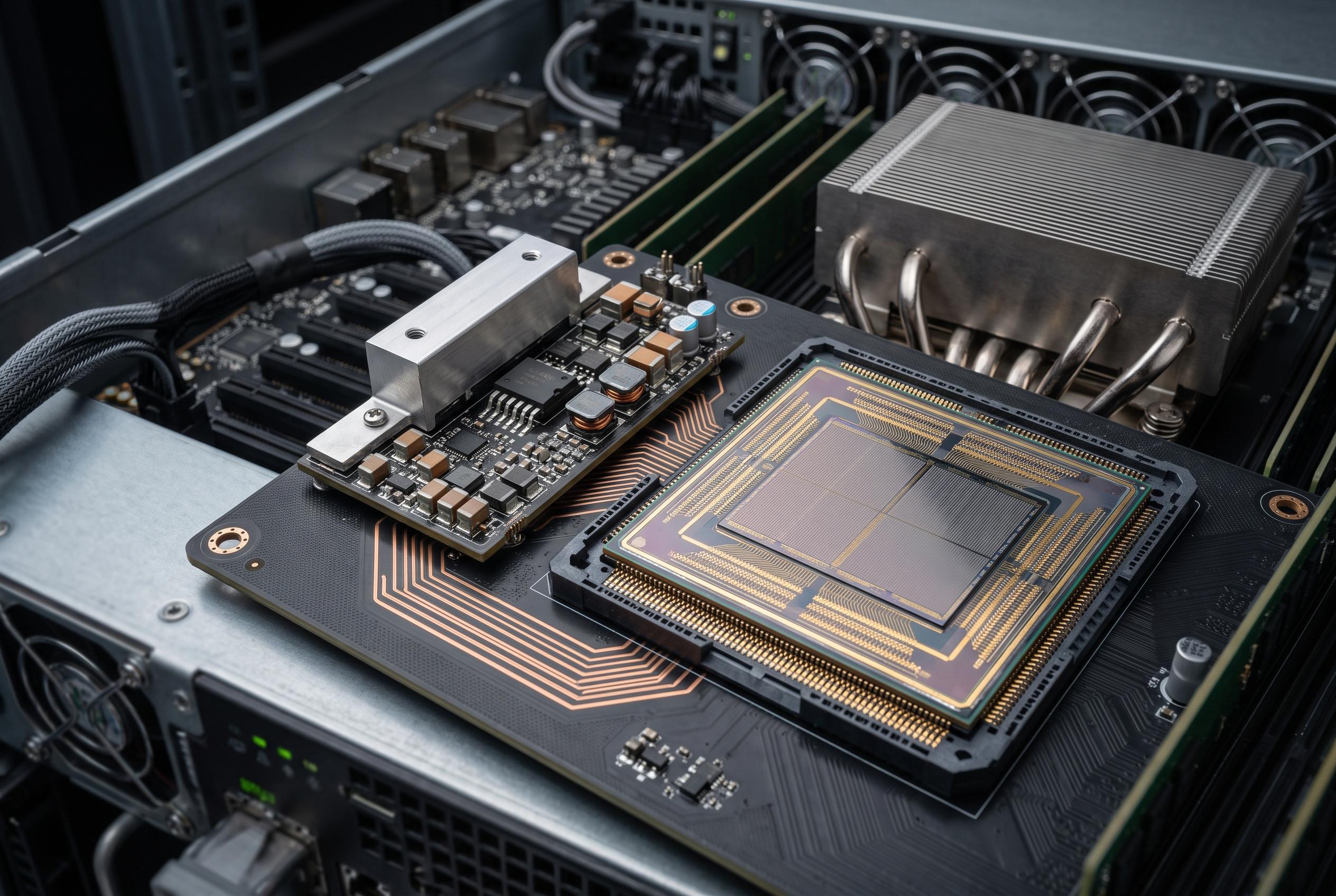

Infineon launches engineering samples of high-density dual-phase smart power stages designed to meet the evolving demands of AI servers, enabling closer integration near processors and supporting higher thermal and transient loads.
On Monday, 7 September, Infineon said engineering samples of two new dual-phase smart power stages, the TDA235E5 and TDA235E0, are available for customer evaluation, in a push aimed at one of the most stubborn constraints in AI server design: how to deliver very high current to advanced processors without surrendering more board area. Power Electronics News and Semiconductor For You both said the parts are aimed not only at next-generation AI xPU accelerators but also at conventional server CPUs used in data-centre systems.
That emphasis reflects a broader change in how the industry is thinking about server power. Electronics Buzz and The Component Club framed the launch as a response to system-level pressure rather than a routine component release. As hyperscalers expand AI infrastructure, regulators must handle sharper transient loads while occupying less space around the processor. The Component Club’s engineer-focused summary cast the problem in practical board terms: cramped layouts and fast-changing current demand are turning voltage regulation into a packaging challenge as much as an electrical one.
Infineon’s approach is to combine OptiMOS 6 MOSFETs with a dual-phase driver in a package measuring 6 x 6 x 0.8 mm. According to Power Electronics News and AutoEVTimes, the family is rated at more than 2 A/mm² of power density, with support for as much as 300 A peak current and 120 A total design current. Those are the sorts of numbers associated with regulators that must sit very close to processor core rails, where layout distance, loss and response time can quickly become limiting factors.
Several of the reports said the devices can be used in both traditional lateral power delivery and newer vertical schemes. That gives server designers more freedom in how they place conversion hardware around the processor package, including layouts that move power components nearer to the load path. Power Electronics News and Semiconductor For You also highlighted the thermal path from junction to the top of the package, which Infineon says is designed to work efficiently with liquid cooling as socket-level power continues to climb beyond what air cooling can comfortably manage.
Infineon is also positioning the launch as part of a wider platform rather than as a stand-alone component family. Electronics Buzz said the company sees the parts as fitting into an AI server power chain that runs from the grid interface down to processor core rails. AutoEVTimes added that Infineon is leaning on a broader semiconductor mix across silicon, silicon carbide and gallium nitride, while using its digital multiphase controllers to support multi-rail server architectures that can be scaled across different processor and board designs.
The company’s message to customers was direct. “Infineon customers are designing AI systems that will define the next decade of computing infrastructure,” Rakesh Renganathan, vice president of power ICs at Infineon, said in remarks carried by Power Electronics News, Electronics Buzz and Semiconductor For You. He said the new devices give designers “power density, thermal performance, and design flexibility”, linking the launch to what Infineon describes as its wider AI server power-delivery portfolio.
Much of the immediate coverage closely followed the company’s announcement, but one repeated detail is commercially important: the parts are already being sampled. AutoEVTimes and Semiconductor For You both said engineering samples are available now, which suggests Infineon is seeking near-term design wins in upcoming AI server platforms rather than merely outlining a future roadmap. Semiconductor For You also noted that Infineon regards data-centre power delivery as one of the semiconductor industry’s fastest-growing demand areas, helping explain why it is putting so much emphasis on dense, processor-adjacent regulation.
Taken together, the launch points to a wider architectural shift in compute hardware. Power conversion is no longer being treated simply as a supporting function pushed to the edge of the motherboard. As The Component Club and Power Electronics News indicate, it is moving closer to the processor, where board space, thermal extraction and transient response increasingly determine whether higher-power AI chips can be deployed efficiently. In that setting, the TDA235E5 and TDA235E0 are best understood not as a minor component refresh but as parts designed for the transition from lateral power layouts to vertical ones.
Disclaimer: This content is intended for informational purposes only. Readers are advised to exercise their own judgement, conduct due diligence, or consult a qualified expert before acting on any information provided.