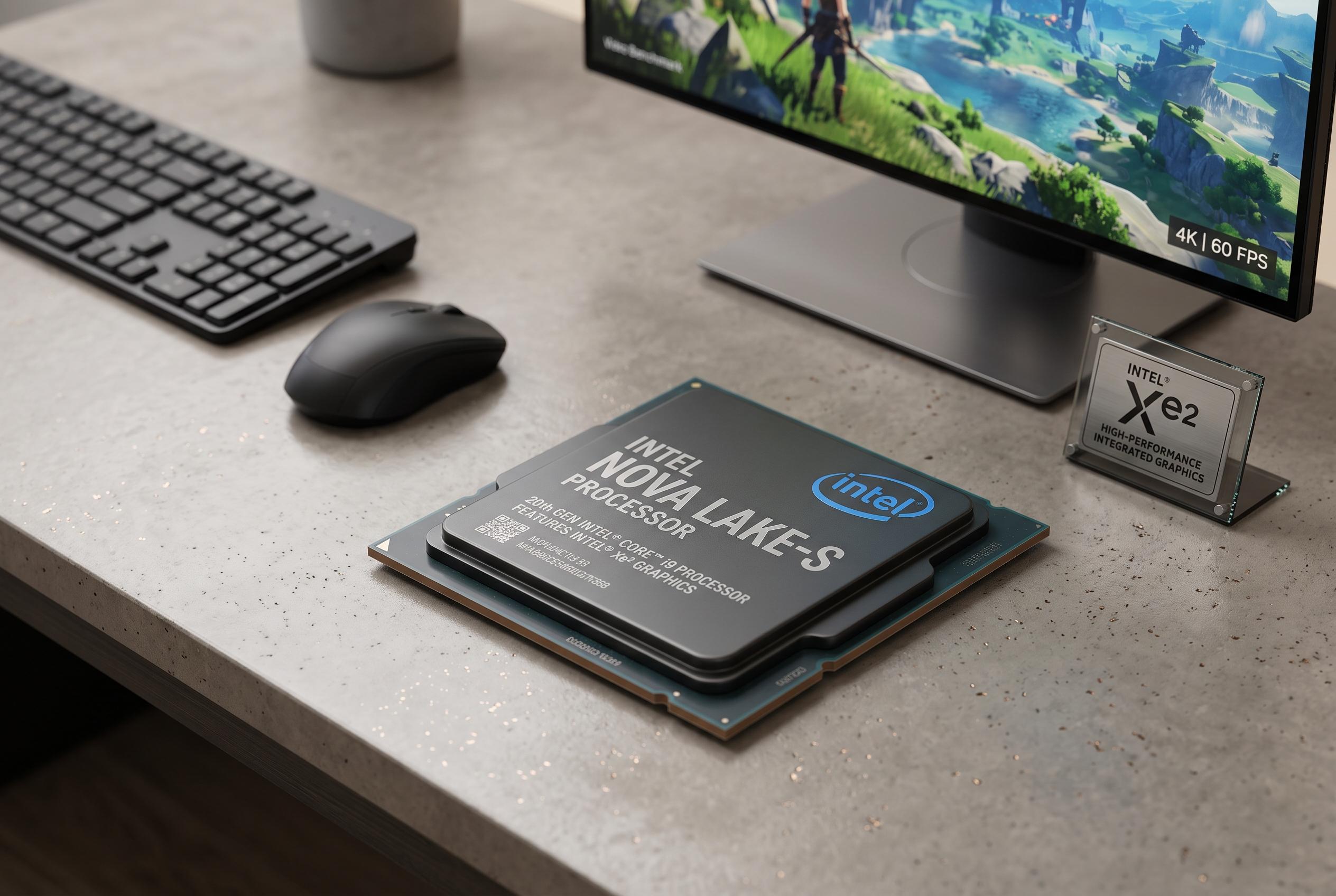

Leaked details suggest Intel is developing a Nova Lake-S processor with powerful integrated graphics, potentially reducing the need for dedicated graphics cards in budget gaming and creative PCs.
Intel’s next desktop processors may take a notable step towards reducing the need for a separate graphics card. A fresh leak reported by Tom’s Hardware and other hardware publications suggests that at least one Nova Lake-S chip could pair a mid-range 16-core CPU with unusually strong integrated graphics, making it more practical for lighter gaming and creative work without discrete GPU hardware.
According to the reported specification details, the most interesting variant would combine four performance cores, eight efficiency cores and four low-power efficiency cores with an integrated GPU built from 12 Xe3P cores, a much larger graphics block than the minimal integrated graphics expected on other Nova Lake parts. The same leaks indicate that the graphics section alone could be allowed to reach a 40W boost limit, while the full chip may be set as high as 154W, with a separate 65W motherboard power path needed to support the iGPU at full tilt.
That would put the chip closer to the concept of an accelerated processing unit, or APU, a class of processor that combines CPU and GPU functions in one package. Tom’s Hardware and TechTimes both note that the move would make sense for budget-conscious users who want acceptable 1080p-class gaming and occasional photo or video editing without paying for a standalone graphics card. It would also mark a clear shift from Intel’s recent desktop parts, which have not been known for especially strong integrated graphics.
The architecture behind that graphics block also matters. Tom’s Hardware has reported that Intel’s Xe3 generation is designed to scale more effectively than earlier designs, and the leaked Nova Lake configuration appears to use a higher-end Xe3P derivative linked to the company’s former Celestial project. If those reports prove accurate, Intel would be trying to close part of the gap with AMD’s Ryzen G-series APUs, while still keeping the stronger graphics options in a limited number of desktop models. The processors are still expected in late 2026 or early 2027, so the specification can still change.
Disclaimer: This content is intended for informational purposes only. Readers are advised to exercise their own judgement, conduct due diligence, or consult a qualified expert before acting on any information provided.