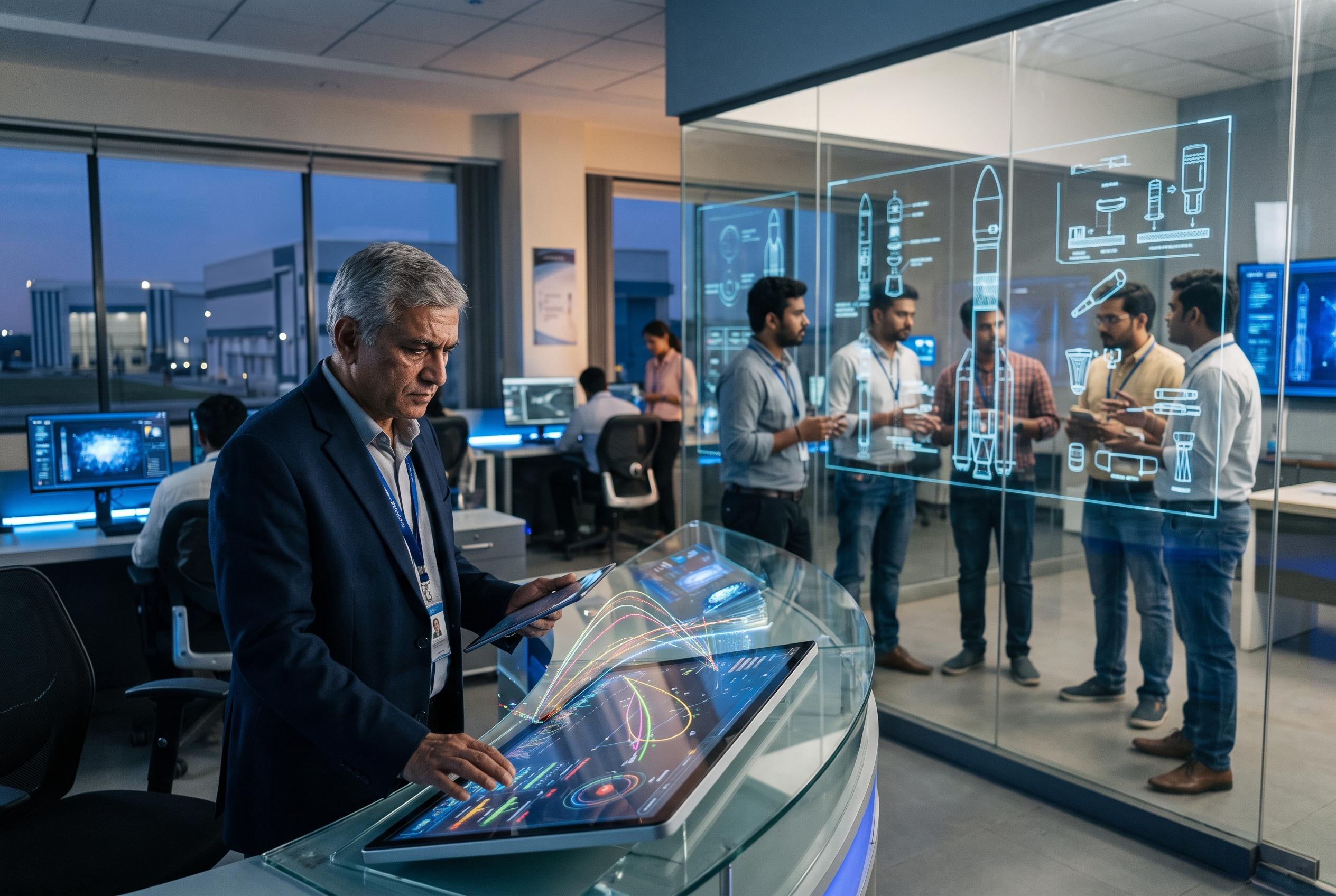

Employee associations at ISRO raise fears over the agency’s evolving role as government officials emphasise the move is aimed at economic growth and strategic scientific advancement, with private companies taking on more manufacturing responsibilities.
Employee associations at the Indian Space Research Organisation have raised fresh concerns over the agency’s changing role after remarks from IN-SPACe chairperson Pawan Goenka suggested that ISRO would eventually stop manufacturing launch vehicles and stop running the spaceport now under development. According to reporting in The Indian Express, the immediate worry among staff is not just about outsourcing, but about what the transition means for ISRO’s core mandate, its institutional expertise and the future of its workforce.
Those anxieties have prompted repeated clarifications from the space establishment. The Times of India reported that Mr Goenka said ISRO would remain the “bedrock of the Indian space sector”, arguing that the reforms are intended to widen India’s space economy rather than hollow out the agency. ISRO chairman V Narayanan has also said the move towards private participation is aimed at expansion, not privatisation in the narrow sense.
The policy framework for that shift was set out in the Indian Space Policy 2023, drafted after the sector was opened up and IN-SPACe was created in 2020. As The Indian Express explains, the policy assigns ISRO a research-led role, centred on developing new systems, sharing technology with industry, and advancing major scientific programmes, while moving away from routine production of operational space hardware. IN-SPACe is meant to authorise and support private activity, NSIL to commercialise mature public capabilities, and non-government entities to undertake end-to-end space activity across launch, satellite and ground infrastructure.
That transition is already visible in launch systems. Small Satellite Launch Vehicle technology has been transferred to Hindustan Aeronautics Limited, which won the bid in 2025 and is expected to produce at least two rockets during the hand-holding phase. The Polar Satellite Launch Vehicle had earlier been handed to a HAL-L&T consortium, while a fresh expression of interest has been issued for the heavier LVM3, after an earlier commercialisation attempt did not result in an award. IN-SPACe has also invited private operators to run the new small-launch spaceport at Kulasekarapattinam in Tamil Nadu, with ISRO expected to provide technical guidance for a limited period.
The broader strategy is economic as much as institutional. According to government figures cited by The Indian Express, private investment in the sector rose sharply from $100.5 million in 2021-22 to $618.5 million by March 2026, as India seeks to lift its global space market share from less than 2% to a much larger slice of a market it hopes could reach $40 billion to $45 billion within a decade. Analysts quoted by the newspaper say the model should free ISRO to focus on strategic and scientific work, including Gaganyaan, the Bharatiya Antariksh Station, Chandrayaan 4 and 5, and planned Mars and Venus missions, while still preserving the in-house capability needed for national missions and future emergencies.
Disclaimer: This content is intended for informational purposes only. Readers are advised to exercise their own judgement, conduct due diligence, or consult a qualified expert before acting on any information provided.