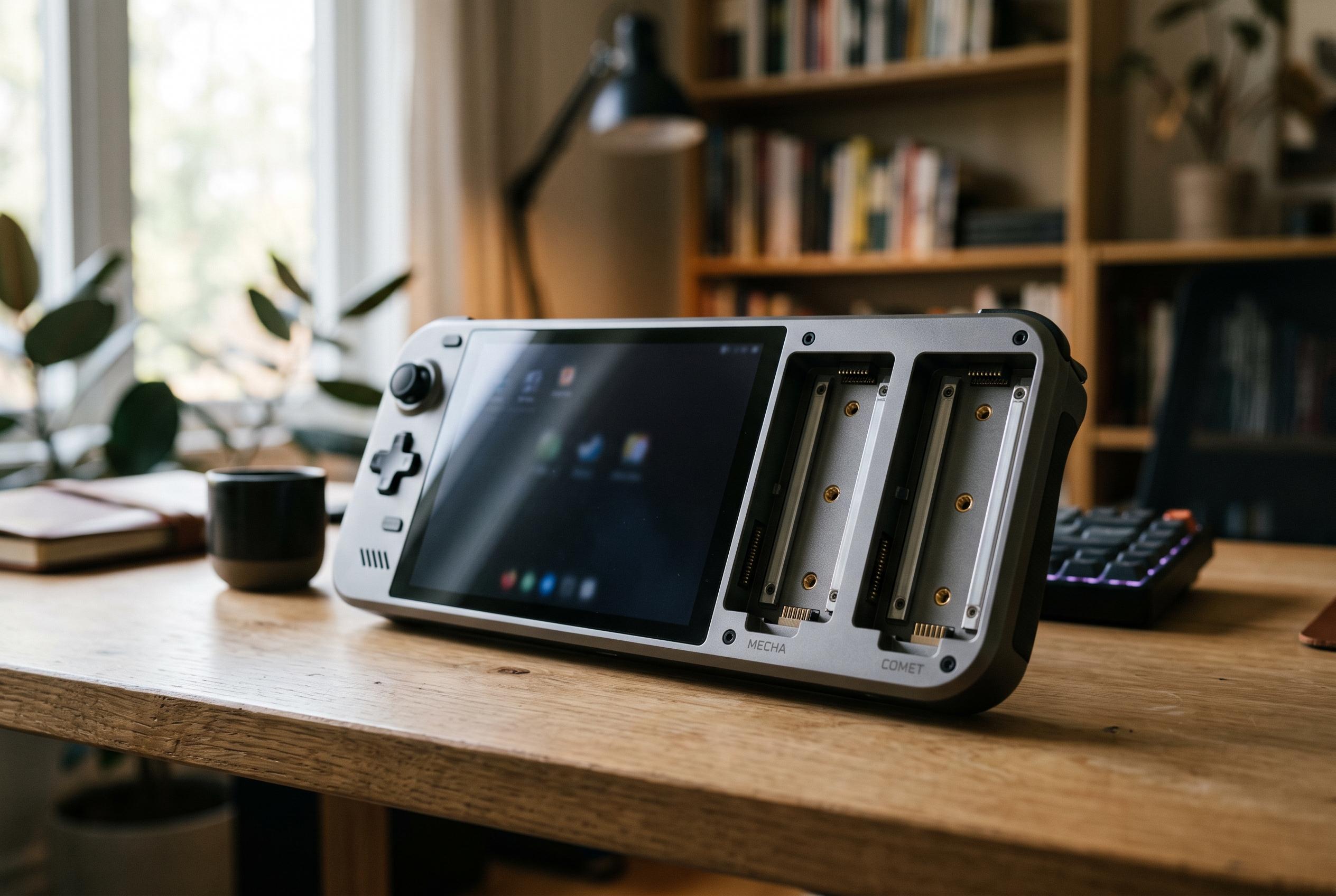

Mecha’s Comet, a highly customisable and modular Linux-powered handheld, transitions from a successful Kickstarter campaign to pre-order on its own website, with shipping expected by October 2026. The device offers users interchangeable mainboards and extensive expansion options, promising a flexible portable computing experience.
Mecha’s Comet is moving from crowdfunding project to retail product, with the company now listing the modular Linux handheld on its own site for pre-order and an October 2026 shipping window. The device was first launched on Kickstarter in January 2026, where it was fully funded, and Mecha is now offering both of its processor variants through separate product pages. According to the company, the design is intended to let users swap mainboards rather than replace the entire device.
At the centre of the Comet is a 3.92-inch AMOLED touchscreen with a 1080 × 1240 resolution and 500-nit brightness. The handheld also includes Wi-Fi 6, Bluetooth 5.4 with LE Audio support, a 4,100mAh battery, USB-C connectivity, an 8MP Sony camera, dual microphones, a speaker and a 3.5mm audio jack. Mecha says DisplayPort output over USB-C can drive an external display at up to 2K60 with audio.
The more powerful version uses NXP’s i.MX95 platform, which pairs six Cortex-A55 cores with an Arm Mali-G310 MP2 GPU and an eIQ Neutron NPU rated at up to 8 TOPS. Mecha also lists support for 4K60 decode and encode on that model, alongside LPDDR5 memory and eMMC storage. The cheaper i.MX8M Plus configuration keeps a quad-core Cortex-A53 processor and lower-spec graphics, but still offers microSD expansion and the same modular handheld form factor. Mecha’s own comparison material presents the i.MX95 board as the higher-performance option while keeping compatibility with the same enclosure and accessory system.
Expansion is one of the Comet’s main selling points. The handheld uses a magnetic 40-pin interface for accessories, including a keyboard module with RGB backlighting and QMK support, a gamepad module with programmable controls and trackpad, and a GPIO breakout aimed at serial console and CAN bus use. Internally, the M.2 slot supports PCIe Gen3 x1 and USB 3.0, with Mecha saying it can be used for LTE modems or, via an adapter, a 2230 NVMe drive. The company has also described plans for open-hardware documentation, repair files and further module support, including LoRa, AI accelerator and FPGA add-ons.
Disclaimer: This content is intended for informational purposes only. Readers are advised to exercise their own judgement, conduct due diligence, or consult a qualified expert before acting on any information provided.