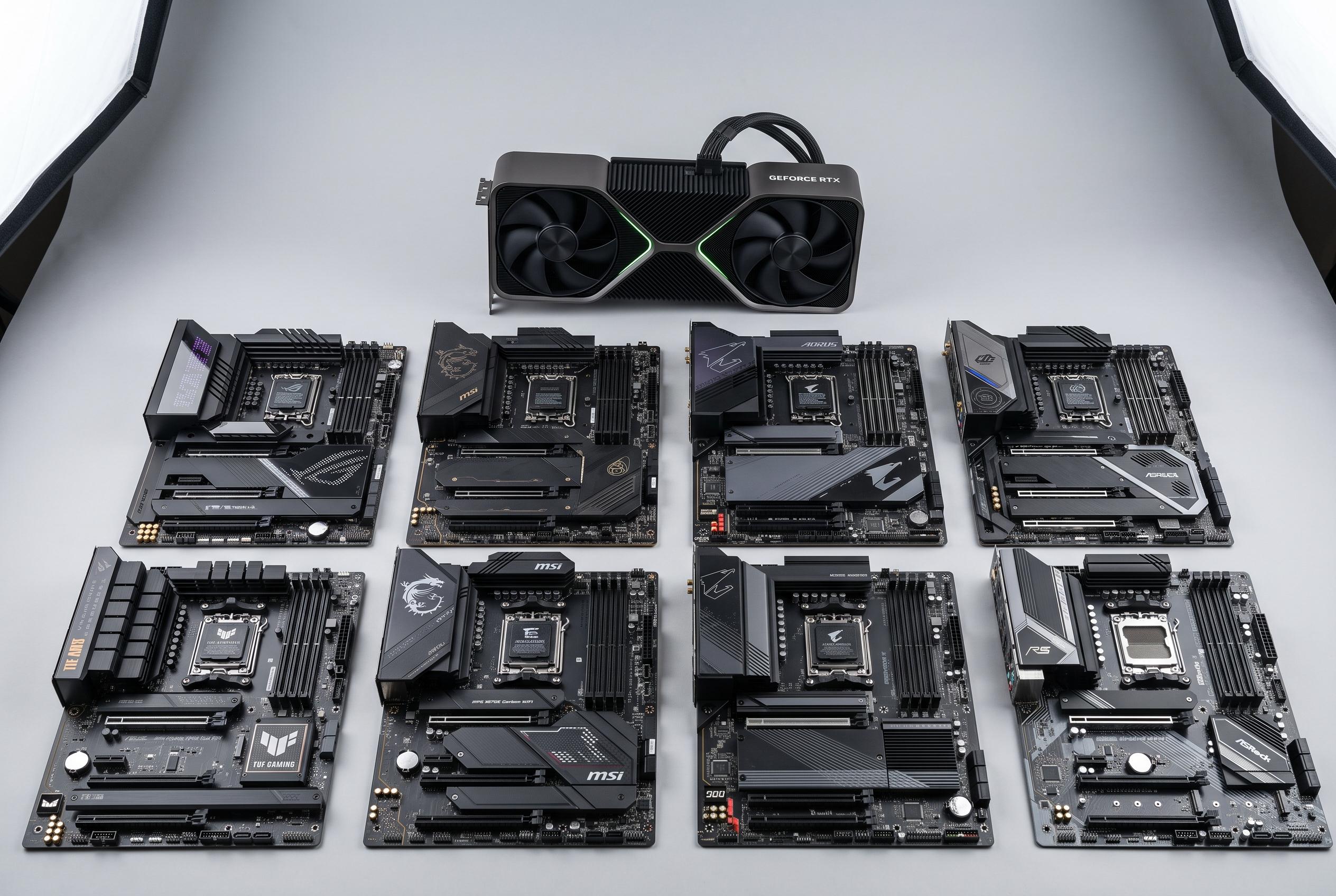

Retailers in Taiwan are increasingly bundling the GeForce RTX 5090 with as many as eight motherboards, transforming straightforward upgrades into forced inventory hampers as the market faces surging prices and limited choice for consumers.
Retailers in Taiwan are pushing some GeForce RTX 5090 buyers into an unusual purchase pattern: the graphics card is bundled with as many as eight motherboards. According to reporting highlighted by Tom’s Hardware, the listings appear on PChome24h and were circulated by Uniko’s Hardware on X, turning what should be a straightforward upgrade into a forced inventory package. For customers, the immediate problem is not just price. It is the loss of choice, since the GPU is effectively being tied to a large stack of components many buyers do not want or cannot use.
The bundle strategy lands in a market already defined by sharp RTX 50-series price volatility. Tom’s Hardware reported that Nvidia drew attention at QuakeCon 2026 by selling RTX 5090, 5080 and 5070 Founders Edition cards at their original launch prices through its Verified Priority Access IRL programme, even as RTX 5090 pricing in the wider market had climbed to more than $4,300. That contrast underlines how far retail conditions have drifted from launch-day expectations. In a separate case, Nvidia cancelled a $4,429 order for an Asus ROG Astral RTX 5090 BTF after a sudden price increase, reportedly refunding the buyer and leaving the card available only at the higher figure.
The Taiwan bundles also sit against a broader backdrop of rising hardware costs across Asia. Tom’s Hardware reported that RTX 50-series cards in South Korea have risen by up to 30% in August 2026, with higher TSMC wafer costs and pricier GDDR7 memory pushing up board prices and retail quotes. The RTX 5090 there has reportedly crossed 7.3 million won, or about $5,112, after a steep monthly increase. Another Tom’s Hardware analysis said the RTX 5090, which launched at $1,999, has been selling for more than $4,200 in mid-2026, with memory costs and persistent demand keeping discounts scarce.
The result is a market in which buyers are often negotiating scarcity mechanics rather than comparing normal products. In Taiwan, that means an RTX 5090 can become the anchor for a bundle designed to move excess stock, rather than a card sold on its own merits. For builders, the practical response is simple: verify the exact contents, check whether any included motherboards have real resale value and avoid assuming that a large bundle equals a good deal. In a market this distorted, the cheapest-looking option can be the one that costs the most.
Disclaimer: This content is intended for informational purposes only. Readers are advised to exercise their own judgement, conduct due diligence, or consult a qualified expert before acting on any information provided.