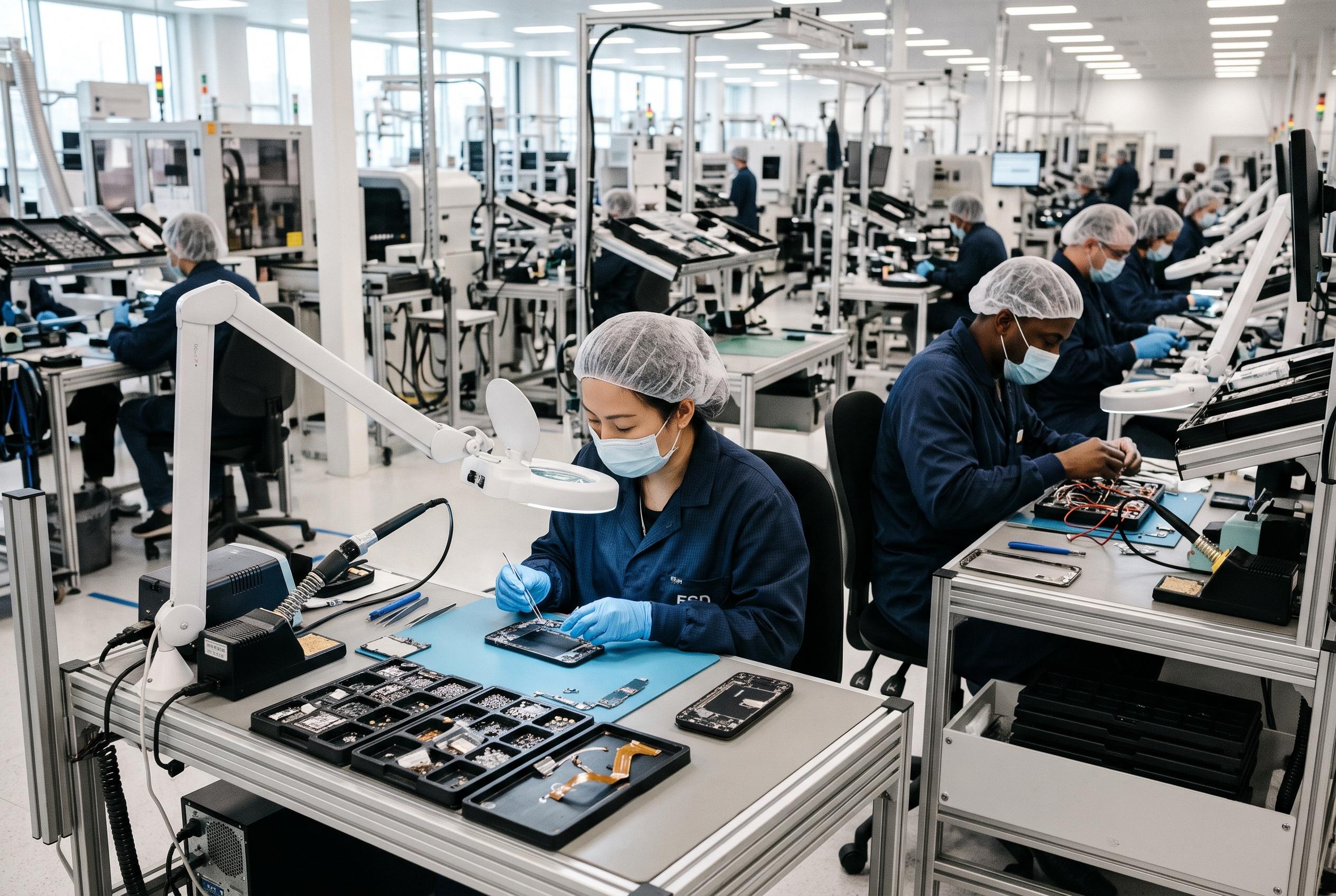

Tata Electronics became India’s biggest iPhone contract manufacturer in FY26, but its INR 99,128 crore export haul came alongside widening losses and a foreign exchange bill that exceeded export earnings by about INR 30,500 crore.
Tata Electronics ended FY26 as India’s biggest iPhone contract manufacturer, with exports of INR 99,128 crore, just below the INR 1 lakh crore threshold. The scale is striking, but the numbers underneath show a business still under strain. According to company filings, the group’s losses widened sharply, and the foreign exchange it spent on imports and equipment exceeded the foreign currency it earned from exports.
Across its three electronics entities, exports rose 29 per cent from INR 76,953 crore in FY25. That comparison is not perfectly clean because Tata Electronics System Solutions, the former Wistron India business, reported a 15-month period in FY25 after its acquisition, which inflates the base. Even so, the direction of travel is clear: revenue is rising quickly, but profitability is not keeping pace. Consolidated losses increased from INR 69 crore in FY25 to INR 1,611 crore in FY26, leaving the business with a net margin of about minus 1.2 per cent on total revenue of roughly INR 1.29 lakh crore.
The sharper concern is the company’s foreign exchange position. The filings show that the three firms spent INR 1,29,641 crore in foreign currency during FY26, about INR 30,500 crore more than they brought in through exports. That means the business is, in effect, a large net importer of the parts and capital goods needed to assemble iPhones. The rupee’s weakness can boost export revenues in headline terms, but it also inflates import costs. In Tata Electronics’ case, the import bill appears to have outweighed the currency benefit from exports.
This imbalance highlights the limitations of India’s current iPhone manufacturing model. Final assembly has shifted to India at speed, but the highest-value inputs, including chips, displays, camera modules and other precision components, remain largely sourced from abroad. The result is that the export figure overstates how much value is actually created locally. According to the filings, exports accounted for 76 per cent of production revenue, but the domestic value addition embedded in those phones still appears limited.
The destination mix of Tata’s exports also reflects Apple’s supply chain design more than end-user demand. Taiwan was the largest destination at INR 47,930 crore, followed by the United States at INR 38,508 crore and Ireland at INR 11,980 crore. Taiwan’s role likely relates to procurement and logistics within Apple’s regional network, while Ireland serves as a base for Apple’s European operations. The United States remains the most strategically important market, because it shows how much of Apple’s American supply is now being routed through India rather than China.
At the same time, domestic sales also expanded, reaching INR 30,182 crore, largely through supplies to Apple’s India operations and its local sales and service business. That matters because it shows Tata is not only assembling for export, but also feeding Apple’s India market. Yet the contrast with Apple India is revealing. Apple’s local unit reported revenue of INR 1,03,853 crore and net profit of INR 5,311 crore in FY26, a margin of about 5.1 per cent. In other words, the brand owner captured healthy profits on lower revenue, while the manufacturer carried the heavier capital burden and still posted a loss.
Tata’s acquisitions of Wistron and Pegatron’s India operations gave it immediate scale and a central role in Apple’s India push. The next test is whether that scale can be turned into better economics. The company has already begun producing some high-precision components, including enclosures, and its longer-term semiconductor plans could reduce dependence on imported inputs. For now, though, the lesson is that India’s iPhone export boom is still built on a thin local value chain. Export numbers are rising quickly, but the gap between what Tata earns abroad and what it spends overseas remains the most important figure in the story.
Disclaimer: This content is intended for informational purposes only. Readers are advised to exercise their own judgement, conduct due diligence, or consult a qualified expert before acting on any information provided.