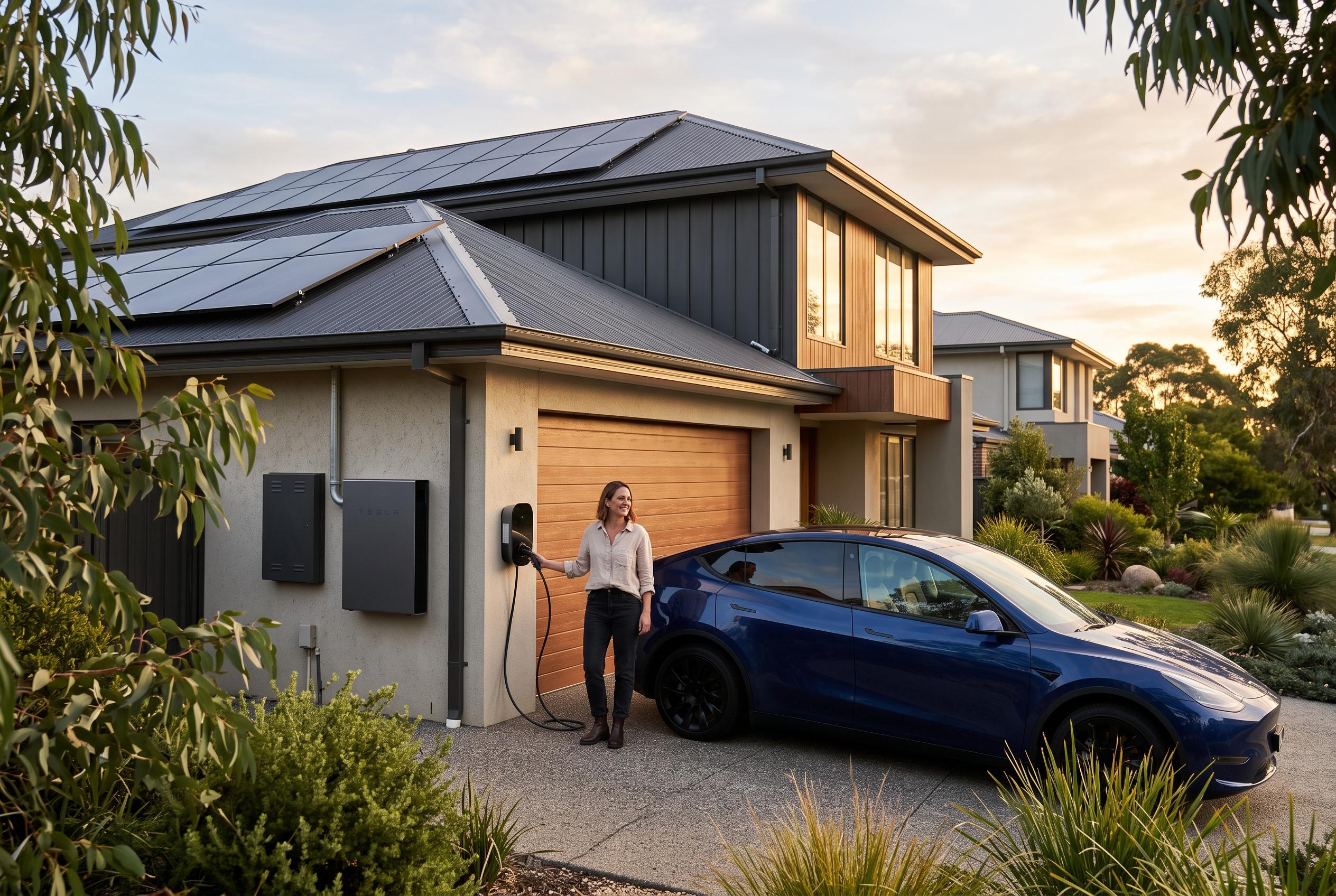

The Australian home energy market is transforming from hardware-focused purchases to integrated systems that optimise solar, storage, and vehicle charging, driven by technical compatibility and consumer requirements.
Australia’s home-battery market is increasingly being shaped as a systems business rather than a box-by-box purchase. Buyers who start with a brochure figure for storage capacity, instead of the equipment already installed on the house, risk paying for hardware that cannot deliver the backup, EV charging or tariff optimisation they expect. That shift is already visible in the products now on sale: Enphase said it began shipping its IQ EV Charger 2 in Australia and New Zealand in July 2025, and launched the IQ Battery 5P with FlexPhase in Australia the following month, presenting solar, storage and vehicle charging as a single managed platform.
The reason is simple. A battery only earns its keep if it fits the household’s usage pattern, tariff and solar output. In a 2023 analysis, BloombergNEF analyst Nelson Nsitem told pv magazine Australia that “EVs are typically unavailable to absorb excess electricity during peak hours of solar generation”, which is why a stationary battery often sits at the centre of the arrangement. He also said the economics improve mainly where homes have high annual electricity use, plenty of surplus solar, low or negligible feed-in tariffs and time-of-use retail pricing. Researchers at the University of South Australia put numbers around that logic, estimating that households charging an EV during the day from solar and battery storage could cut annual energy costs by as much as 39.6% against petrol-car ownership. The same work found smaller gains from solar alone, at 6.71%, or a battery alone, at 10.38%.
That does not mean any integrated-looking offer will work well in practice. The same pv magazine Australia feature noted that most EV charging management systems still cannot communicate directly with a stationary household battery. Where they do, it is usually inside tightly controlled ecosystems offered by inverter makers such as SolarEdge, Fronius, Growatt, SMA and Sungrow, alongside battery suppliers including Sonnen, Senec and Solarwatt. The technical prize is better coordination and fewer conversion losses. Researchers cited in the report said DC coupling, where energy stays on the direct-current side for more of its journey, can lift conversion efficiency by 5% to 10%, depending on power level.
Fronius and BYD provide an early Australian example of why these pairings matter. In December 2018, pv magazine Australia reported that the companies were preparing a three-phase residential backup solution for the local market by coupling the Fronius Symo Hybrid with BYD’s modular Battery Box HV. The attraction was not branding but capability: the system was designed to deliver 400V three-phase supply during an outage, with the house able to island from the grid and continue using rooftop solar in daylight hours. Martin Hackl, Fronius’ head of solar energy, said at the time: “As yet, there are still hardly any solutions for providing three-phase emergency power from a battery.”
Current manufacturer guidance shows how much of that promise depends on precise compatibility rules and commissioning steps. Fronius says the BYD Battery-Box Premium HVS and HVM ranges are the successors to the earlier HV line and can be used with its GEN24 Plus, while the Symo Hybrid can work with the HVM model. The supported capacities run from 5.1 kWh to 12.8 kWh for HVS and from 8.3 kWh to 22.1 kWh for HVM. Fronius also says this arrangement can provide “true grid back-up”, including for three-phase loads, but only within defined limits: installers are told to commission the BYD unit before the inverter, switch the battery on first, and note that while up to three batteries can be paralleled on one GEN24 hybrid inverter, several GEN24 hybrid inverters cannot be run in parallel. For the Symo Hybrid, compatibility with the BYD Battery-Box Premium HVM depends on firmware version 1.16.6-1 or later, and backup changeover takes less than 90 seconds with an external switchover box and grid-operator approval.
Installer behaviour helps explain why homeowners still receive generic battery recommendations. An EUPD Research survey reported by pv magazine Australia in 2022 found that more than half of Australian solar installers were moving into storage, but the market was still heavily influenced by familiar stock lines. Fronius was named by 84% of respondents and was stocked by 57% of them. SolarEdge was stocked by 34.8%, Sungrow by 24.5%, Enphase by 20.6% and SMA by 20%. On batteries, LG solutions were offered by 43.1% of installers active in storage, Tesla by 40.4%, BYD by 18.3% and Alpha-ESS by 17.4%. The same survey found 76% of storage jobs were new systems and only 18% were retrofits, while 83% of installed capacity sat below 15 kWh. That is not proof of poor advice, but it does suggest much of the market was still built around standard packages rather than painstaking optimisation of existing systems.
The software layer adds another filter. Amber’s support material, updated on 16 June 2026, shows that excess-solar EV charging is not simply a matter of buying an EV charger with the right logo on it. Amber currently offers direct, connected excess-solar charging only for Tesla vehicles, and only where the home system is enrolled in SmartShift and can report both solar production and household consumption. The supported hardware list includes SolarEdge and Fronius inverters, Sungrow systems, Redback inverters, and Tesla, Sigenergy and AlphaESS batteries that expose the necessary data. Amber says it reads the inverter, the EV and the consumption meter directly, can disable solar curtailment during charging, and can pause charging when a nominated feed-in tariff threshold is exceeded so exports can be sold instead. Where that data link is not available, Amber falls back to a predictive mode using system specifications and AEMO weather data, but it warns that an unenrolled home battery will not be accounted for.
Taken together, the evidence points to a more demanding first conversation for anyone considering storage. The useful questions are not only battery size and price, but the age and type of the existing inverter, the amount of winter solar available, whether the household wants whole-home backup or only selected circuits, which EV is already owned or on order, and whether the tariff rewards self-consumption or export. That also means some product narratives need to be tested against the market’s current state. Enphase, for example, is no longer talking about a distant integrated offer: it says its IQ EV Charger 2 can begin charging from as little as 1.38 kW of solar, while the IQ Battery 5P with FlexPhase is already being sold in Australia in single-phase and three-phase configurations, scaling from 5 kWh to 70 kWh. For buyers, the practical lesson is straightforward. A competent installer should begin with the house that exists, not the battery they most want to sell.
Disclaimer: This content is intended for informational purposes only. Readers are advised to exercise their own judgement, conduct due diligence, or consult a qualified expert before acting on any information provided.