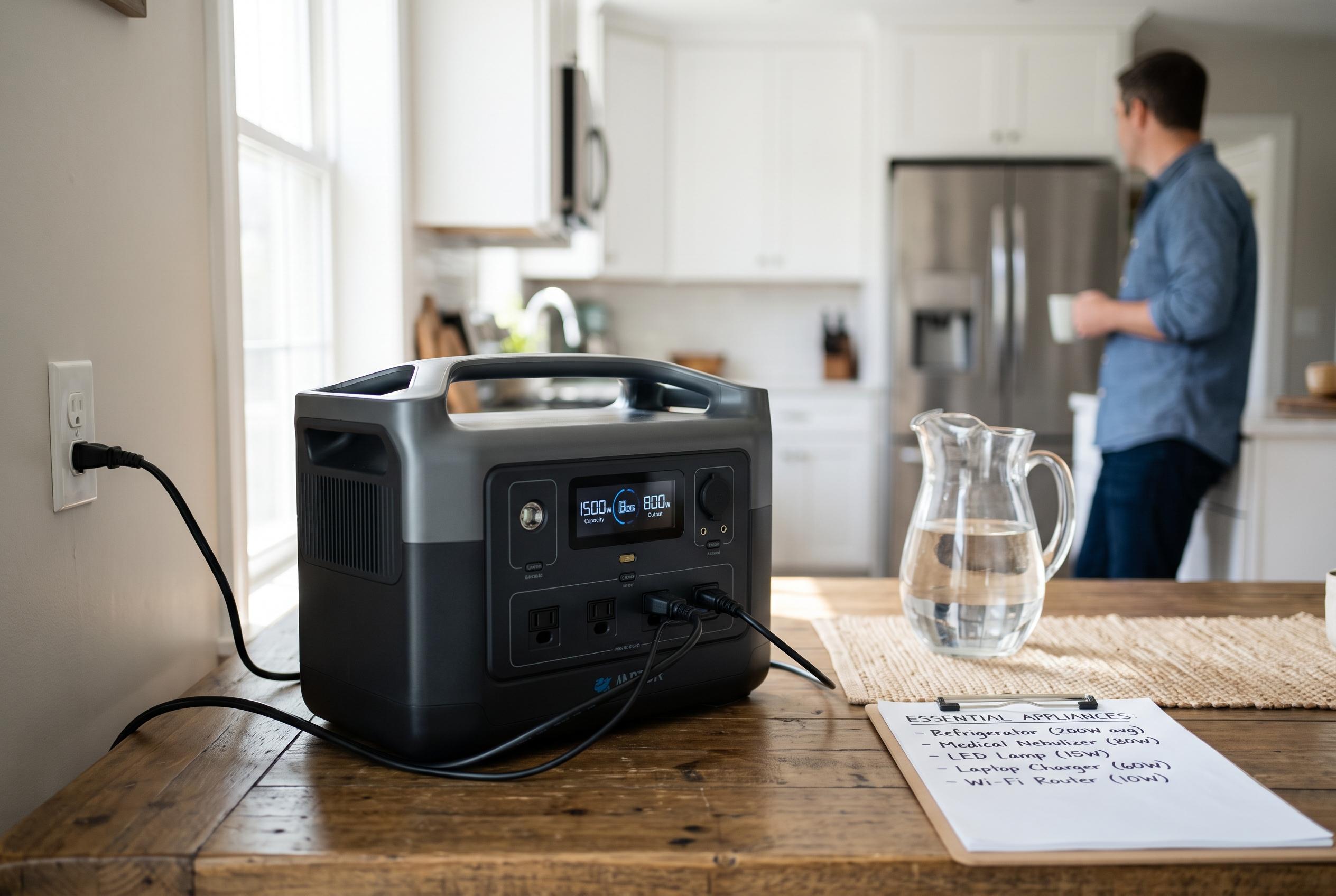

Effective sizing of home power stations for emergencies hinges on prioritising essential appliances, understanding capacity versus output, and strategic recharging to ensure resilience during prolonged outages.
Sizing a home power station for emergencies begins with a basic but easily missed question: what, exactly, must stay on when the grid goes down? The most reliable approach is to focus on essential loads rather than trying to back up the whole house. That usually means a refrigerator, router, phones, lights, perhaps a fan and, for some households, medical equipment or short-burst use of a microwave. Battery calculators and home backup guides consistently stress that this critical-load method is the foundation of practical sizing.
The next step is to separate power demand from energy storage. Wattage tells you how much power a device needs at a given moment, while watt-hours and kilowatt-hours describe how long a battery can supply that power. As the source article explains, a 1,000Wh station running a 100W load should last roughly 10 hours before losses are considered, but real-world efficiency means the usable figure is lower. Industry guides also recommend adding a safety margin of 20% to 30% rather than planning right up to the theoretical limit.
That distinction matters because output and capacity are not the same thing. A power station may have enough stored energy to run a refrigerator for hours, yet still fail if its inverter cannot supply the startup surge when the compressor kicks in. Several sizing guides note that this is one of the most common mistakes homeowners make. The result is a battery that looks large on paper but cannot actually start heavier appliances when needed.
For small outages, compact stations are usually enough. They are best suited to charging phones, powering a router, lighting a room and keeping a laptop running. For longer outages or broader coverage, larger expandable systems make more sense, particularly where refrigeration, sump pumps, space cooling or several rooms must stay active. The source article points to expandable units such as the Anker SOLIX F3800 Plus Portable Power Station, which can start at 3.84kWh and scale to 53.8kWh, with 6kW AC output per unit.
Chemistry and recharge options also affect how useful a system will be in practice. Home backup guides highlight LiFePO₄, or lithium iron phosphate, because it is widely used for its longevity and safety profile. Recharging is equally important. A larger battery is of limited value if the household cannot refill it through the grid, solar input or a generator during a prolonged outage. In a multi-day emergency, recharge strategy can matter as much as capacity itself.
The most sensible way to choose capacity is to work backwards from the outage you are preparing for. List the appliances you truly need, total their running watts, account for surge loads and estimate how many hours of backup you want. That method avoids overspending on unused capacity and reduces the risk of ending up with a system that is large enough on paper but inadequate in the field. For homeowners weighing portability against resilience, the right answer is usually the smallest system that can safely meet the essential load, with room to grow if future needs change.
Disclaimer: This content is intended for informational purposes only. Readers are advised to exercise their own judgement, conduct due diligence, or consult a qualified expert before acting on any information provided.