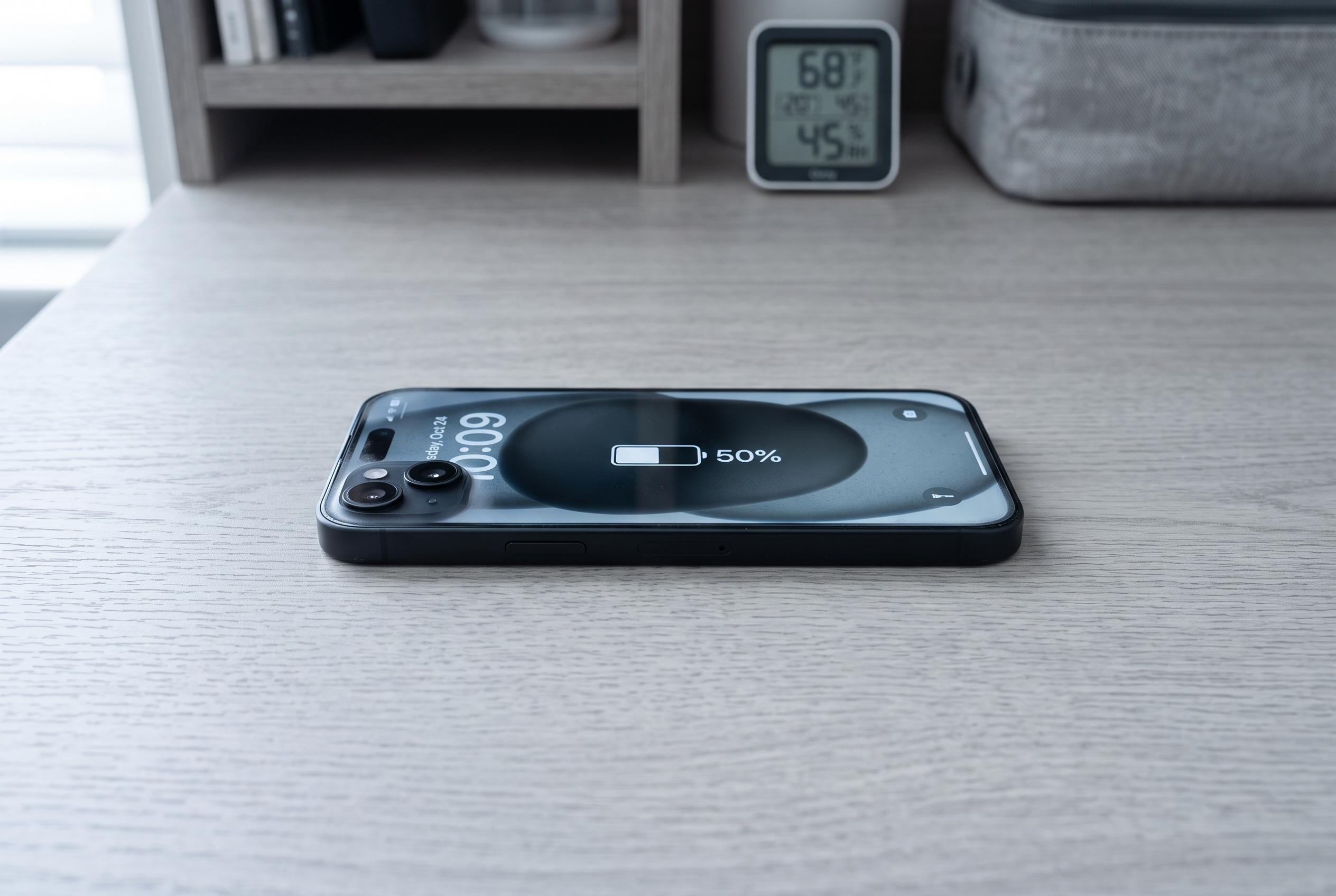

Storing an unused iPhone requires careful attention to battery charge level and temperature to prevent degradation. Apple’s updated guidance reveals how to keep your device’s battery healthy during prolonged inactivity, especially with the latest iPhone 15 models designed for longer lifespan.
Keeping an unused iPhone in a drawer for months can be harder on the battery than many owners realise. Apple’s guidance is straightforward: if a device is going into storage for a long period, it should be left with roughly 50% charge, powered off and kept in a cool, dry place. The point is to avoid both a full battery and a completely empty one, as either condition can shorten battery health over time.
A battery stored at 100% for long periods is more exposed to chemical ageing, while a battery left at 0% risks deep discharge, a state in which it may no longer hold a charge properly. Apple’s advice is based on the behaviour of lithium-ion cells, which naturally lose charge even when a phone is switched off. That is why a mid-level charge is the safest compromise for long-term storage.
Temperature matters just as much. Apple says iPhones should be kept below 32C in a moisture-free environment, away from direct sunlight, cars and other hot spaces. Heat speeds up battery degradation, while damp conditions can create additional risk for the device itself. For anyone storing a spare handset at home, a stable indoor location is far better than a window ledge, garage or vehicle.
If the storage period runs beyond six months, Apple recommends checking the battery and charging it back to around 50% every six months. That helps prevent the device from drifting into a low-charge state while unused. The broader picture is that Apple has been improving battery endurance in newer models: reporting cited by MacRumors and Macworld says the iPhone 15 line is designed to retain 80% of its original capacity after 1,000 full charge cycles under ideal conditions, up from the earlier 500-cycle estimate for older devices.
Disclaimer: This content is intended for informational purposes only. Readers are advised to exercise their own judgement, conduct due diligence, or consult a qualified expert before acting on any information provided.